Reading Whitetail Sign in Ontario Hardwoods
It's incredibly frustrating, isn't it? You head into those vast Ontario hardwood forests, full of hope, but sometimes it feels like you're just wandering in a giant, beautiful, empty space. Deer are there, you know it, but finding them can feel like searching for a needle in a haystack. This guide is all about changing that – we're going to break down how to read the subtle (and sometimes not-so-subtle) clues whitetails leave behind, turning that confusing woodland into a roadmap for your next successful hunt.
The Allure and Challenge of Ontario Hardwood Forests for Whitetails
Ontario's hardwood forests, particularly through much of the central and southern regions, are a unique and often challenging landscape for deer hunters. They offer incredible potential, but also demand a keen eye and a deep understanding of whitetail behaviour. Unlike dense conifer stands or open agricultural fields, hardwoods present their own set of signals that, once decoded, can lead you right to where the deer are.
Why Hardwoods are Whitetail Havens and Headaches
Hardwood forests are truly whitetail havens primarily because of the incredible food sources they provide. Think about it: during the fall, mature oak, beech, and even cherry trees drop their bounty. Acorns are a powerhouse of nutrition for deer, packed with fat and protein, and deer will absolutely gorge themselves on them, sometimes for weeks on end. Beech nuts, when available, are another huge draw. Beyond the mast crops, the understory in many hardwood stands offers a diverse buffet of browse, from various shrubs and young saplings to forbs and fungi. Understanding What Acorn Crops Do to Ontario Deer is critical, as a good acorn year can significantly impact deer distribution and movement patterns, often concentrating them in specific areas that might otherwise be less trafficked.
However, these same attributes can also be a headache for hunters. The sheer vastness and uniformity of some hardwood stands make it hard to pinpoint specific deer activity. Unlike a small bush lot bordering a field, where deer movement is often predictable, a sprawling hardwood forest can feel overwhelming. Deer can bed down practically anywhere, and their travel routes might seem random without clear linear features like fencelines or obvious terrain changes. It takes a different kind of scouting and a more nuanced approach to decipher the subtle nuances of deer presence in such an expansive environment.
Furthermore, the structure of hardwoods provides a mix of cover. While it might not always be as thick and impenetrable as a cedar swamp, the varied terrain, including subtle ridges, hollows, and pockets of thicker undergrowth, offers deer excellent bedding and escape cover. Deer learn to use these features to their advantage, often bedding on higher ground for a vantage point, or dropping into thickets to evade detection. The challenge for us as hunters is to identify these specific pockets of preferred cover amidst the general forest, figuring out which subtle terrain features are providing the optimal bedding conditions for a mature whitetail.
Seasonal Movements and Habitat Use in Hardwoods
Throughout the year, whitetails utilize hardwood forests differently, and understanding these seasonal shifts is key to finding fresh sign. In the spring and summer, deer are generally more dispersed. They're focused on browsing on succulent new growth, and while they're present, their activity is less concentrated. You might find droppings and casual tracks, but the intense rubs and scrapes indicative of fall will be absent. It’s a time for them to build reserves and grow their antlers (for the bucks) in a relatively low-stress environment.
As fall approaches, everything changes. With the arrival of cooler temperatures and the drop of mast crops, deer activity in the hardwoods skyrockets. This is when acorns and beechnuts become absolute magnets. Deer will travel significant distances to access these high-energy food sources, and their movements become far more concentrated. During the pre-rut and especially when Hunting the Rut in Early to Mid November, bucks become much more active, leaving behind the most prominent and exciting sign: rubs and scrapes. You'll see their behaviour shift from mere feeding to a territorial and breeding mindset, creating a literal "signpost" network throughout the woods.
When winter really sets in, especially with deep snow, deer patterns shift dramatically once more. Hardwood forests, while excellent for food in the fall, often lack the thermal cover deer need to survive harsh Ontario winters. You'll often find deer migrating from pure hardwood stands to adjacent thermal cover like conifer swamps, particularly dense cedar stands. Understanding Where Ontario Whitetails Yard in Deep Snow is crucial, as they will gather in these sheltered areas to conserve energy. This means that while you might find a lot of sign in hardwoods in October, come January, you might need to shift your focus to the edges of those hardwoods, or into the nearby evergreens. Similarly, learning to hunt Hunting a Cedar Swamp Edge can be incredibly productive during late season when deer are seeking refuge from the cold.
Decoding the Language of Deer Sign on Hardwood Trees
The trees themselves in an Ontario hardwood forest can tell a vivid story if you know what to look for. Bucks, in particular, use trees as communication billboards, leaving behind clear signals of their presence, size, and even their mood.
Reading Rubs: Buck Signposts and Communication
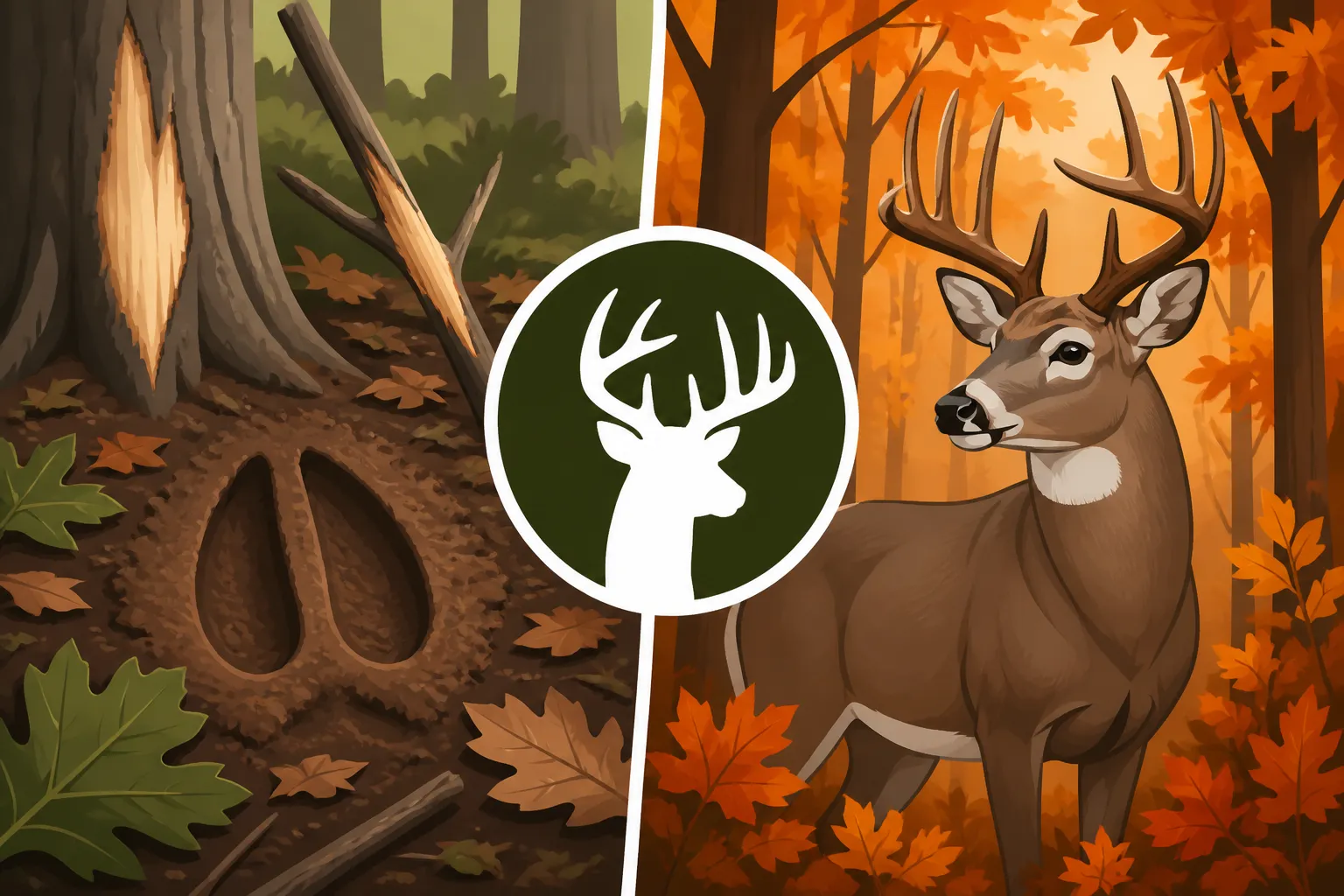
Rubs are one of the most exciting pieces of whitetail sign you can find. These are spots where a buck has scraped the bark off a tree using his antlers, leaving exposed wood. They serve multiple purposes: bucks use them to shed velvet, to strengthen their neck muscles, to deposit scent from glands on their forehead, and critically, to mark their territory and express dominance to other bucks. Finding rubs tells you a buck is not only in the area, but he's actively moving through it and laying claim to it.
When you find a rub, pay close attention to its freshness. A fresh rub will have light, moist wood exposed, sometimes even still showing sap, and the torn bark will be curled outwards. An older rub will have dried, darkened wood, often with the edges weathered. The size of the tree rubbed can also indicate the size of the buck. While a small sapling rub might be made by any deer, a rub on a tree 4-6 inches in diameter or larger suggests a mature, dominant buck. Also, notice the height of the rub – higher rubs often indicate a taller, larger-antlered deer. Don't just look for isolated rubs; try to find rub lines, which are a series of rubs leading in a specific direction.
Rub lines are like a buck's personal highway through the woods. They indicate a regular travel route, often connecting a bedding area to a feeding area, or leading towards a doe-congregating spot. Following a rub line can be one of the most effective ways to pattern a buck's movements. You might find them along the edge of a thicket, on a subtle ridge, or even parallel to a faint deer trail. The more rubs you find in a concentrated area, especially fresh ones, the hotter that location is for buck activity. These are prime locations to set up a stand, particularly when you're looking to intercept a mature deer moving through his home range.
Interpreting Scrapes: The Whitetail’s Personal Ads
Scrapes are another powerful form of communication among whitetails, especially bucks. A scrape is a bare patch of ground, pawed clean by a buck, often directly beneath an overhanging branch known as a "licking branch." Bucks will typically bite, chew, or rub their forehead on this licking branch, depositing scent from glands on their head. Then, they will urinate over the tarsal glands on their hocks into the pawed-out earth, further saturating the scrape with their unique scent. These are essentially the whitetail version of a personal ad or a community message board.
The freshness of a scrape is paramount. A truly active scrape will have moist, disturbed earth, often with fresh tracks in it, and sometimes you can even detect a musky scent. The licking branch above it might be visibly broken or frayed. If the scrape is dry, covered in leaves, or has undisturbed cobwebs, it's likely inactive or old. The size of the scrape can also hint at the size or enthusiasm of the buck making it, with larger, more aggressively pawed scrapes often indicating a dominant buck. While bucks make "mock" scrapes outside the rut, primary scrapes that are consistently tended become super important during the pre-rut and rut.
Scrapes are most often found along travel corridors, near food sources, or on the edges of bedding areas. Finding an active scrape, especially a "primary" scrape that's used repeatedly, is a clear indicator that you're in a high-traffic area for bucks, and likely does too, as they also visit scrapes to check for buck presence. If you're encountering multiple fresh scrapes, you've hit a hot zone where breeding activity is likely heating up. Focusing on these areas during the rut is a smart strategy, as bucks will regularly check them for receptive does. They’re effectively telling you, "I'm here, and I'm looking for love!"
Tracks, Trails, and Droppings: Following the Daily Routine
Beyond the obvious tree sign, the ground itself holds a wealth of information about deer movements. Tracks, trails, and droppings are the daily diary entries of whitetails, detailing their habits, diet, and travel routes.
Footprints in the Leaves: Reading Whitetail Tracks
Tracks are fundamental to deer scouting, especially in the softer soils or moist leaf litter common in Ontario's hardwoods. The first thing to assess is freshness. A fresh track will have sharp, crisp edges, with displaced leaves or soil that haven't yet dried or been disturbed by wind. An older track will have rounded edges, might be partially filled with debris, or show signs of drying. The deeper the impression, the heavier the deer, and sometimes a buck's track will show a slight "drag" where his front feet push dirt forward due to his heavy shoulders.
Pay attention to the size and shape of the track. Generally, larger, more rounded tracks with splayed toes often indicate a mature buck, while smaller, more pointed tracks suggest a doe or fawn. However, this isn't always foolproof. The most telling sign is when you find tracks consistently in a specific direction, forming a visible trail. These are the routes deer take daily between bedding and feeding, or to water. Finding a freshly pounded trail is a golden ticket to understanding their routine.
Trails through the hardwoods are critical arteries of deer movement. They might be faint, almost invisible in some areas, or well-worn paths in others. Deer typically take the path of least resistance, so look for trails that follow subtle contours, skirt thick brush, or pass through low saddles. These trails become even more pronounced during peak activity periods like the rut or when deer are concentrated on a specific food source. Learning to spot these subtle pathways, even when covered by leaves, can reveal major travel corridors that often lead to prime stand locations.
Droppings and Bedding Areas: Pinpointing Deer Activity
Deer droppings, while perhaps not as glamorous as a massive rub, are incredibly informative. Like tracks, freshness is key. Fresh droppings will be dark, moist, and shiny, often in a pile or concentrated group. Older droppings will be dry, dull, and may crumble easily. The consistency and shape of the droppings can also tell you about their diet: hard, pellet-like droppings indicate a drier, browse-heavy diet (common in winter), while softer, clumped droppings suggest a more succulent, green diet (common in summer and fall). Finding a large pile of fresh droppings indicates a deer has recently spent a significant amount of time in that spot, often a feeding area or a bedding site.
Identifying bedding areas in hardwoods requires a keen eye. Deer will typically bed down in areas that offer both cover and a tactical advantage. Look for high ground, like the tops of small knolls or subtle ridges, especially those facing south or southeast to catch the morning sun. These spots often provide a good vantage point downwind, allowing the deer to see and smell anything approaching. Within these preferred bedding areas, look for matted-down leaves or grass, roughly oval-shaped depressions where a deer has recently lain. You might find some fresh droppings nearby, indicating recent use.
Bedding areas are often found adjacent to food sources or thick escape cover. In hardwoods, this might mean a small, dense thicket of young growth within the mature timber, or on the edge where the hardwoods transition to a dense conifer stand. If you stumble upon a bedding area, proceed with caution and quietly back out. You don't want to spook the deer and make them abandon their preferred spot. Instead, use this information to plan a strategic approach for your next hunt, perhaps setting up a stand downwind on a trail leading away from the bedding area, anticipating their evening movement to a feeding ground.
Connecting the Dots: Establishing Patterns and Funnels
Finding individual pieces of sign is a good start, but the real art of scouting in Ontario's hardwoods is connecting these clues to form a coherent picture of deer movement. This means understanding how they use the terrain to their advantage.
Travel Corridors and Natural Funnels
Deer are creatures of habit and efficiency. They move through the landscape using the easiest and safest routes available, which we call travel corridors. These corridors connect their essential habitat components: bedding areas, feeding areas, and water sources. In hardwood forests, these might be subtle, but they are there. Look for natural breaks in thick cover, slight depressions or rises, or edges where different types of vegetation meet. Well-worn trails, fresh tracks, and a series of rubs can all indicate a heavily used travel corridor.
Natural funnels or pinch points are absolute goldmines for hunters. These are areas where the landscape physically constricts deer movement, forcing them into a smaller area. In hardwoods, this could be a narrow strip of timber between two open fields, a saddle in a ridge, a point of land jutting into a swamp, or a narrow crossing over a creek. When deer are moving from one larger area to another, they will often be "funneled" through these narrower sections. Identifying these funnels is critical because they concentrate deer movement, making your chances of intercepting a deer much higher.
Once you identify these funnels and corridors, you can then plan your setup. Think about where deer are likely to enter and exit, and consider the prevailing wind direction. A funnel is an excellent place for a stand, as it limits the deer's options and guides them past your position. Mastering the art of Hanging a Stand on an Ontario Bush Edge in relation to these funnels can significantly increase your success rate, especially when you're anticipating deer moving between different habitat types or from bedding to feeding areas.
Utilizing Terrain Features: Ridges, Valleys, and Edges
The topography of Ontario's hardwoods plays a massive role in how deer move. Ridges, for example, are often used as travel routes, especially by bucks. Deer will often walk just below the crest of a ridge, staying out of sight of anything on top, while still being able to detect movement or scent from below. This allows them to use the wind to their advantage. Learning to hunt Hunting a Hardwood Ridge for Whitetails effectively means understanding these subtle movements. Sometimes, deer will cross over a ridge at a lower, less steep "saddle" or dip, which also acts as a natural funnel.
Valleys and creek bottoms also serve as vital travel routes, particularly in areas with steep terrain. These low-lying areas provide cover and are often protected from the wind, making them comfortable travel corridors. Deer will often follow these features, especially if they connect different feeding or bedding zones. Water sources, even small ephemeral seeps or creeks, can also concentrate deer movement, especially during dry periods.
Edges, where one habitat type meets another, are always deer magnets. In hardwoods, this could be the edge where the forest meets an agricultural field, a logging clearcut, a power line right-of-way, or even a dense cedar swamp. Deer thrive in these "edge habitats" because they offer easy access to multiple resources: food from the hardwoods or fields, and dense cover from the thickets or conifers. These transition zones are almost always worth investigating for concentrated deer sign, as deer frequently move along them, pausing to browse or check for other deer.
Enhancing Your Hardwood Scouting with Modern Tools
While traditional boots-on-the-ground scouting is irreplaceable, modern technology can significantly boost your efficiency and effectiveness when reading whitetail sign in Ontario's hardwoods.
Leveraging Mapping Apps for Efficient Scouting
GPS mapping applications have truly revolutionized how we scout. Tools like GoHunt allow you to virtually explore vast tracts of Ontario's hardwood forests from the comfort of your home. You can overlay satellite imagery, topographical maps, and even public land boundaries, giving you an incredible birds-eye view of the landscape. This allows you to identify potential funnels, ridge lines, water sources, and areas of dense cover that might serve as bedding spots before you even step foot in the woods. You can mark waypoints for these potential hot spots, creating a strategic plan for your physical scouting trips. This kind of pre-scouting helps you understand Scouting With Satellite Imagery in Ontario in a practical, hands-on way.
When you're actually out in the field, GoHunt or similar apps become invaluable tools for documenting your findings. As you discover rubs, scrapes, fresh tracks, or potential bedding areas, you can instantly mark them with GPS waypoints. Over time, you'll build a comprehensive map of deer activity in your hunting area. This allows you to see patterns emerge that might not be obvious on a single visit. You can track how deer use different parts of the hardwood forest throughout the season, which ridge lines are preferred travel routes, and where the most consistent sign is located. The ability to visualize these patterns on a map gives you a huge advantage in understanding and predicting deer movement.
Beyond simply marking points, many of these apps offer features like measuring distances, marking property lines, and even wind direction tools, which are all crucial for planning your approach and stand placement. They allow you to analyze the terrain, identify subtle elevation changes, and understand how deer might be using the contours of the land to their advantage. For any serious hunter looking to master the complexities of Hunting Ontario's Mixed Hardwood Bush, integrating a robust mapping app into their scouting routine is a game-changer, transforming scattered observations into actionable intel.
The Importance of Boots-on-the-Ground Verification
As much as we love our technology, it's absolutely crucial to remember that mapping apps are just tools. They give you a fantastic starting point and help organize your observations, but nothing, and I mean nothing, replaces the raw experience of boots-on-the-ground scouting. You need to physically walk the land, feel the contours of the ridges, push through the thickets, and smell the forest air to truly understand what the deer are doing. The subtle nuances that a satellite image can't capture—like a fresh drop of sap on a rub, the strong musky odor of an active scrape, or the almost imperceptible bending of a tall grass stalk from a passing deer—are only visible to the human eye.
Physical scouting allows you to confirm what you've seen on the map and discover things you never would have noticed otherwise. You might identify a small seep that's a critical water source in a dry year, or a tiny, overlooked pocket of dense cover that's a preferred bedding spot for a mature buck. These are the kinds of hyper-local details that often make the difference between an average hunt and an exceptional one. It also gives you a feel for the prevailing winds in specific pockets of the woods, how scent might swirl in a valley, or where sound carries more readily.
Ultimately, the most effective approach to reading whitetail sign in Ontario's hardwoods is a powerful combination of both worlds. Start with your digital maps to identify potential areas of interest and plan your routes. Then, hit the woods with purpose, using your maps to navigate to those spots. Once there, let your eyes, ears, and nose take over. Confirm the sign, look for the fresh details, and build a comprehensive understanding of how the deer are using that specific piece of ground. This synergy of technology and traditional woodsmanship is what will truly elevate your hunting success.
| Type of Sign | What to Look For | What it Tells You | Freshness Indicators |
|---|---|---|---|
| Rubs | Bark rubbed off on trees, often saplings to 4-6 inches thick | Buck presence, size (diameter, height), territorial marking, travel route | Exposed wood is light/wet (fresh), dark/dry (old) |
| Scrapes | Bare patch of ground, pawed clean, often under a licking branch | Buck communication, breeding activity, deer frequenting area | Moist soil, strong odor, broken licking branch (fresh) |
| Tracks | Impressions in mud, soft ground, or leaf litter | Presence, direction of travel, size (buck vs. doe), recent activity | Sharp, clear edges (fresh), rounded, filled with debris (old) |
| Droppings | Pellets or clumps of fecal matter | Presence, diet, recent activity, quantity | Moist, shiny, dark (fresh), dry, dull, crumbly (old) |
| Bedding Areas | Oval depressions in leaves/grass, matted down | Resting spots, often with thick cover or vantage points | Disturbed leaves, body warmth (if recent), fresh droppings nearby |
| Browsed Vegetation | Twigs, leaves, buds bitten off at varying heights | Feeding areas, deer diet | Clean, jagged cuts (fresh), dried, discolored (old) |
Disclaimer
Please remember that hunting regulations and seasons can change. Always consult the most current Ontario Hunting Regulations Summary before heading out into the field. Safety first!