Hunting Ontario’s Mixed Hardwood Bush
Hunting Ontario's mixed hardwood bush can feel like trying to solve a complex puzzle, especially when the deer seem to vanish into the dense undergrowth and rolling terrain. Many hunters find themselves frustrated, walking miles without cutting a track, or setting up in what looks like a prime spot only to see no action. This guide is here to untangle that puzzle, offering practical, on-the-ground strategies to understand, scout, and successfully hunt the rich, yet challenging, mixed hardwood forests of our province.
Understanding the Mixed Hardwood Habitat
Ontario's mixed hardwood forests are a truly unique and productive landscape for deer, offering a buffet of food sources and diverse cover that changes dramatically with the seasons. It's not just a collection of trees; it's an ecosystem buzzing with life and constantly evolving.
What Defines Mixed Hardwood Bush in Ontario?
When we talk about mixed hardwood bush in Ontario, we're typically describing areas where deciduous trees like maples, oaks, beeches, and birches intermingle with conifers such as pines, hemlocks, and spruces. This blend is what makes these areas so special and often so challenging. Unlike pure coniferous forests that offer consistent, dense cover year-round but limited food, or expansive agricultural fields that are primarily food-focused, the mixed hardwoods strike a balance. You'll find pockets of mature maples dropping seeds, oak ridges providing acorns, and beech stands offering nuts. These mast crops are incredibly important to deer, especially heading into the colder months.
Beneath the canopy, the undergrowth can vary wildly. Some areas might have a relatively open forest floor, while others are choked with young saplings, thorn bushes, or dense patches of regenerating forest after a cut. This variability creates a patchwork of dense bedding cover right alongside more open feeding areas. The terrain itself is often rolling, with gradual slopes, steep ridges, and valleys, sometimes cut by small creeks or wet areas. This undulating landscape naturally funnels deer, creates thermal cover, and provides endless opportunities for them to evade detection. Understanding this intricate mosaic is the first step to successful hunting.
Why Mixed Hardwoods Are a Deer Magnet
Deer absolutely thrive in mixed hardwood environments because these areas provide everything they need to survive and flourish: food, water, and cover. During the spring and summer, the lush understory offers abundant browse and forbs, essentially a natural salad bar. As fall approaches, the focus shifts to mast crops. Acorns from red and white oaks are a huge draw, as are the nuts from beech trees and the seeds from maples. Deer will gravitate to areas with heavy mast production, making scouting for these food sources paramount.
Beyond food, the diverse structure of mixed hardwoods provides essential cover. Dense conifer stands within the hardwoods offer thermal protection during cold snaps and deep snow, serving as vital wintering yards where deer can conserve energy. The thick regenerating patches and areas with significant blowdowns create secure bedding areas where deer feel safe from predators and human disturbance. Furthermore, the topography of rolling hills and valleys naturally forms travel corridors, funnelling deer movement between bedding, feeding, and watering sites. A deer might bed on a sun-drenched, south-facing slope in a thicket, then travel along a subtle ridge line to an oak flat for an evening meal, making full use of the varied terrain to move undetected. This ability to blend into the landscape and find all their necessities in one general area is why these forests consistently hold healthy deer populations, including those mature bucks that make Southern Ontario grows heavy bucks.
Scouting Strategies for Mixed Hardwood Terrain
Effective scouting in mixed hardwood bush is about more than just looking for tracks; it's about understanding the subtle language of the forest and interpreting the signs deer leave behind. With the right approach, you can piece together their daily patterns and preferred haunts.
Reading the Sign: Rubs, Scrapes, and Trails
Deer are creatures of habit, and their activities leave clear indicators if you know what to look for. Rubs, where a buck scrapes his antlers against a tree, are fantastic indicators of buck presence and can tell you a lot about his size and travel patterns. Look for fresh rubs, especially on smaller saplings and trees along ridge lines or near bedding areas. A line of rubs, often referred to as a "rub line," points directly to a buck's preferred travel route. Similarly, scrapes – patches of pawed-up earth with an overhanging branch – are scent communication hubs, often visited regularly by bucks, especially during the pre-rut and rut phases. The overhanging branch, called a "licking branch," is just as important as the pawed ground, as deer will rub their pre-orbital glands on it. Finding a cluster of fresh rubs and scrapes near a transition line between thick cover and a feeding area is a goldmine.
Beyond these more obvious signs, deer trails are your roadmap. In mixed hardwoods, trails might not be as pronounced as in open fields, often appearing as subtle depressions or areas with disturbed leaves. Look for trails connecting bedding areas (often dense, thick cover on south-facing slopes or in conifer pockets) to feeding areas (oak flats, beech stands, or even agricultural field edges if present). Pay close attention to trails that cross creek beds, funnel through saddles in ridges, or hug the edges of dense swampy areas. These are natural pinch points that deer use consistently. By diligently reading whitetail sign in Ontario hardwoods, you can pinpoint exactly where and when deer are most likely to pass by your stand.
Leveraging Technology and Topography
In today's hunting world, technology can be a powerful ally in deciphering the complexities of mixed hardwood terrain. Mapping applications like GoHunt provide invaluable insights even before you set foot in the woods. Using GoHunt's satellite imagery and topographical maps allows you to identify key features from the comfort of your home. You can pinpoint potential bedding areas in dense conifer thickets, locate oak or beech stands, and identify natural funnels like saddles, creek crossings, or areas where thick cover pinches down between more open timber. This virtual scouting helps you develop a solid plan, focusing your on-the-ground efforts on the most promising spots rather than aimlessly wandering. You can mark potential stand locations, escape routes, and access points, making your physical scouting far more efficient.
Topographical features themselves are crucial in mixed hardwoods. Deer often use elevation changes to their advantage, moving along contours, dropping into valleys for thermal cover, or cresting ridges to survey their surroundings. Look for subtle saddles or low points in ridges that deer will use to cross from one side to another, as these offer easier travel and less exposure. Water sources, even small ephemeral seeps or trickling creeks, can also be natural magnets, especially during warmer periods. Overlaying these topographical insights with satellite views on a platform like GoHunt helps you visualize deer movement patterns. Furthermore, understanding the prevailing wind direction in relation to these topographical features is vital, as it dictates how deer approach and use these areas, and ultimately, where you should set up your stand. Scouting with satellite imagery in Ontario has truly revolutionized how we approach these challenging landscapes.
Hunting Tactics for Mixed Hardwood Bush
Hunting mixed hardwoods requires a versatile approach, blending strategic stand placement with careful movement. The dense nature of the cover means you need to be constantly aware of your surroundings and adapt your tactics to the deer's behavior.
Stand Placement and Concealment
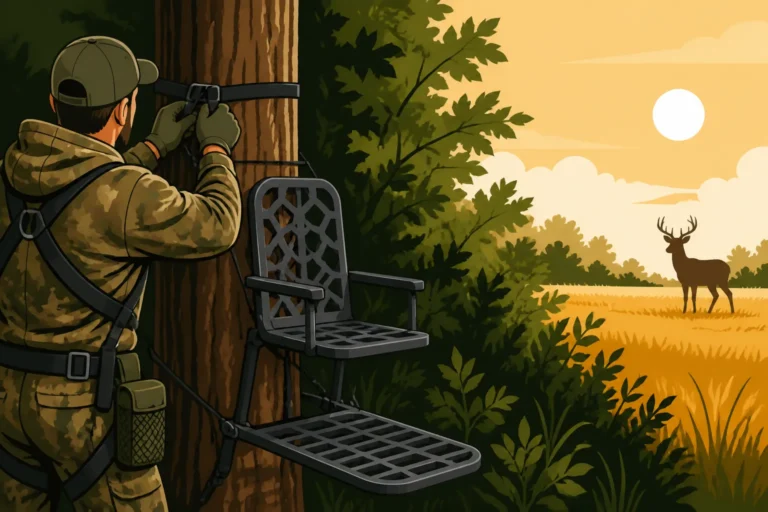
When it comes to hanging a stand on an Ontario bush edge or within the hardwoods themselves, location is everything. You need to identify key transition areas where deer naturally move between bedding and feeding, or along primary travel corridors. Often, this means looking for the junction of different cover types – perhaps where a dense pine plantation meets an open oak ridge, or where a swamp edge gives way to higher ground. A subtle ridge running through otherwise flat terrain can also be a highway for deer. Position your stand downwind or crosswind of these travel routes, considering the prevailing winds in your hunting area. Deer rely heavily on their sense of smell, so any whiff of human scent will send them packing.
Concealment isn't just about wearing camouflage; it's about blending into the environment. Choose a tree that offers good cover from all angles, breaking up your outline. Don't just pick the tallest tree; sometimes a gnarled, multi-branched tree offers superior concealment even at a lower height. Think about the sun's position throughout the day – you don't want to be silhouetted against the morning or evening sky. Access to and from your stand is equally critical. Plan a route that minimizes disturbance, avoiding crossing known deer trails or bedding areas. Consider approaching your stand well before daylight and staying until after dark, making sure your entry and exit are as quiet and scent-free as possible. For bowhunting Ontario's long archery season, precise stand placement is even more crucial due to the shorter shot distances.
Still Hunting and Driving Techniques
While stand hunting is a staple, the dynamic nature of mixed hardwoods makes still hunting a highly effective tactic, particularly when deer movement is slow or unpredictable. Still hunting involves moving incredibly slowly and deliberately through the woods, pausing frequently to scan, listen, and glass your surroundings. Take five to ten steps, then stop for several minutes, allowing your eyes to adjust to the subtle movements and shapes of the forest. Focus on areas with varied topography and cover, like the edges of thickets, subtle draws, or along a hardwood ridge for whitetails. The goal is to spot deer before they spot you, or to jump them and get a quick, ethical shot. Pay attention to wind direction, always moving into the wind or with a crosswind to keep your scent from preceding you.
Another effective strategy, especially in larger blocks of mixed hardwoods, is organizing deer drives with three or four hunters. This requires careful planning and communication. Typically, one or two hunters (drivers) will push through a specific section of bush, moving slowly and steadily, while others (blockers or standers) are strategically positioned at potential escape routes, such as saddles, pinch points, or where the bush opens into a field. The key is to keep the drive organized and safe, with everyone knowing their role and direction of movement. For instance, you might focus on pushing a specific cedar swamp edge or a dense patch of regenerating pines. This method can be particularly effective during the colder months when deer are more prone to yarding up and are less likely to move extensively on their own. Remember to always prioritize safety and clear communication when employing this tactic, ensuring everyone knows where other hunters are located.
Overcoming Challenges and Maximizing Success
Hunting mixed hardwood bush comes with its own set of challenges, from navigating varied terrain to adapting to Ontario's unpredictable weather. Being prepared for these elements is key to a successful and enjoyable hunt.
Dealing with Variable Cover and Terrain
The very thing that makes mixed hardwoods so appealing to deer – its diverse cover and terrain – can also make it incredibly tough to hunt. You might be walking through open timber one minute, then find yourself pushing through a dense tangle of thorn bushes and young saplings the next. This variable cover demands flexibility in your approach. For instance, in areas with very thick undergrowth, moving quietly becomes a monumental task. Here, it might be more effective to position yourself on the downwind side of the thick stuff, letting the deer come to you as they move out to feed, or to conduct a slow, deliberate drive through it.
The rolling and often rugged terrain also presents physical challenges and navigational puzzles. Steep ridges and deep ravines can be exhausting to traverse, and it's easy to get turned around, especially when focused on tracking or moving quietly. Always carry a reliable GPS device or use a mapping app like GoHunt on your phone, ensuring you have offline maps downloaded since cell service can be spotty. Learn to use topographical maps to predict deer movement and identify natural funnels. For example, deer often choose the path of least resistance, so look for benches, saddles, and gradual slopes they'll use for travel. Understanding how to use the land to your advantage, both for finding deer and for your own navigation and concealment, is a crucial skill in these varied landscapes.
Adapting to Weather and Seasonal Changes
Ontario's weather can be notoriously fickle, and its impact on hunting in mixed hardwoods cannot be overstated. Early season hunts might be warm, with deer still on summer patterns, feeding heavily on lush browse and moving primarily in the low light of dawn and dusk. As the leaves begin to fall, deer become more visible, but also more wary. This is when the mast crops really come into play. Pinpointing active oak or beech flats becomes critical. The rut, typically peaking in early to mid November, brings increased daytime activity as bucks search for does, offering prime opportunities. This is often when hunters are sitting all day in an Ontario blind, knowing that a cruising buck could appear at any moment.
Later in the season, particularly when snow begins to fall, conditions change dramatically. Snow not only reveals fresh tracks, making it easier to determine direction and freshness of deer movement, but it also pushes deer towards thermal cover, often the dense conifer stands within the mixed hardwoods. They'll yard up in these areas to conserve energy, making it a good time to focus your efforts around cedar swamp edges or thick pine plantations. Deep snow can also restrict deer movement, sometimes making them more predictable. Legal rifle calibres for big game are certainly effective here, but hunters need to be prepared for the cold and wet conditions, dressing in layers and ensuring their gear is up to the task. Understanding these seasonal shifts and how they influence deer behavior is vital for success in Ontario's mixed hardwood bush, letting you adapt your tactics for Ontario Deer Season Dates and Tags as they unfold.
| Deer Sign | What It Looks Like | What It Tells You | Best Time to Find/Interpret |
|---|---|---|---|
| Rubs | Scraped bark on saplings/trees, often 1-4 inches in diameter for smaller bucks, larger for mature ones. | Buck presence, travel routes, rough buck size, sometimes direction of travel. | Pre-rut through late season. Fresher rubs indicate recent activity. |
| Scrapes | Pawed-up patch of bare earth, typically 2-4 feet in diameter, with a low-hanging "licking branch" above. | Buck presence, communication hub, pre-rut/rut activity. | Pre-rut and rut primarily. Active scrapes will be fresh and moist. |
| Trails | Distinct paths of disturbed leaves, compacted earth, or subtle depressions. | Regular deer travel routes between bedding, feeding, and water. | Year-round. Most visible after leaf drop or light snow. |
| Droppings | Piles of pellet-like droppings (single or clumped), size varies. | Deer presence, freshness indicates recent use, helps determine preferred feeding areas. | Year-round. Fresh, soft droppings are hot sign. |
| Beds | Oval depressions in leaves/snow, often in thick cover, out of the wind. | Deer bedding locations, can indicate preferred cover type. | Year-round. Fresher beds will show impressions, warmth in snow. |
| Browsing | Nipped twigs, often with ragged edges (deer don't have upper incisors). | Deer feeding activity, preferred food sources. | Year-round. More evident in winter on woody browse. |
Disclaimer
Always consult the most current Ontario Hunting Regulations Summary for specific rules, season dates, and bag limits before heading into the field. This guide provides general information and best practices, but regulations can change annually. Safety should always be your top priority when hunting.