Hunting a Fallow Field Border
For many hunters, the frustration of trying to pattern deer movement can feel like an endless puzzle. You scout, you plan, you sit, and sometimes, it just doesn't come together. But if you've got access to agricultural land, especially fields that have been left fallow, you've stumbled upon a potential goldmine. These overlooked edges can be absolute magnets for whitetails, offering predictable movement patterns if you know how to read the signs and hunt them right. This guide will walk you through how to unlock the secrets of hunting a fallow field border in Ontario, turning those elusive patterns into successful opportunities.
Understanding the Fallow Field Ecosystem
Before you can effectively hunt a fallow field border, you need to understand why deer are drawn to it in the first place. These aren't just empty spaces; they're dynamic environments that offer specific resources at different times of the year, making their edges prime real estate for whitetails.
What Exactly is a Fallow Field?
A fallow field is essentially agricultural land that has been left uncultivated for a season or more. Farmers do this for various reasons: to allow the soil to regain nutrients, reduce erosion, or manage crop rotation. While it might look "empty" to the untrained eye, a fallow field quickly becomes a natural buffet and sanctuary for wildlife. It's not a neatly ploughed field, nor is it a dense woodlot. Instead, it's a transitional zone, often overgrown with weeds, volunteer crops, grasses, and small shrubs that take root once the primary crop is harvested and the ground is left untouched.
Imagine an old soybean field from last year, now covered in a mix of milkweed, goldenrod, ragweed, and maybe some volunteer wheat or clover that didn't get ploughed under. This diverse growth provides an incredible amount of natural forage for deer, much of which is highly palatable. More importantly, this dense, unmanaged vegetation offers excellent cover, creating a sense of security for deer that might otherwise feel exposed in open areas. It's this combination of food and cover, often adjacent to more active agricultural fields or established woodlots, that makes the border so attractive.
Why Deer Use Fallow Fields and Their Borders
Deer, being creatures of edge habitat, are naturally drawn to the intersection of different cover types. A fallow field border provides just that – a rich seam where the dense cover of the field meets a woodline, a fencerow, or even another type of active crop field. This border acts as a crucial transition zone and travel corridor.
Think about a deer's daily routine: they need food, water, and security. A fallow field border often provides all three. During the day, deer might bed down deep within the dense growth of the fallow field itself, enjoying the security and concealment. As dusk approaches, they'll use the border to stage before moving into adjacent active crop fields for prime feeding. In the morning, they'll reverse the pattern, using the border as a safe pathway back to their bedding areas. The taller weeds and grasses offer a visual screen, allowing deer to move with confidence, feeling less exposed than if they were crossing an open pasture or freshly tilled ground. Moreover, these borders can offer crucial thermal cover, shielding deer from biting winds in the fall or intense sun in the early season.
Seasonal Changes and Deer Behavior
Deer behavior around fallow fields changes dramatically with the seasons, making year-round observation vital for successful hunting. Understanding these shifts is key to knowing when and where to focus your efforts.
In spring and early summer, as new growth emerges, fallow fields become vital feeding grounds. Young, tender shoots of clover, volunteer wheat, and various weeds are highly nutritious and attractive. Does often choose these areas for fawning due to the dense cover providing excellent concealment for their newborns. As summer progresses, the growth in fallow fields becomes incredibly thick and tall, offering superb thermal and visual cover, especially for does and fawns trying to escape the heat or hide from predators. This makes the interior of the field a major bedding area.
Come early fall, as other food sources begin to dry up or disappear, fallow fields often still hold a variety of seeds, leftover browse, and sometimes even volunteer brassicas or clover that become more palatable after a frost. This can be a major draw before the main crop fields are harvested. As the rut approaches in late October and November, bucks will frequently cruise these borders, scent-checking for does moving between bedding and feeding areas. During the intense period of Hunting the Rut in Early to Mid November, these travel corridors along the edge of a fallow field can be incredibly productive. Finally, in late fall and early winter, once many other fields are bare, the remaining cover in a fallow field still provides crucial protection from the elements, and deer will continue to use the edges as safe travel routes, especially if adjacent to winter browse sources or Where Ontario Whitetails Yard in Deep Snow.
Scouting Strategies for Fallow Field Borders
Effective scouting is the bedrock of any successful hunt, and fallow field borders are no exception. You need to become a detective, piecing together clues about deer movement and habits before you even think about setting up a stand. This involves both pre-season digital reconnaissance and boots-on-the-ground investigation.
Pre-Season Scouting: Using Tools and Maps
Long before the season opens, I'm already "hunting" from my couch using various digital tools. Platforms like GoHunt, along with satellite imagery on Google Maps or other mapping applications, are invaluable for this initial phase. Start by identifying potential fallow fields in your hunting area, especially those bordered by dense bush, woodlots, or other active agricultural fields. Look for topographical features that might create natural funnels or pinch points along these borders. Creeks, ditch lines, changes in elevation, or even distinct changes in vegetation where the fallow field meets a hardwood ridge can all influence deer movement.
Overlaying property lines and identifying access points is also crucial at this stage, particularly when Hunting Deer in Southern Ontario Farmland where private land dominates. Digital tools help you visualize the landscape in a way that's hard to do from the ground. Look for patterns: where does the thickest cover meet the lightest? Are there any visible game trails leading into or out of the fallow field along its edge? This digital groundwork saves you countless hours of aimless walking and helps you focus your ground scouting efforts on the most promising areas.
Identifying Key Deer Sign
Once you've done your digital homework, it's time to hit the field. Focus your efforts on the very edge where the fallow field transitions into another cover type. This is where you'll find the most concentrated deer sign. Look for well-worn trails, especially those that parallel the edge or cut directly through it into adjacent cover. These are highways for deer.
Beyond trails, keep your eyes peeled for rubs and scrapes. Bucks will often create rubs on small trees and saplings along these borders as they move, marking their territory and communicating their presence. Scrapes, particularly during the pre-rut and rut, will appear in clusters along these travel corridors. These are essentially calling cards, where bucks paw the ground, urinate, and sometimes even chew on an overhanging branch. Identifying fresh rubs and active scrapes tells you that bucks are using this specific border, and often indicates a consistent travel route. Don't forget to look for droppings (pellets) and tracks, paying attention to the size and freshness, which can give you clues about the size and number of deer frequenting the area. A consistent pattern of fresh sign along a particular section of the border is a strong indicator of a high-traffic area.
Locating Pinch Points and Natural Funnels
Deer, like people, are creatures of efficiency; they'll almost always take the path of least resistance. This means they will gravitate towards natural pinch points and funnels. These are areas that constrict deer movement into a narrower path, making their travel more predictable. On a fallow field border, these could be formed by several factors.
Imagine a section where the dense fallow field cover narrows significantly between a steep bank and an old logging road. That's a textbook funnel. Another common scenario is where a thick patch of evergreens or a small, isolated bush lot extends into the fallow field, forcing deer to walk around it. The edges of these obstructions become natural travel lanes. Similarly, a small creek or a wet, boggy area might create a bottleneck, pushing deer to drier, more stable ground along its edge. Even a well-defined fence line or an old stone wall can act as a funnel if it limits easy passage. Using your GoHunt maps again, look for these features, then confirm them on the ground. These pinch points are absolutely prime locations for stand placement because they significantly increase your odds of intercepting a deer moving along the border.
Effective Hunting Tactics for Fallow Field Borders
Once you've put in the time scouting and identified those key locations, it's time to think about how you're actually going to hunt these valuable fallow field borders. Success often comes down to precise stand placement, understanding deer movement patterns relative to time of day, and knowing when to use calls or scents.
Stand Placement: Trees, Blinds, Wind Considerations
Proper stand placement is paramount when hunting fallow field borders. Your goal is to intercept deer without alerting them to your presence. The first decision is often between a tree stand and a ground blind. Tree stands offer a height advantage, allowing your scent to dissipate higher and giving you a better view over the dense field growth. Look for a sturdy tree along the border that offers good concealment, preferably one with branches that can break up your outline. Ideally, position your stand overlooking a well-used trail or pinch point, with a clear shooting lane. Consider putting up a stand like one you might use when Hanging a Stand on an Ontario Bush Edge.
Ground blinds can be effective if natural cover is sparse, or if you prefer a more concealed, warmer setup. Position a ground blind slightly back into the bordering cover (bush, woodlot) rather than right on the field edge, to keep it from silhouetting. Regardless of your choice, wind direction is your absolute number one priority. Always hunt with the wind in your favor, blowing your scent away from where you expect deer to approach. Prevailing winds in Ontario can often shift, so having multiple stand options for different wind directions is a smart strategy. Don't overlook sun angle either – you don't want the rising or setting sun directly in your eyes, or directly illuminating your position.
Hunting the Edge vs. Within the Field
While the focus is on the "border," understanding when to hunt just the edge versus when to penetrate a bit into the fallow field itself can make a difference. Early in the season, or during mid-day, deer might be bedded deeper within the thick cover of the fallow field. If you have a good understanding of their bedding areas from scouting, and the wind is perfect, slipping a short distance into the field (along a hidden depression or ditch, for example) could put you closer to a deer that's moving internally. This is a higher-risk play, as the thick cover makes quiet movement difficult.
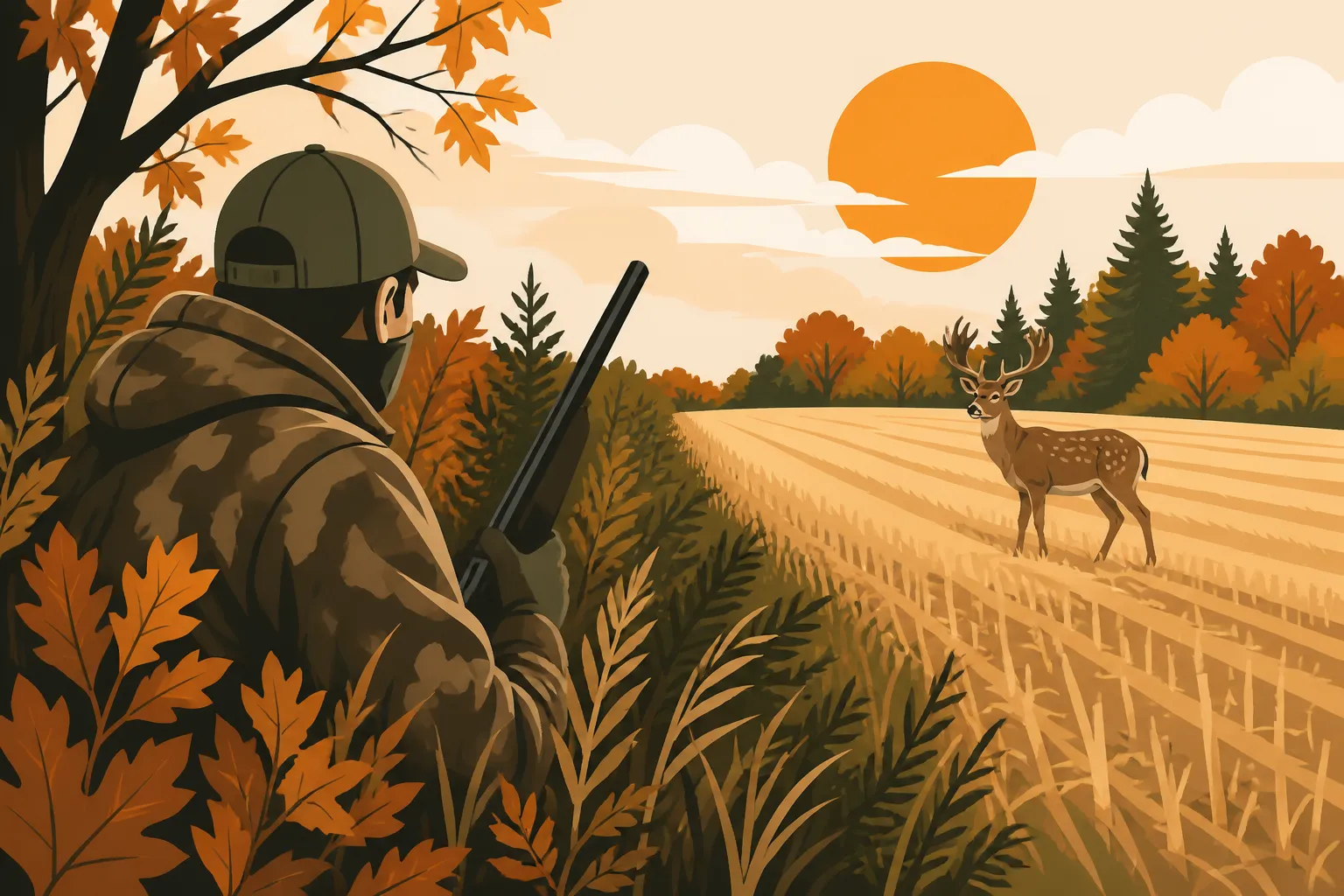
More often, the safer and more productive bet is to stick to the defined border. Deer will use these edges for staging and travel. In the mornings, set up to intercept deer moving from active feeding fields back into the fallow field or adjacent heavy cover. In the evenings, position yourself to catch deer emerging from the fallow field to feed in active crop fields. The border is a natural transition point, and by focusing your efforts there, you're hunting their established travel routes. Being patient and letting them come to you along these natural pathways is often the most successful strategy.
Timing Your Hunt: Dawn, Dusk, Mid-Day, Weather Effects
The timing of your hunt around a fallow field border is critical, often dictated by the deer's natural patterns and environmental factors. Dawn and dusk are almost always prime times. Deer are most active during these low-light periods, transitioning between bedding and feeding areas. In the morning, be in your stand well before first light, ready for deer to filter back into the cover of the fallow field after a night of feeding. In the evening, get set up mid-afternoon, anticipating deer emerging from the fallow field or adjacent cover to begin their nightly forage.
Don't rule out mid-day entirely, especially during the rut. Cruising bucks might use these borders throughout the day as they search for does. Overcast days, light rain, or cooler temperatures can also extend deer activity, making mid-day hunts more viable. A passing cold front can really get deer moving. Conversely, very hot or very windy days might suppress movement, pushing activity primarily to the absolute lowest light hours. Keep an eye on the weather forecast and adjust your hunting schedule accordingly. Remember that deer might use the field more for bedding if it's overly hot, seeking cooler temperatures in the dense growth.
Using Calls and Scents
When hunting fallow field borders, strategic use of calls and scents can sometimes tip the odds in your favour, especially during the breeding season. During the pre-rut and rut, grunt calls and rattling can be effective. Grunt calls, mimicking a buck searching for a doe or signaling dominance, can pique a buck's curiosity and draw him closer to investigate the fallow field edge. Rattling antlers, simulating a fight between two bucks, can also work wonders, especially if you believe a mature buck is using the border. However, in heavily pressured areas, deer can become call-shy, so use them judiciously.
As for scents, deer urine (doe estrus, buck urine) can be used to either attract deer or mask your own scent. Placing a scent wick downwind of your stand along a trail, or creating a mock scrape with buck urine on the border, can draw deer closer. Be mindful of wind direction when using scents – you want the scent to drift into the areas where deer are likely to be. Remember, while calls and scents can be powerful tools, they are secondary to proper scouting, stand placement, and scent control. They are enhancers, not replacements, for sound hunting fundamentals. You might use these tactics when Rattling and Calling Ontario Whitetails.
Gear and Considerations for Fallow Field Hunting
Hunting fallow field borders, while potentially rewarding, comes with its own set of gear requirements and practical considerations that can greatly impact your success and comfort. Being prepared for the specific environment will ensure a smoother, more effective hunt.
Clothing and Concealment
The thick, often tall vegetation of a fallow field demands excellent concealment. Camouflage that blends with the browns, greens, and grays of dying weeds, grasses, and bordering hardwoods is essential. This isn't just about looking like a tree; it's about breaking up your outline. Pay particular attention to your face and hands, which can shine and alert deer. A good face mask or face paint and gloves are non-negotiable.
Beyond camouflage, consider the practicalities of the terrain. Fallow fields can be wet, especially in the mornings with dew, or after rain. Waterproof boots are a must. Durable, quiet outerwear that won't snag loudly on brush as you move to and from your stand is also crucial. Layering is key in Ontario's variable fall weather, allowing you to adapt to temperature swings from frosty mornings to mild afternoons. Don't forget your blaze orange; understanding Ontario Blaze Orange Requirements is not just about legality, but safety, especially during gun seasons where hunters may be spread out across diverse agricultural and bushland settings.
Weapon Choice and Shot Distances
Your choice of weapon – whether rifle, bow, or muzzleloader – will influence how you set up and what kind of shots you can realistically expect on a fallow field border.
- Bowhunting: If you're Bowhunting Ontario's Long Archery Season, fallow field borders can be fantastic. The thick cover often allows deer to approach quite close, presenting excellent archery opportunities. However, shot distances are usually shorter, typically within 30-40 yards. Ensure your shooting lanes from your stand are meticulously cleared to avoid deflections from even small twigs in the dense growth. The advantage here is the quiet nature of archery, allowing for less disturbance if you only wound or miss.
- Rifle Hunting: Rifle Hunting Ontario's Deer Season offers more flexibility with longer shot distances, which can be an advantage if deer are hanging just out of bow range in the middle of a large fallow field or moving quickly along a distant edge. However, the thick vegetation can still obscure deer, making identifying vitals challenging. Use optics wisely to ensure a clean shot. Be very aware of your backdrop and what lies beyond your target, especially in farming areas where buildings or roads might be close. Familiarize yourself with Legal Firearms and Bows for Big Game for specific regulations.
- Muzzleloader Hunting: Muzzleloaders offer a unique challenge and reward. Their effective range often falls between that of a bow and a modern rifle. They are potent, but typically single-shot, demanding careful shot placement. Like rifle hunting, muzzleloaders benefit from clear lines of sight, but the "smoke pole" experience is a cherished tradition for many.
Regardless of weapon, practice at various distances and angles. Knowing your effective range and sticking to it is crucial for an ethical harvest.
Retrieval Challenges and Meat Care
Successfully taking a deer is only half the battle; retrieval and proper meat care are equally important. Fallow fields, with their dense, tangled growth, can make tracking and dragging a deer incredibly difficult. A wounded deer can quickly disappear into the thickest part of the field, making retrieval a grueling task.
Always mark the spot where the deer was standing when you shot, and the last place you saw it. Use flagging tape or brightly colored markers. If you have a good shot and the deer runs, give it time before you start tracking – 30 minutes to an hour for a lung shot, several hours for a gut shot. Bring a strong rope or a deer cart, as dragging a heavy deer through tangled weeds can be exhausting. Consider hunting with a partner who can assist with tracking and hauling.
Once the deer is down, immediate field dressing is crucial, especially during Ontario's warmer early seasons, to prevent spoilage. You might need to carry a sharp knife, game bags, and perhaps even some water for rinsing. If you're hunting in a remote area, plan how you'll get the animal out and keep the meat cool. Review resources on Meat Care in Ontario's Warm Early Seasons to ensure your hard-earned venison doesn't go to waste. Having a plan for these post-shot steps is just as important as the shot itself.
Navigating Access and Regulations
Hunting fallow field borders in Ontario often means navigating a mix of public and private land, each with its own set of rules. Understanding these regulations and securing proper access is fundamental to a legal and enjoyable hunt.
Understanding Landowner Permissions
In Southern Ontario, particularly where agriculture dominates, most fallow fields are on private property. This means you absolutely must obtain explicit permission from the landowner before stepping foot on their land. Never assume permission. A simple conversation, showing respect for their property, and offering to share some venison can often go a long way. Some farmers might be grateful for deer harvest to help manage crop damage.
When you do get permission, clarify the boundaries you are allowed to hunt, where you can park, and any specific requests they may have. Always carry written permission if possible, or at least have a clear understanding of the terms. Respecting the landowner's property is paramount; leave no garbage, close gates, and be mindful of livestock. Building a good relationship with a landowner can open doors to years of productive hunting opportunities. For more information, check out Knocking on Doors in Southern Ontario.
Wildlife Management Unit Rules and Season Dates
Every hunting activity in Ontario is governed by specific rules for the Wildlife Management Unit (WMU) you are in. Fallow fields will fall within a specific WMU, and you need to know its particular regulations. This includes deer season dates, bag limits, and any special antlerless tags or controlled hunt validations that might apply.
Using a tool like GoHunt or consulting the official Ontario Hunting Regulations Summary will provide you with the exact Ontario Deer Season Dates and Tags for your WMU. WMUs that feature significant agricultural land, especially in the south, often have different season lengths or tag allocations compared to the more remote northern units. Always ensure your Outdoors Card and appropriate deer tag are valid for the WMU and season you are hunting. Ignorance of the rules is never an excuse, and violations can lead to heavy fines and loss of hunting privileges.
Respecting Adjacent Properties and Safe Hunting Practices
When hunting a fallow field border, you're often in proximity to other properties, whether they be other farms, residences, or other hunters. It is your responsibility to know where you are at all times and ensure every shot is safe. Never shoot across a road, towards a building, or onto property where you don't have permission. Always know what is beyond your target.
Safety around livestock is also crucial. If the fallow field is bordered by a pasture, ensure you have a clear shot that won't endanger any animals. Ethical hunting extends beyond just the kill; it encompasses everything from safe firearm handling to respecting fellow hunters and non-hunters. By adhering to these practices, you not only ensure your own safety but also help maintain a positive public image for hunters.
| Aspect | Morning Hunt (Dawn to Mid-Morning) | Evening Hunt (Late Afternoon to Dusk) |
|---|---|---|
| Deer Movement | Deer moving from active feeding areas (e.g., corn fields) back into fallow field or deep cover. | Deer emerging from fallow field bedding areas or deep cover to move towards active feeding areas. |
| Stand Location | Position for deer entering the fallow field/cover. Often slightly off the edge, deeper into cover. | Position for deer exiting the fallow field/cover. Can be closer to the open field edge. |
| Wind Strategy | Wind should blow into the open field, carrying your scent away from deer approaching cover. | Wind should blow into the fallow field, carrying your scent away from deer emerging from cover. |
| Lighting | Sun rising in the east, plan to avoid being backlit or silhouetted by rising sun. | Sun setting in the west, plan to avoid being directly in your eyes or silhouetted against the horizon. |
| Tactics | Patience; watch for deer filtering in. Consider light calling to draw attention as deer slow down. | Active calling/scenting as deer start moving. Be ready for deer to appear suddenly from dense cover. |
| Challenges | Deer may already be bedded, or moving subtly. Visibility can be poor in deep shadows. | Deer may appear suddenly and unexpectedly. Managing low light for shot placement. |
Conclusion
Hunting a fallow field border in Ontario offers some of the most consistent and exciting opportunities for whitetail hunters, provided you approach it with diligent scouting and smart tactics. These unique transitional zones provide deer with everything they need – food, cover, and safe travel corridors – making them predictable hubs of activity throughout the hunting seasons. By understanding the ecosystem, employing effective scouting techniques, and placing your stand strategically with the wind in mind, you can turn these often-overlooked edges into your most productive hunting spots. Remember, patience, respect for the land and its rules, and an unwavering commitment to ethical hunting practices are the hallmarks of a truly successful hunt.
Disclaimer
Please remember that hunting regulations and conditions can change. Always consult the most current Ontario Hunting Regulations Summary and relevant government resources before planning any hunt. This guide is for informational purposes only and does not replace official regulatory documents.