Scouting Fields for Ontario Waterfowl
There's nothing quite as frustrating as waking up before dawn, driving for miles, and setting up an elaborate spread of decoys, only to watch the sun rise over an empty field. It feels like you've wasted precious hunting time and fuel, all because the birds just weren't there. This guide is all about equipping you with the knowledge and practical strategies you need to effectively scout fields for Ontario waterfowl, dramatically increasing your chances of being exactly where the ducks and geese want to be.
Understanding Waterfowl Movements and Habitat Choices
Successful waterfowl hunting in Ontario starts long before you ever pull the trigger; it begins with a deep understanding of why ducks and geese choose the fields they do. These birds aren't just randomly dropping into a field; they're driven by instinct, seeking out optimal food sources, safety, and efficient travel routes. Ignoring these fundamental drivers means you're leaving your success up to pure luck.
Why Ducks and Geese Use Agricultural Fields
For many waterfowl species, particularly various types of geese and certain dabbling ducks like mallards, agricultural fields are essentially giant buffet tables. After spending the night on a secure body of water, they'll often fly to nearby fields at first light to feed, fueling up for the day. This flight pattern repeats in the late afternoon, as they stage for their return to roosting areas. The type of crop heavily influences their preference. Geese, for example, absolutely love waste grain in harvested cornfields. They'll spend hours meticulously gleaning every kernel, often creating noticeable "burns" or areas where the stubble is completely flattened by their feeding. Similarly, they'll target recently cut winter wheat fields, especially those with green shoots emerging after a late-summer rain, or even green clover and alfalfa fields for their nutrient-rich forage. Ducks, while often found with geese, might also seek out fields with standing water or very muddy conditions where they can dabble for seeds and invertebrates, like a flooded soybean field after a heavy rain. Understanding these preferences is key to knowing where to start looking.
The Impact of Weather on Field Use
Weather isn't just a minor factor; it's often the dominant force dictating waterfowl movements, especially when it comes to field usage. A strong north wind after a cold front pushes birds south, bringing in fresh flocks that haven't been pressured. These new arrivals might be less wary and more predictable in their movements. Heavy rains can flood low-lying areas of fields, creating temporary water bodies that attract ducks, transforming an otherwise barren field into a prime feeding and resting spot. Conversely, a prolonged dry spell might send birds searching for fields closer to permanent water sources. Snowfall is another game-changer. A fresh blanket of snow can cover up waste grain, forcing birds to work harder to find food, or concentrate them on bare patches blown clear by the wind. On the flip side, deep, crusted snow can make fields completely inaccessible, pushing birds to rivers, lakes, or fields with less snow accumulation. Pay close attention to the forecast, not just for hunting comfort, but to anticipate how birds might adjust their patterns. It's often the subtle shifts in weather that unlock a hot new field.
Essential Scouting Techniques for Waterfowl
Now that we know why birds use fields, let's dive into the how of finding them. Effective scouting isn't just driving around aimlessly; it's a strategic process that combines modern technology with old-school field craft. Neglecting either can lead to missed opportunities and empty decoy spreads.
Pre-Season Digital Scouting
Before you even step foot in a field, the real work begins from the comfort of your home. Satellite imagery and digital mapping tools are absolute game-changers for any modern waterfowl hunter. Programs like GoHunt or even Google Earth allow you to virtually "fly" over vast areas of Ontario, identifying potential hot spots. Look for large expanses of agricultural land, especially those adjacent to significant bodies of water – think Lake St. Clair, Lake Erie, or the large rivers that traverse prime farming country. You'll want to identify potential feeding areas (corn, wheat, soybean fields, particularly those with visible stubble from previous harvests), but also important roosting areas like large marshes, secluded bays, or quiet stretches of river. Pay attention to field boundaries, fencerows, and small woodlots that might offer concealment for setting up blinds. Identifying main flight corridors, often marked by power lines, tree lines, or natural funnels, can give you a huge advantage. This digital recon helps narrow down your physical scouting efforts, saving you time and fuel, and focusing on the most promising areas. It's like having a bird's-eye view of the landscape without leaving your kitchen table. For more on this, check out our guide on Scouting With Satellite Imagery in Ontario.
In-Season Field Reconnaissance
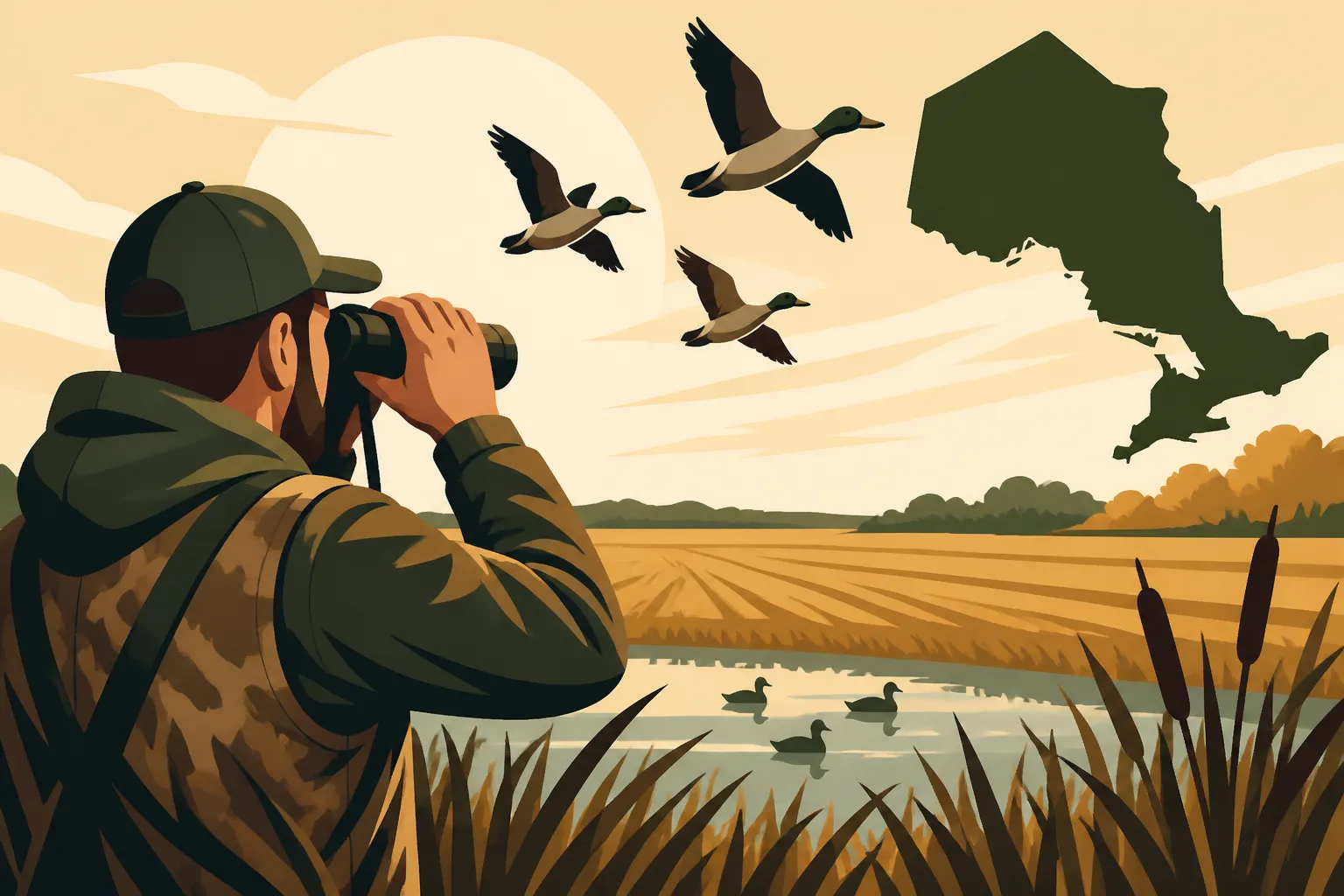
Once you've done your digital homework, it's time to hit the road. Physical reconnaissance is irreplaceable. Drive slowly along concession roads and side roads, always with binoculars or a spotting scope at the ready. The key here is to be observant but undetected. You don't want to spook birds off a field you plan to hunt; once pressured, they often become much warier and may abandon that field entirely.
The best times to scout are usually during the birds' normal feeding periods: early morning, right around sunrise, and late afternoon, an hour or two before sunset. This is when they are most actively moving between roosting and feeding grounds. Look for birds feeding, flying over, or even loafing in a field. Pay attention to specific species – are they Canada geese, mallards, pintails, or a mix? Each has slightly different preferences. If you spot birds, watch their behaviour. Are they comfortable? Are they alert and constantly looking around? How many are there? Where exactly in the field are they? Don't just note the field; note the specific corner, the rise, or the low spot they're using. You might need to return to the same field several times over a few days to confirm a pattern, especially if a weather front is moving through or if the birds seem to be using it sporadically.
Reading the Landscape for Waterfowl Sign
Birds leave clues, and a good scout learns to read them like a detective. Even if you don't see birds actively using a field, fresh sign can tell you they've been there recently and are likely to return. The most obvious sign is droppings. Fresh goose droppings are typically green or dark and soft; older droppings will be white, dry, and brittle. A field littered with fresh droppings is a goldmine. Look for feathers, particularly larger primary or secondary feathers, which indicate a bird has been preening or perhaps lost one during a skirmish. Tracks in muddy areas or along field edges can also reveal their presence, though these are often harder to distinguish.
Beyond the droppings, pay attention to the state of the crop itself. In a harvested cornfield, look for areas where the remaining stubble is flattened or trampled, especially in patterns that suggest heavy feeding. This is often referred to as a "burn" or "crater" and indicates a preferred feeding area. In a winter wheat field, you might see small patches of flattened or grazed-down green shoots. These visual cues, even without seeing a single bird, confirm recent activity and can guide your setup on hunt day. This attention to detail is what separates a casual observer from a truly effective waterfowl scout, especially when you're targeting specific species on Ontario farmland. You'll use these observations when you're Hunting Canada Geese on Ontario Farmland.
Practical Tips for Effective Field Scouting
Scouting isn't just about what you see; it's also about how you conduct yourself and the strategies you employ. There are definite dos and don'ts that can make or break your success before you even set up your first decoy.
Getting Permission and Respecting Landowners
This cannot be stressed enough: always, always, always get permission before entering private land. In Ontario, the vast majority of prime agricultural fields are privately owned. Trespassing is not only illegal but it also gives hunters a bad name and jeopardizes access for everyone. Start by identifying the landowner. Often, local municipal offices or online assessment tools can help. Then, approach them respectfully, ideally not during busy planting or harvest seasons. Introduce yourself, explain what you're hoping to do, and assure them you will respect their property, close gates, avoid driving on wet fields, and pick up any spent shells. Offer to share some of your harvest if they are interested. A polite, honest approach goes a long way. Many farmers are fed up with crop damage from geese and might be more amenable to granting access than you think. Building a good relationship with a landowner is priceless. It's often your ticket to repeated access for years to come, and a single permission can open doors to multiple fields. This is paramount for Hunting Deer in Southern Ontario Farmland, and the same principles apply here. For more insights on this, read our post on Knocking on Doors in Southern Ontario.
Stealth and Observation
Once you have permission, or if you're scouting public land, maintaining stealth is crucial. If birds see you scouting, they learn quickly. They'll associate your vehicle or presence with danger and might avoid that field. Park your vehicle out of sight, ideally a good distance from the field entrance. Use binoculars or a spotting scope from a discreet location – perhaps behind a fencerow, a small clump of trees, or a gentle rise in the land. Avoid walking directly into the fields you intend to hunt unless you are absolutely certain there are no birds present or that you can do so without being detected.
Movement and bright colours are easily picked up by waterfowl, especially geese with their incredible eyesight. Dress in muted, natural colours, even when just scouting. If you need to observe for an extended period, consider bringing a comfortable chair and setting up in a spot that offers natural concealment. The goal is to be a ghost, collecting as much information as possible without leaving any trace of your presence or alerting the birds to your intentions. This careful approach directly influences your ability to be successful when planning your Waterfowl Hunting Across Ontario adventures.
Timing Your Scouting Trips
Just like in real estate, timing is everything in waterfowl scouting. While morning and evening flights are prime observation times, there are other strategic windows.
- Post-Weather Front: After a significant cold front has passed, or a major storm has moved through, new birds often arrive, or existing birds shift their patterns dramatically. This is a prime time to re-scout fields, as previously unused areas might suddenly become active.
- Mid-Day Loafing: Sometimes, birds will feed hard in the morning, then loaf in a field mid-day, especially if it's sunny and calm, before feeding again in the late afternoon. This can be a good time to spot them without the intense flight activity.
- Changing Agricultural Practices: Pay attention to when local farmers are harvesting. A field that was full of standing corn one day might be a stubble field the next, completely changing its attractiveness to birds. Drive by regularly during harvest season.
- Pressure Management: If you've hunted a field successfully, don't scout it immediately afterward. Give the birds a day or two of peace. Over-scouting or over-hunting the same spot can quickly burn it out. Understanding these nuances, along with knowing the Ontario Goose Season Dates by District and Ontario Duck Season Dates by District, allows you to plan your scouting and hunting efforts for maximum impact.
Interpreting and Adapting Your Scouting Data
Finding birds is only half the battle; knowing what to do with that information, and how to react when conditions change, is where the real hunting acumen comes into play. Waterfowl hunting is rarely static, and your scouting efforts need to be flexible.
Keeping a Scouting Log
A well-maintained scouting log is an invaluable tool that too few hunters utilize. Don't rely on memory; jot down detailed notes immediately after each scouting trip.
Your log should include:
- Date and Time: Essential for tracking patterns.
- Location (WMU, concession road, specific field number): Be precise.
- Weather Conditions: Temperature, wind direction and speed, precipitation, cloud cover.
- Crop Type and Status: Standing corn, harvested beans, green wheat, fallow field.
- Bird Species and Numbers: How many geese, how many ducks? What kind?
- Specific Activity: Feeding, flying, loafing.
- Flight Paths: Where are they coming from, where are they going?
- Observed Sign: Fresh droppings, feathers, flattened stubble.
- Pressure Noted: Did you see other hunters? Did you spook birds?
- Notes for Next Time: Should I re-check this field tomorrow? Is it worth hunting?
This log will help you identify long-term patterns, understand how different weather affects bird movements, and build a historical database for future seasons. It also helps you recall successful setups, like for Setting a Goose Spread in Cut Corn, or if you were Hunting a Field of Standing Corn. Over time, this detailed information becomes a powerful predictive tool.
| Crop Type | Primary Attractors (Ontario) | Best Time for Scouting | Key Scouting Signs |
|---|---|---|---|
| Harvested Corn | Canada Geese, Mallards, Pintails | Early morning, late afternoon, post-harvest | Flattened stubble ("burns"), abundant droppings, kernels on ground |
| Winter Wheat | Canada Geese, Snow Geese, Wigeon | Early fall (green shoots), spring (new growth) | Grazed patches, droppings |
| Soybeans | Mallards, Teal, Wood Ducks | Post-harvest (especially with rain/standing water) | Droppings, tracks in mud, ducks landing in water-filled depressions |
| Peas/Barley | Canada Geese, Doves | Post-harvest | Droppings, scattered waste grain |
| Alfalfa/Clover | Canada Geese | Any time, especially after frost when other food is scarce | Grazed areas, droppings |
| Fallow/Pasture | Canada Geese | Depending on green growth, proximity to water | Droppings, tracks |
Adapting to Changing Conditions
Waterfowl are dynamic. A field that was hot yesterday can be stone cold today. This often leads to major hunter frustration. Why did they leave? It could be anything: new hunting pressure, a change in wind direction, a sudden drop in temperature, or simply that they've eaten out the accessible waste grain. This is where adaptation comes in. Don't be afraid to change your plans, even last minute. If your scouted field is empty on hunt morning, have a backup plan. This might mean driving to another promising field you scouted, or relocating to a water-based hunt if field conditions aren't cooperating.
Perhaps the most crucial adaptation is understanding that ducks and geese are constantly looking for new, unpressured food sources. A field that was ignored all season might suddenly become a magnet after a fresh harvest or a good rain. Similarly, fields that were pounded by hunters early in the season might be completely avoided by wary birds. Always be on the lookout for these shifts, which sometimes means revisiting fields you'd previously dismissed. This continuous reassessment, combined with tools like GoHunt that provide up-to-date aerial views, can keep you one step ahead. Remember, being adaptable is key to consistent success, whether you're Hunting a Soybean Field at Dusk or chasing divers on the Great Lakes.
Combining Scouting with Decoy Spreads
Your scouting efforts directly dictate your setup on hunt day. It's not enough to just know which field the birds are using; you need to know where in that field, how they are approaching, and what they are doing. This informs your decoy spread, your blind placement, and even your calling strategy.
If you observe birds feeding in a specific corner of a Hunting a Winter Wheat Field, that's where your spread should go. If they are consistently flying over a particular fencerow to get to the field, that's your kill zone. If they are landing short of a spread of decoys, perhaps your decoys are too close to your blind, or your spread isn't realistic enough.
Good scouting will tell you if the birds are landing in tight groups or scattering across the field. This influences whether you deploy a tight, family group spread or a looser, more dispersed setup. It will also help you determine the number of decoys needed. Sometimes, a smaller, more realistic spread works better for pressured birds. For less wary, newly arrived birds, a huge spread might be the ticket. Your scouting notes, particularly on specific field topography and bird behavior, will be your blueprint for a successful hunt, allowing you to fine-tune your approach for optimal results, including considerations like using Non-Toxic Shot Requirements for Waterfowl.
Disclaimer
Hunting is an inherently dangerous activity. Always prioritize safety, follow all local, provincial, and federal regulations, and obtain appropriate licenses and permits. This guide is for informational purposes only and does not substitute for professional instruction, adherence to hunting laws, or landowner permission. Be aware of your surroundings and always know your target and what is beyond it.