When the Whitetail Rut Peaks Here
That unmistakable chill in the air, the crisp crunch of fallen leaves underfoot, and the sudden appearance of scrapes and rubs – if you’re an Ontario deer hunter, you know exactly what that means. The whitetail rut is coming, or perhaps it’s already here, and few things get a hunter's blood pumping quite like the thought of a lovesick buck letting his guard down. But pinpointing when that frantic, unpredictable period truly peaks can feel like trying to catch smoke, leaving many of us frustrated and wondering if we're missing the prime window. This guide is dedicated to helping you understand the nuances of the whitetail rut across Ontario, giving you the insights to be in the right place at the right time.
Understanding the Ontario Whitetail Rut Cycle
The whitetail rut isn't a switch that flips overnight; it's a dynamic, multi-stage process influenced by a complex interplay of biology and environment. For us hunters, understanding these stages is crucial to predicting deer behavior and maximizing our chances.
The Phases of the Rut: Pre-Rut, Peak, and Post-Rut
Think of the rut as a three-act play, each with its own unique characteristics. The Pre-Rut is the opening act, usually kicking off in late October into early November. Bucks are feeling their oats, shedding velvet, and starting to establish dominance. You’ll see increased rubbing and scraping activity as they lay down scent and assert their presence. They're still somewhat nocturnal, but their daylight movement starts to pick up as they search for the first does coming into estrus. This is a fantastic time to be in the woods, as bucks are actively looking, but aren't yet locked down with a doe.
Next comes the Peak Rut, typically from mid-November to late November in many parts of Ontario. This is the main event, the chaos we all dream about. Does are actively receptive, and bucks are throwing caution to the wind, chasing, fighting, and breeding. Day-long movement is common, and you might see deer in places they normally wouldn't be during daylight hours. Bucks might be with a doe for 24-36 hours, but once breeding is complete, they're back on the prowl for the next receptive female. This is often the shortest, most intense phase.
Finally, we have the Post-Rut, which carries through late November and into December, sometimes even into January. A primary breeding surge has passed, and many does have been bred. However, it's not over yet! Younger does might come into estrus later, and some does that weren't successfully bred during the peak rut will cycle again roughly 28 days later. Bucks are often exhausted from the peak, depleted of energy, and focused on replenishing fat reserves, but they'll still respond to estrus if they find it. This can be a great time to catch a mature buck off guard, especially if you're hunting Ontario's December Muzzleloader Days.
Key Environmental Factors Influencing the Rut's Intensity
While photoperiod (the amount of daylight) is the primary driver of the rut, triggering hormonal changes in deer, other environmental factors can definitely influence its intensity and visible activity. Temperature is a big one. A sudden cold snap can really kick deer activity into high gear, making them more willing to move during daylight hours to find food or mates. Warm, mild weather, on the other hand, often means deer will remain more nocturnal, conserving energy.
Precipitation, like rain or snow, also plays a role. A light rain might dampen human scent and make deer feel more secure, while a heavy downpour can shut down movement temporarily. Fresh snow, however, can be a game-changer, not only making tracking easier but often stimulating deer movement as they seek out browse that's now easier to access. The presence of significant snow early in the season, particularly in Northern Ontario, can also impact deer movement and where they choose to yard up for the winter, affecting their overall activity patterns during the late rut. You might want to check out "Reading Sign After a Fresh Snow" for more insights on this.
It’s worth mentioning the moon phase, which has been debated among hunters for decades. While some swear by its influence on deer movement, scientific studies generally show that the lunar cycle has a negligible direct impact on when does come into estrus. However, a bright full moon could contribute to more nocturnal deer activity, meaning less visible movement during daylight hours for us hunters. Ultimately, it’s a subtle factor compared to photoperiod and temperature, but still something to consider in your overall hunting strategy.
Pinpointing Peak Rut Times Across Ontario's Diverse Regions
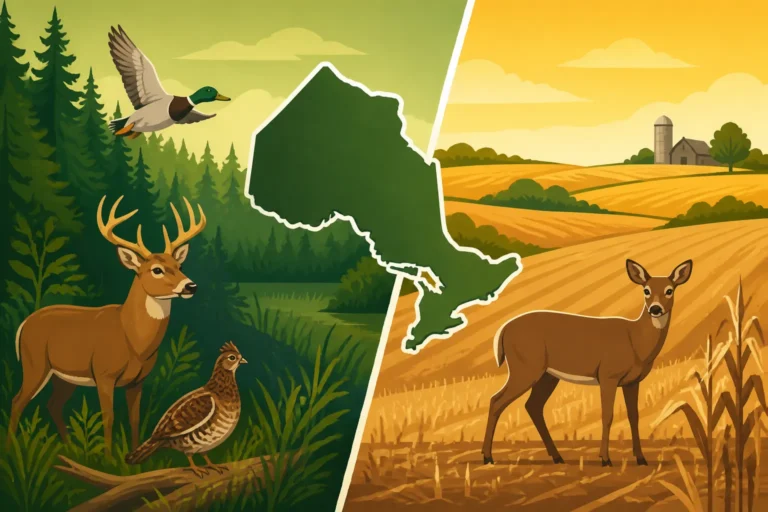
Ontario is a massive province, and deer hunting conditions can vary wildly from the agricultural fields of the south to the vast boreal forests of the north. This means the precise peak of the rut might shift slightly depending on where you are.
Southern Ontario's Farmland Whitetails
In Southern Ontario, where farmlands dominate the landscape and deer densities are generally higher, the peak rut typically falls in the second and third weeks of November. This is when you'll see the most frantic chasing and breeding activity in areas like Essex, Kent, and Lambton counties, or the agricultural pockets around Kingston and Ottawa. The abundant food sources – corn, soybeans, alfalfa – mean deer are often in prime physical condition, and bucks are incredibly eager to find receptive does.
Because of the higher deer densities, the rut often feels more intense and drawn out in these regions. Bucks don't have to travel as far to find does, but there's also more competition. You'll witness a lot of cruising movement in daylight, with bucks scent-checking hedgerows, woodlots, and field edges. These areas are also where you'll find some of Ontario's heaviest bucks, often thriving on the rich forage. If you're hunting deer in Southern Ontario farmland, understanding these high-traffic corridors is paramount.
The timing can feel quite consistent year-to-year in Southern Ontario due to stable populations and relatively predictable agricultural cycles. However, even here, a sudden cold front or an unseasonably warm spell can push peak daylight activity around by a few days. Keeping an eye on local deer sign and reports from other hunters in your specific Wildlife Management Unit (WMU) is always a good idea, as things can vary even within close proximity.
Central and Eastern Ontario's Mixed Forest
Moving into Central Ontario and parts of Eastern Ontario, where you find a mix of hardwoods, pines, and smaller agricultural clearings – areas like the Haliburton Highlands, Frontenac Arch, or the Kawartha Lakes region – the peak rut also generally occurs in mid-November. However, the experience can feel a bit different than in the south. Here, deer densities might be slightly lower, and the terrain is often more rugged, with more broken bush and rock ridges.
In these mixed forest environments, bucks often cover more ground to find does, making funnels, pinch points, and natural travel corridors even more critical for hunters. The peak activity might be slightly more concentrated around specific thermal cover like cedar swamps or hardwood ridges where deer prefer to bed and browse. You’ll notice an uptick in scrapes and rubs along game trails leading between bedding and feeding areas. Understanding Hunting a Hardwood Ridge for Whitetails or a Hunting a Cedar Swamp Edge becomes particularly relevant during this time.
Hunter pressure can also play a significant role here. With more accessible Crown Land and popular hunt camps, deer might become more cautious during the peak, sometimes pushing visible activity towards dawn and dusk, or into thicker cover. However, the core breeding activity remains driven by the does, so persistence is key. Even if you’re not seeing constant chasing, bucks are still moving, albeit perhaps more discreetly, making your scent control and patience vital.
Northern Ontario's Boreal Fringe
As you venture further north into Ontario's vast boreal fringe, bordering the true wilderness, the rut still follows the same general principles, but the peak might feel slightly later or more compressed, often solidifying in the third week of November and even bleeding into early December. This shift is likely due to the harsher climate, shorter growing seasons, and often lower deer densities. Northern bucks carry more body mass, a survival adaptation for the brutal winters, and their energy reserves are critical.
In areas like the fringes of the Chapleau Crown Game Preserve, parts of the Temagami country, or the mixed forests around Thunder Bay and Kenora, deer populations are typically lower, and vast tracts of forest mean deer can be harder to locate. Bucks here will travel immense distances in search of receptive does. Snow depth can also become a significant factor; early heavy snow can restrict movement and concentrate deer in specific wintering areas, or "yards," making them less susceptible to widespread movement.
Hunting the rut in Northern Ontario often means focusing on old logging roads, clear-cuts that offer new browse, or travel corridors between large blocks of timber. While the peak intensity might feel less frenetic than in the south, the biological drive is still there. Hunters often find success by focusing on smaller, isolated pockets of good habitat where deer might congregate. It's a completely different challenge, but equally rewarding when a northern monarch finally steps out. For more on navigating this landscape, consider reading up on Hunting an Old Logging Road in the North.
Recognizing the Signs of the Peak Rut in the Bush
Walking into the woods during the rut, you're looking for clues. Deer leave a whole story behind them, and during the peak rut, those stories become much more dramatic and easier to read.
Increased Scrapes and Rubs: What They Tell You
During the pre-rut and especially into the peak, the woods come alive with rubs and scrapes. Rubs are made when bucks rub their antlers on trees, stripping bark. They do this to mark territory, remove velvet, and deposit scent from glands on their forehead. Fresh rubs, shiny and with sap still oozing, tell you a buck was recently in the area and is actively asserting dominance. A "rub line" – a series of rubs leading in a specific direction – can tell you a buck's travel route between bedding and feeding areas, or between doe groups.
Scrapes, on the other hand, are spots where a buck paws away leaves and debris from the forest floor, creating a bare patch of dirt, often under an overhanging branch called a "licking branch." Bucks will urinate on their tarsal glands into the scrape and also chew/rub the licking branch to deposit scent. These are essentially communication hubs for deer. During the peak rut, you’ll find fresh scrapes popping up frequently, often along field edges, trails, or in transition zones. An active scrape indicates a buck is checking it regularly for receptive does. Sometimes, does will even visit scrapes, adding their own scent. Paying close attention to fresh scrapes and rub lines is critical for Reading Whitetail Sign in Ontario Hardwoods.
Don't just look for a scrape; look for clusters of fresh scrapes, or "community scrapes" where multiple deer might be visiting. The freshest, most aggressively worked scrapes will tell you exactly where bucks are cruising for does. If you find one consistently refreshed, especially one with a strong, musky scent, you're likely in a prime location.
Visible Deer Activity: Chasing, Cruising, and Seeking
This is perhaps the most obvious sign: you're simply seeing more deer, especially during daylight hours. During the peak rut, bucks lose much of their inherent wariness. They become single-minded, driven by the urge to breed. You'll witness them chasing does across fields, through open timber, or along bush edges. These chases can be short and intense, or longer, more drawn-out affairs. If you see a doe running with her tail tucked, looking over her shoulder, a buck is likely hot on her heels.
Beyond direct chasing, you’ll also observe bucks cruising. This means they're not necessarily on the trail of a specific doe, but rather constantly on the move, scent-checking, grunting, and generally searching for any receptive female. This cruising behavior makes them vulnerable, as they're covering more ground and often paying less attention to their surroundings. This is often the best time to be sitting in a stand, particularly in a natural funnel or pinch point that deer use to travel between larger blocks of cover.
Finally, keep an eye out for seeking behavior – bucks methodically working through cover, stopping to sniff the ground, licking branches, and occasionally letting out a grunt or snort-wheeze. This tells you they're actively trying to locate a doe. Even if you don't see a deer directly, hearing these vocalizations nearby is a clear indicator of rut activity. The deer are out there, and they're talking to each other.
Interpreting Trail Camera Data and GoHunt Analytics
In today's hunting world, technology can be a huge asset in understanding the rut. Trail cameras are invaluable for tracking deer movement patterns, especially around scrapes and food sources. By monitoring your cameras regularly, you can pinpoint exactly when buck activity starts to intensify, when does begin to come into estrus, and when the chasing really kicks off in your specific hunting area. Look for images of bucks interacting with scrapes, sparring, or chasing does. Consistent daylight photos of mature bucks are a dead giveaway that the peak rut is on.
Platforms like GoHunt can also be incredibly useful for hunters wanting to understand the rut. While GoHunt focuses more on western big game, the principles of using data to track animal movement and identify optimal hunting windows apply directly to Ontario whitetails. Even without specific GoHunt data for Ontario, the mindset of using historical data, weather patterns, and local observations to build a more informed picture is key. It's about combining your boots-on-the-ground scouting with any available data to make better decisions.
Many local hunters and outfitters will share their observations about rut activity through social media or local forums, offering an aggregated picture of what's happening on the ground. When you combine your own trail camera intel with these broader observations, and perhaps even mapping tools to identify ideal travel corridors, you get a much clearer, real-time understanding of the rut's progression. It helps confirm what your gut feeling is telling you and gives you confidence in your stand choices.
Strategies for Hunting Ontario During the Peak Rut
The peak rut is a window of opportunity where traditional hunting rules often bend. Bucks become more vulnerable, making it a prime time to be in the woods, but you still need a solid strategy.
Stand Placement and All-Day Hunting Tactics
During the peak rut, buck movement can be less predictable, but it's often more frequent and less cautious. This means your stand placement should focus on areas where deer are most likely to encounter each other: transition zones, funnels, and pinch points. Think about saddles between ridges, narrow strips of timber connecting two larger woodlots, or edges where different habitat types meet (e.g., hardwood forest meeting a cedar swamp). Bucks will naturally funnel through these areas while searching for does. Also, consider areas with dense thermal cover where does might be bedding, as bucks will actively patrol these spots.
This is also the time for all-day hunting. Forget the idea that deer only move at dawn and dusk. During the peak rut, a buck might be locked down with a doe for hours, but once breeding is done, he's up and moving again, often in the middle of the day, looking for the next opportunity. Bringing enough food, water, and warm layers to stay in your stand from daylight to dark significantly increases your odds. Many trophy bucks are taken between 10 AM and 2 PM during the peak rut. Remember that Sitting All Day in an Ontario Blind requires careful planning for comfort and stealth.
Don't be afraid to adjust your stand if conditions change or if you notice new activity. Deer patterns can shift quickly during the rut. If you've been seeing does in a particular area, a buck won't be far behind. Play the wind, stay quiet, and be ready for anything, because a lovesick buck can appear out of nowhere.
Effective Calling and Decoy Strategies
One of the most exciting aspects of rut hunting is the effectiveness of calling and decoying. During the peak, bucks are aggressive and responsive. Grunt calls are your bread and butter. A deep, drawn-out grunt can mimic a buck trailing a doe or a buck challenging another male. Short, excited grunts can simulate a chase. Don't be shy; mature bucks will often come investigate. Combine grunts with a snort-wheeze to really challenge a dominant buck. You can find excellent advice on Grunt Calls Late in Ontario's Rut, but remember they work throughout the peak as well.
Rattling antlers can also be incredibly effective, simulating two bucks fighting. Start with light sparring, then escalate to intense clashing, followed by some grunts. Always have your bow or rifle ready, as bucks can respond quickly and aggressively, often circling downwind to catch your scent. For hunting in Ontario's thick bush, remember that Rattling Volume in Thick Bush should be adjusted so the sound doesn't get swallowed by the dense cover.
Decoys add another visual layer to your calling. A standing buck decoy, especially one with an aggressive posture, can draw in other bucks looking for a fight. A doe decoy, particularly an estrus-scented one, can lure in cruising bucks. Place your decoy so the approaching buck will present a good shot opportunity. Always consider the wind direction when placing a decoy, as bucks will try to get downwind to scent-check. The goal is to make your setup look as natural and inviting as possible.
Leveraging Weather and Pressure to Your Advantage
As we touched on earlier, weather plays a critical role. Cold fronts, especially those following a warm spell, can trigger a surge in deer activity. Bucks need to feed more and are more comfortable moving in cooler temperatures. High-pressure systems often correlate with stable, clear weather, which can lead to increased movement. Keep a close eye on the forecast and plan your hunts around these favorable conditions. A drop in temperature of 5-10 degrees Celsius can make a noticeable difference.
Hunter pressure is another factor you can either fall victim to or leverage. During peak gun season in Ontario, popular areas, especially accessible Crown Land, can see a lot of hunters. Deer in these pressured areas will often become more nocturnal or seek refuge in thick, overlooked cover. This is where your scouting and willingness to go the extra mile come in. Find those small pockets of thick cover that other hunters walk past, or areas away from major trails. A little bit of extra effort can put you in a prime, undisturbed location.
Some hunters even use minor pressure to their advantage with small, organized Deer Drives With Three or Four Hunters in specific bush lots, carefully pushing deer towards waiting standers. This is more common in private land scenarios or hunt camps but requires careful planning and communication for safety and effectiveness. Regardless, understanding how deer react to pressure in your specific WMU is key to adapting your tactics.
Common Misconceptions and Local Nuances of the Ontario Rut
Even for seasoned hunters, the rut can hold a few surprises, and some old wives' tales persist. It's helpful to separate fact from fiction and understand Ontario's unique conditions.
The "Lockdown" Phase and Its Reality
You often hear about the "rut lockdown" – a period, typically after the initial peak, where bucks seemingly disappear. The idea is that once a buck finds a receptive doe, he "locks down" with her for a day or two, and during this time, visible deer movement grinds to a halt. While there's a kernel of truth to bucks pairing up with does, the idea of a universal, widespread "lockdown" where all bucks stop moving is largely a misconception, especially in Ontario.
What's more accurate is that individual bucks might spend 24-36 hours with a doe, leading to localized lulls in their visible movement. However, other bucks are still cruising, and as soon as one doe is bred, that buck is back on the hunt for the next one. In high-density areas of Southern Ontario, with a continuous stream of does coming into estrus, a complete "lockdown" is rare. Instead, you might just be experiencing a brief slowdown in your specific hunting spot because the deer moved on, or a particular mature buck is temporarily occupied. Keep hunting, and stay patient, as activity can pick back up quickly.
Furthermore, the timing of doe estrus isn't perfectly synchronized. There will always be some does coming into heat later, especially younger does entering their first breeding cycle, or those that weren't successfully bred during the first wave. This means there are always some receptive does, and thus, always some bucks moving. For instance, in areas with a healthy population, a "second rut" can occur roughly a month after the primary peak when these unbred or late-cycling does become receptive, offering another chance at a mature buck.
The Moon Phase Debate and Ontario's Experience
The discussion around how moon phase affects the rut is one of those topics that can get a deer camp buzzing. Many hunters swear that the rut really kicks off around the full moon, or that specific moon phases dictate peak daylight movement. While it's a compelling idea, scientific research, particularly studies conducted over many years and across various regions, including those with similar deer populations to Ontario, generally indicates that the moon phase has no direct, significant impact on when does enter estrus or on overall rutting activity.
The primary driver, as mentioned, is the photoperiod – the amount of daylight in a 24-hour cycle. This consistent, yearly change in light dictates the hormonal cascade that brings does into estrus and bucks into a breeding frenzy. Any perceived correlation with moon phases is likely coincidental or influenced by other, more impactful factors like temperature swings or hunting pressure. For example, a bright full moon might encourage more nocturnal feeding and movement, leading to slightly less visible activity during daylight hours, but it won't change the underlying biological timing of the rut itself.
Instead of obsessing over the moon, focus your energy on what truly matters: monitoring local weather patterns, understanding deer sign on your property or Crown Land, and being in the stand during the peak weeks of November. Consistent cold weather, for example, will almost always trump a specific moon phase in terms of stimulating daylight deer movement. Ontario's deer are resilient and driven by instinct, and while conditions vary, their breeding cycle is remarkably consistent in its general timing, year after year.
Approximate Peak Rut Dates Across Ontario Regions
To help summarize, here's a general guide to when you might expect to see peak rut activity across Ontario:
| Region | Approximate Peak Rut Window (Visible Chasing & Breeding) | Key Characteristics & Notes |
|---|---|---|
| Southern Ontario | Mid-November to Late-November (approx. Nov 10 – Nov 25) | High deer densities, abundant agriculture, intense and prolonged activity. Bucks chase frequently. |
| Central/Eastern Ontario | Mid-November to Late-November (approx. Nov 12 – Nov 28) | Mixed forests, more rugged terrain, slightly lower densities. Bucks cover more ground. Focus on funnels. |
| Northern Ontario | Late-November to Early December (approx. Nov 20 – Dec 5) | Lower deer densities, boreal forest, harsher climate. Peak may feel more compressed or slightly later. |
Note: These are general guidelines. Local conditions, specific weather patterns, and deer population dynamics can cause variations. Always observe local sign and adapt your strategy.
Disclaimer
Please note that hunting regulations, seasons, and licensing requirements in Ontario are subject to change. Always consult the most current Ontario Hunting Regulations Summary available from the Ontario Ministry of Natural Resources and Forestry (MNRF) before planning any hunting activity. This content is for informational purposes only and does not constitute legal advice.