What Polar Bear Range Means Up North
You might be surprised to hear "polar bear" and "Ontario" in the same sentence, especially if your hunting adventures usually keep you south of the French River. But for those venturing into our province's extreme north, understanding polar bear range isn't just a fun fact—it's a critical safety consideration. This guide will clarify exactly where these magnificent creatures roam in Ontario, what it means for anyone in their territory, and how to safely share their remote habitat.
The True North: Where Polar Bears Roam in Ontario
When we talk about polar bear country in Ontario, we're not talking about Sudbury or even Timmins. We're venturing into a truly remote, sparsely populated wilderness far beyond what most Ontarians ever experience. Their presence is a stark reminder of just how vast and ecologically diverse our province truly is, reaching all the way to the frozen shores of Hudson Bay and James Bay.
Geographic Boundaries and Climate
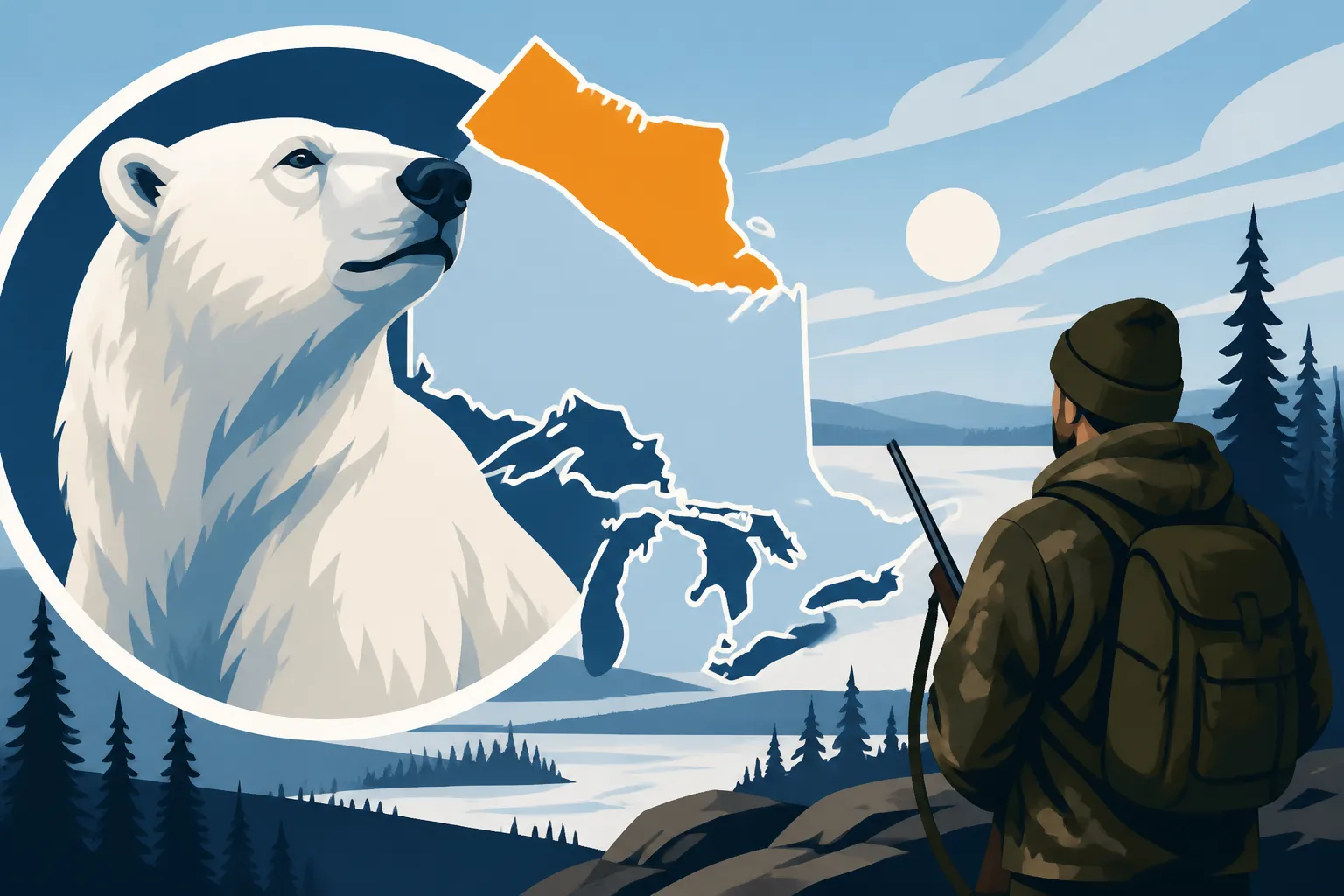
Ontario's polar bear range is exclusively found along its far northern coastline, specifically the Hudson Bay and James Bay lowlands. This immense, flat, wetland-rich landscape transitions into the subarctic tundra and ultimately, the Arctic. Here, the climate is defined by long, brutally cold winters and short, cool summers. The critical factor for polar bears isn't just the cold, but the sea ice. These incredible predators are intrinsically linked to the frozen ocean, using it as a platform for hunting their primary prey: seals. Without that solid ice, their hunting grounds shrink dramatically, impacting their ability to feed and thrive.
If you're looking at a map, you'll see WMUs far north, stretching towards the provincial boundary. These areas, particularly those bordering the bay, are where the small, isolated population of Ontario's polar bears lives. It’s a very different landscape than the mixed forests or farmlands many of us are familiar with when Whitetail Hunting in Ontario or even Moose Hunting Ontario's Northern Bush.
Habitat and Food Sources
Polar bears are marine mammals, first and foremost. Their habitat isn't dense forest or rocky shield country; it's the sea ice. They spend most of their lives on this ice, waiting for seals to surface at breathing holes or haul out onto the ice. When the ice melts in the summer, they are forced ashore, often spending months on land, relying on fat reserves built up during the abundant winter hunting season. On land, they might forage for berries, bird eggs, or even carrion, but these terrestrial foods are poor substitutes for high-fat seals.
The Hudson Bay Lowlands, with their vast wetlands, peat bogs, and coastal marshes, offer some terrestrial refuge, but it’s not ideal hunting grounds. This makes their time on land a challenging period, and it's why healthy sea ice is so vital for their survival. While you might use a tool like GoHunt to scout for game sign in more accessible areas, understanding the unique, ice-dependent habitat of polar bears requires a different perspective entirely.
Historical Presence and Seasonal Movements
Polar bears have been a part of Ontario's natural heritage for millennia, adapted to the extreme conditions of the Hudson Bay coast. Their movements are largely dictated by the annual freeze and thaw cycle of the bay. In late fall and early winter, as the bay freezes, bears eagerly head out onto the ice to hunt. They remain there through winter and into spring. As summer approaches and the ice breaks up, they move back onto land, congregating in certain coastal areas until the ice returns in the fall.
This seasonal migration means that while they are always "up North," their exact location can shift. Hunters or researchers operating in this extreme northern region during the open water season should be particularly aware of coastal areas where bears might be waiting for the ice. Conversely, during the deep winter, most bears will be out on the ice, potentially far from shore. These patterns are crucial for anyone planning to work or recreate in these remote territories.
Sharing the Landscape: Safety and Awareness
The chance of an average hunter encountering a polar bear in Ontario is incredibly low, given how remote their range is. However, for those few who do venture into these far northern reaches, perhaps on an expedition or a very specialized hunt, proper awareness and safety protocols are non-negotiable.
Safety Precautions and Bear Awareness
Just like with black bears, prevention is key. But polar bears are a different league; they are the largest land predators in the world, and they view humans as potential prey. This isn't like encountering a curious black bear in Ontario's mixed forest. Their sheer size, strength, and predatory nature demand respect and vigilance.
Here are some crucial safety considerations:
- Never travel alone: Always be in a group, and ensure at least one person is designated as a bear watch.
- Carry deterrents: Banger pens, bear spray (ensure it's rated for extreme cold and you know how to use it), and a firearm are essential. A shotgun with slugs or a powerful rifle is often recommended as a last resort.
- Secure food and attractants: Polar bears have an incredible sense of smell. All food, garbage, and scented items must be stored in bear-proof containers or suspended out of reach, far from camp.
- Be aware of your surroundings: Constantly scan for bears, especially along coastlines, near ice edges, or in areas with natural cover. Using binoculars to scan the horizon frequently is a good practice.
- Avoid prime bear habitat: While you can't always avoid it, try to set up camps away from known travel corridors, denning sites, or areas with abundant carrion. Before you head out, tools like GoHunt can help you understand the general topography and potential sensitive areas in your chosen WMU.
Remember, the goal is to avoid an encounter entirely. This means being proactive, not reactive.
Encountering Polar Bears: What to Do
Unlike black bears or even grizzlies in other regions, you should never try to scare off a polar bear. They are not easily intimidated. If you encounter a polar bear:
- Do not run: This can trigger a chase response.
- Stay calm and group up: Make yourself look as large and intimidating as possible. Keep children and pets close.
- Back away slowly: If the bear has not noticed you, or is moving away, continue to back away slowly, giving it plenty of space.
- Use deterrents: If the bear approaches, attempt to deter it with banger pens or bear spray. Aim for the face. These are meant to discourage, not necessarily stop, a charge.
- Prepare to use a firearm: If a bear charges aggressively and deterrents fail, you may have no choice but to use a firearm in self-defence. This is a life-or-death situation, and knowing how to use your chosen firearm under immense stress is critical.
This is a scenario most hunters will thankfully never face, but being prepared means understanding the stark reality of these powerful animals. It’s also important to remember that deliberately seeking out or harassing polar bears is illegal and extremely dangerous.
Legal Considerations for Self-Defence
In Ontario, as in most places, the use of lethal force against a wild animal, even a dangerous one, is typically restricted to situations of immediate threat to human life. If you are in a situation where a polar bear is attacking you or another person, and all other deterrents have failed, you may use a firearm for self-defence.
However, any such incident must be reported immediately to provincial authorities. There will be an investigation to determine if the use of force was justified. Hunters venturing into these remote areas must be fully aware of Wildlife Safety in Ontario Bear Country guidelines and the legal framework surrounding self-defence. It's a serious matter with serious consequences if not handled correctly.
The Conservation Picture: Protecting Ontario's Northern Giants
Ontario's polar bear population is part of the larger Southern Hudson Bay subpopulation, and like all polar bear populations globally, they face significant challenges, primarily due to climate change. Understanding their conservation status helps paint a complete picture of these magnificent, yet vulnerable, creatures.
Monitoring and Research
Ontario, in collaboration with other jurisdictions bordering Hudson Bay and with Indigenous communities, actively participates in monitoring and researching polar bear populations. This involves aerial surveys, tracking individual bears, and studying their health, movements, and reproductive success. The goal is to gather data that informs conservation strategies and helps understand how environmental changes are impacting the bears.
These efforts are vital because polar bears are considered a species of special concern in Ontario and a vulnerable species globally. The data collected helps the province make informed decisions regarding their protection and management. Scientists often use advanced mapping and tracking technology, much like how a dedicated hunter might utilize GoHunt to analyze game movements, but on a much larger, more complex scale for these wide-ranging animals.
Climate Change and Habitat Challenges
The most pressing threat to polar bears is the loss of sea ice habitat due to climate change. As global temperatures rise, the sea ice on Hudson Bay forms later in the fall and breaks up earlier in the spring. This means bears have less time on the ice to hunt seals and build up their crucial fat reserves. Shorter ice seasons lead to longer periods on land, where food sources are scarce and less nutritious.
The consequences are dire: thinner, less healthy bears, lower reproductive rates, and increased cub mortality. This direct link between climate change and polar bear survival is a major focus for conservationists. It's a stark example of how What Climate Shift Means for Ontario Game extends to even our most iconic northern species.
The Role of Indigenous Communities
Indigenous communities, particularly those living along the Hudson Bay and James Bay coasts, have an intimate and ancestral relationship with polar bears. Their traditional knowledge and observations are invaluable to conservation efforts. These communities have lived alongside polar bears for generations, understanding their behaviour, movements, and the health of the ecosystem.
Their involvement in research, monitoring, and management is critical. They are often the first to notice changes in bear health or behaviour and play a vital role in local safety and educational initiatives. Any approach to polar bear conservation in Ontario must respect and integrate the perspectives and wisdom of these local communities.
Separating Fact from Fiction: Polar Bear Myths
The mystique of the polar bear often leads to misconceptions, especially for those of us living far from their remote northern habitat. It's important to clarify what's true and what's not about these iconic animals in Ontario.
Misconceptions About Southern Sightings
One of the most common myths is the idea that polar bears might wander far south into "regular" hunting country, or that sightings are becoming more common in areas like Cochrane or Hearst. Let's be clear: genuine polar bear sightings are extremely rare south of their traditional coastal range. While there have been a handful of highly unusual, isolated incidents over the decades where a lone, disoriented bear might travel further inland, these are incredibly uncommon and newsworthy precisely because they are so out of place.
Any report of a "polar bear" far south often turns out to be a very light-coloured black bear or an albino black bear. These animals can be strikingly pale, leading to mistaken identity. The idea of routinely encountering a polar bear while Hunting Deer in Southern Ontario Farmland is simply not rooted in reality.
Here's a quick comparison to help differentiate:
| Feature | Polar Bear | Black Bear |
|---|---|---|
| Size | Much larger, up to 1,500 lbs and 10 ft tall | Smaller, up to 600 lbs and 6 ft tall |
| Colour | White to yellowish-white | Typically black, but can be brown, cinnamon, or even very light blonde/white |
| Body Shape | Longer neck, smaller head, powerful shoulders, no shoulder hump | Shorter neck, larger head relative to body, distinct shoulder hump often visible |
| Ears | Small, rounded, close to head | Larger, more prominent, pointed |
| Snout | Long, narrow | Shorter, wider |
| Paws | Massive, large footpads for walking on ice | Smaller, adapted for climbing |
| Habitat | Sea ice, coastal tundra, extreme north | Forests, woodlands, swamps, across most of Ontario |
| Primary Diet | Seals (high fat marine prey) | Omnivorous (berries, nuts, insects, carrion) |
Differentiating from Black Bears
As mentioned, the biggest source of "polar bear sightings" in the south is often misidentification of a light-coloured black bear. Black bears, despite their name, come in a wide range of colours, from jet black to various shades of brown, cinnamon, and even a very rare blonde or white phase. A blonde black bear can easily fool someone not familiar with the nuances of bear identification, especially at a distance or in poor light.
If you are seeing a "white bear" in any area other than the Hudson or James Bay coast, it is almost certainly a black bear with unusual colouring. They inhabit almost all of Ontario's forested regions, from the deep south to the far north. A hunter who is familiar with Black Bear Hunting in Ontario will understand the variations in black bear appearance. The true polar bear's body structure, its massive size, and its uniquely adapted features for marine life set it apart entirely.
The Rarity of Encounters for Most Ontarians
For the vast majority of Ontarians, including most hunters, the chances of encountering a polar bear are virtually zero. Their habitat is incredibly remote, requiring specialized travel, often by air or sea, and a significant commitment to get there. It's not a place you just drive into for a weekend hunt.
The "polar bear range" represents a tiny, ecologically unique sliver of our enormous province. While the thought of sharing the land with such a magnificent predator is certainly exciting and humbling, it's not a realistic concern for hunters pursuing deer, moose, or small game in more accessible parts of Ontario. Understanding what polar bear range means up north is ultimately about respecting the incredible biodiversity of our province and appreciating the remote wildness that still exists far beyond our daily lives.
Disclaimer
This article is for general informational purposes only and does not constitute professional advice. Laws, prices and regulations vary by location and change over time. Consult a qualified professional for guidance on your specific situation.