The Grouse Species You Will Find Here
For many hunters, the crisp autumn air in Ontario means one thing: grouse. But stepping into the diverse landscapes of this province, from dense boreal forests to sprawling farmlands, can leave you wondering what feathered rockets might burst from the underbrush. This guide will take a deep dive into the various grouse species you can find here, helping you understand their habitats, behaviours, and how to successfully pursue them.
Unpacking Ontario's Grouse Diversity
Ontario is a vast province, and with that vastness comes an incredible array of ecosystems, each supporting different wildlife. When it comes to upland birds, grouse hold a special place in the hearts of many hunters, offering fast-paced action and delicious table fare. However, not all "grouse" are created equal, and knowing the differences between species can significantly improve your hunting success and appreciation for these remarkable birds. It's not just about flushing a bird; it's about understanding the specific world each species inhabits.
Understanding the General Grouse Family
Before we delve into specific species, it’s helpful to understand what unites these birds. Grouse are typically ground-dwelling birds known for their stout bodies, feathered legs (which are fantastic for insulation in cold climates), and often camouflaged plumage. They are primarily herbivores, feasting on buds, leaves, berries, and seeds, though they'll snatch up insects, especially when young. Their flight is explosive and powerful, making them a challenging target. They spend most of their lives concealed within various types of cover, from dense conifer stands to mixed hardwood forests, making them truly creatures of the bush. Identifying their preferred habitat is often the first step in finding them.
Why Knowing Your Grouse Matters
Beyond the sheer joy of identification, understanding which grouse species inhabits certain areas is crucial for effective hunting. Each species has distinct habitat preferences, feeding habits, and even flight patterns. What works for a Ruffed Grouse in a poplar stand won't necessarily apply to a Spruce Grouse hunkered down in a black spruce bog. Knowing these nuances helps you focus your scouting efforts, choose the right terrain to walk, and even adapt your calling or dog handling techniques. It also aids in proper game management, as certain species might have different population dynamics or conservation statuses. For instance, knowing that Sharp-tailed Grouse need specific open habitats helps highlight areas where you might find them, rather than wasting time in dense woods where they'd never venture.
The Ruffed Grouse: King of the Ontario Bush
Ah, the Ruffed Grouse. For many, this is the grouse of Ontario, and for good reason. It's widely distributed across much of the province's forested areas, from the deep north down into the mixed forests of the south. This bird, often affectionately called a "partridge" by old-timers, is renowned for its explosive flush and challenging flight through thick cover. They are a true icon of autumn in Ontario.
Identifying the Ruffed Grouse
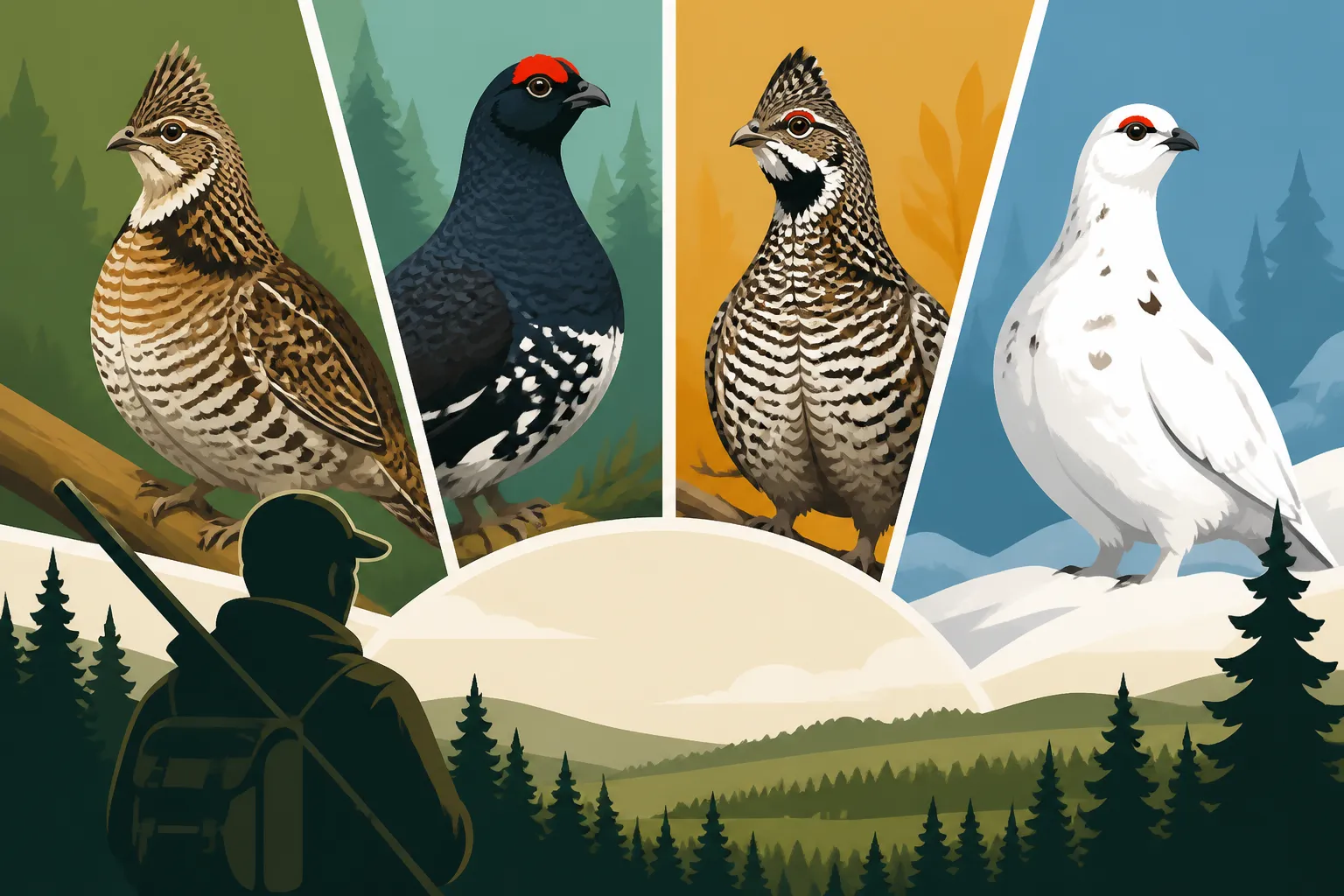
The Ruffed Grouse (Bonasa umbellus) is a medium-sized bird, typically weighing between 1.5 to 2 pounds. Their plumage is a beautiful mosaic of browns, greys, and blacks, providing excellent camouflage against the forest floor. The most distinctive features are the ruff of dark feathers on either side of its neck (which it can erect during display) and its fan-shaped tail, usually banded with a broad dark sub-terminal band. You'll notice two main colour phases in Ontario: a grey phase more common in the northern parts of the province, and a reddish-brown phase prevalent in the south. Don't be fooled by the colour; they're the same species. Telling a Ruffed Grouse From a Spruce Grouse is usually quite easy once you get a closer look, mainly because of the tail fan and overall body shape. Their rich brown eyes are also quite striking up close.
Preferred Habitats and Behaviour
Ruffed Grouse are generalists when it comes to forest types, but they absolutely thrive in young, regenerating forests. Think dense stands of aspen, birch, poplar, and mixed hardwoods with a healthy understory of dogwood, hazel, and young conifers. These areas provide both cover from predators and abundant food sources like catkins, buds, and berries. They particularly love areas where different forest types meet, such as the edge of a mature hardwood stand bordering a young poplar regeneration or a cedar swamp. You'll often find them along logging roads, old clear-cuts, and the edges of beaver ponds.
Their behaviour is what makes them so thrilling to hunt. They prefer to walk or run rather than fly when disturbed, often holding tight until you're practically on top of them. Then, with a sudden, thunderous burst of wings, they explode skyward, weaving through trees at incredible speed. This "flush" often catches hunters off guard, providing only a split second for a shot. In the spring, males are famous for their drumming display, where they beat their wings rapidly against the air to attract mates, creating a deep, resonant thumping sound that echoes through the quiet woods. This drumming happens on a specific log or rock, which can be a hot spot to check come fall.
Hunting Techniques for Ruffs
Hunting Ruffed Grouse is often a physically demanding but incredibly rewarding experience. Most hunters employ a walk-and-flush method, slowly covering ground in prime habitat. Ruffed Grouse Hunting Ontario's Bush Roads is a classic approach, as these birds frequently feed and dust along gravel paths and ATV trails, especially in the mornings and evenings. When you're walking these trails, keep your eyes peeled for fresh droppings, dust baths, and peck marks on the ground or low-hanging branches.
Another highly effective method, if you have access to a good bird dog, is Using a Pointing Dog in Ontario Cover. A well-trained pointer will lock up on a bird, indicating its location, allowing you to walk in for the flush. For those with flushing breeds, Using a Flushing Dog in Thick Bush can be just as effective, pushing birds into the air where you might get a shot. Regardless of whether you use a dog, moving slowly, pausing frequently, and staying alert are key. Many hunters find that Ruffed Grouse are most active early in the morning and late in the afternoon, often feeding on berries, seeds, and buds. In terms of seasons, Ontario Ruffed Grouse Season Dates typically run through the fall, often opening in September and extending well into December in some WMUs. Always check the specific regulations for your Wildlife Management Unit (WMU) before heading out.
The Spruce Grouse: The Fool Hen of the North
Venture further north into Ontario's expansive boreal forest, and you'll likely encounter the Spruce Grouse. This bird holds a special place in the hearts of those who hunt the deep bush, primarily due to its unique habitat and its famously docile nature, which has earned it the nickname "fool hen."
Spotting the Spruce Grouse
The Spruce Grouse (Falcipennis canadensis) is slightly smaller than the Ruffed Grouse, typically weighing around 1 to 1.5 pounds. Its plumage is a masterpiece of camouflage for its coniferous home: males are strikingly marked with a black breast, white barring on their sides, and a distinct red comb above their eyes, while females are more mottled brown and black, blending seamlessly with pine needles and shadows. Their tail is black with a rusty-brown band at the tip, though not as fanned as a Ruffed Grouse's. One key visual difference from the Ruffed Grouse is the lack of a prominent neck ruff and the generally darker, more conifer-suited colouring.
Habitat and Their "Foolish" Nature
As their name suggests, Spruce Grouse are strongly associated with coniferous forests, particularly dense stands of black spruce, white spruce, balsam fir, and jack pine. They thrive in boggy areas, muskegs, and areas with thick undergrowth, where they feed primarily on conifer needles, especially spruce and pine. You'll rarely find them in open hardwood stands; they are creatures of the deep, dark woods. This preference for thick, often remote coniferous habitat is a big part of why they're less pressured than Ruffed Grouse.
Their "foolish" or docile nature is legendary. Unlike the explosive flush of a Ruffed Grouse, a Spruce Grouse will often sit tight, sometimes even allowing a hunter to approach within a few feet before finally taking to the air. They might even just hop onto a low branch, seemingly unfazed by human presence. This behaviour is likely an adaptation to living in areas with fewer ground predators, but it certainly makes for an interesting hunting experience. Hunters often joke that you could "kick them to make them fly." While not quite true, their reluctance to flush makes them a very different bird to pursue. This characteristic also makes them particularly vulnerable to overhunting in accessible areas, hence the need for responsible harvesting.
Ethical Considerations and Hunting Zones
Given their docile nature, Hunting Spruce Grouse in Black Spruce comes with a unique set of ethical considerations. It's easy to harvest multiple birds if you're not careful, which can impact local populations, especially since they have smaller home ranges and are less prone to wide dispersal. Responsible hunters often limit their take to ensure sustainable populations. Many hunters see it as a bonus bird while moose or bear hunting in the far north.
Where Spruce Grouse has no season, as is the case in some specific areas or during certain times to protect breeding populations, it's absolutely crucial to respect those regulations. Always consult the Ontario Hunting Regulations Summary for the most current information regarding season dates and limits for the specific WMU you plan to hunt. Using a detailed map, perhaps one from a service like GoHunt, can help you identify prime coniferous zones within a legal hunting area. They are found predominantly in the vast expanse of Northern Ontario, from Northwestern Ontario's Big Bush to Northeastern Ontario's Clay Belt.
The Sharp-Tailed Grouse: Ontario's Prairie Relic
While Ruffed and Spruce Grouse dominate the conversation, Ontario is also home to a more specialized, and increasingly rare, species: the Sharp-tailed Grouse. Finding one of these birds is a true testament to dedicated scouting and an understanding of very specific habitat requirements. They are a magnificent bird, but definitely not a common sight for most Ontario hunters.
Distinctive Features and Location
The Sharp-tailed Grouse (Tympanuchus phasianellus) is a strikingly beautiful bird, larger than both the Ruffed and Spruce Grouse, typically weighing 1.5 to 2.5 pounds. Its plumage is a finely barred pattern of light brown, white, and black, perfectly blending with dry grasses and sparse shrubs. The most obvious distinguishing feature is its short, pointed tail, from which it gets its name. Unlike the Ruffed Grouse's fan or the Spruce Grouse's dark tail, the Sharp-tail's tail feathers are stiff and graduated, with the central feathers extending beyond the others. Males also have purplish air sacs on their neck that inflate during their elaborate courtship display, where they dance and stomp on traditional "lek" grounds.
These birds are primarily associated with prairie and savanna habitats. In Ontario, this means they are largely confined to specific, fragmented areas, mostly in the far north-western regions of the province, particularly around Thunder Bay and Kenora. They need open grasslands, old farm fields that have gone to seed, or large clear-cuts that are slowly reverting to forest, always with scattered aspen groves or brushy cover nearby.
Open Country vs. Forest Edge
Unlike their forest-dwelling cousins, Sharp-tailed Grouse are birds of open country and the forest edge. They won't be found in dense timber. They prefer areas with a mosaic of tall grass, low shrubs, and scattered stands of aspen or willow. These areas provide cover from aerial predators, dusting sites, and crucial food sources like berries, seeds, and insects. They are particularly fond of blueberry and cranberry patches in these open areas. You might find them along the fringes of agricultural fields, abandoned pastures, or large, regenerating clear-cuts, particularly those that have a significant component of grass and shrub growth rather than immediate dense forest regrowth.
Hunting Sharp-Tailed Grouse Country requires a different mindset and approach than hunting Ruffed or Spruce Grouse. Instead of walking dense bush roads, you'll be covering more open ground, often in larger sweeps. This is where a good pair of binoculars can come in handy, scanning distant fields and brushy edges for movement. They might hold tighter than a pheasant, but when they flush, they often fly considerable distances.
Challenges and Opportunities for Hunters
Hunting Sharp-tailed Grouse in Ontario presents both significant challenges and unique opportunities. The primary challenge is their limited distribution and habitat. Their populations are less robust than Ruffed Grouse, and their specific habitat needs make them vulnerable to habitat loss and changes in land use. This means finding them often requires dedicated scouting and travel to specific regions. Furthermore, when they do flush, they often fly fast and far, sometimes out of range, making for challenging shots.
However, the opportunity to hunt Sharp-tails is a special one. It allows hunters to explore unique landscapes and experience a different kind of upland bird hunting. A well-trained pointing dog can be incredibly valuable for locating these birds in their expansive habitats. For hunters already in the far north for other species like moose or bear, adding a Sharp-tail hunt can be a fantastic bonus if local regulations and habitat allow. As with all species, checking Ontario Game Bird Seasons and Limits for specific regulations in your chosen WMU is non-negotiable before pursuing these beautiful birds. Given their sensitivity, conservation efforts are paramount, and hunters play a vital role in reporting observations and adhering to limits.
A Comparative Look at Ontario's Grouse
To help visualize the differences between these three fascinating grouse species, here's a quick comparison table summarizing their key characteristics. This can be a handy reference when you're out in the field, trying to identify that bird that just flushed or trying to determine the best habitat to scout with your GoHunt mapping application.
| Feature | Ruffed Grouse (Bonasa umbellus) | Spruce Grouse (Falcipennis canadensis) | Sharp-tailed Grouse (Tympanuchus phasianellus) |
|---|---|---|---|
| Size | Medium (1.5-2 lbs) | Small to Medium (1-1.5 lbs) | Medium to Large (1.5-2.5 lbs) |
| Key ID Features | Fan-shaped tail with dark band, neck ruff, two colour phases. | Darker plumage, red comb (males), black tail with rusty band, no ruff. | Pointed tail, barred plumage, purplish neck sacs (males). |
| Primary Habitat | Young, regenerating mixed and hardwood forests, forest edges, old clear-cuts. | Dense coniferous forests (spruce, fir, pine), bogs, muskegs. | Open grasslands, prairies, large regenerating clear-cuts with scattered trees/shrubs. |
| Flush Style | Explosive, thunderous, fast, close-quarters. | Docile, often sits tight, may hop onto branch, slow to flush. | Fast, often flies long distances across open ground. |
| Diet | Buds, catkins, berries, leaves, seeds, insects. | Conifer needles (especially spruce/pine), buds, berries. | Berries, seeds, insects, leaves, grains. |
| Distribution | Widespread across forested Ontario. | Northern Ontario's Boreal Forest. | Limited, specific open areas in Northwestern Ontario. |
| Common Nickname | Partridge | Fool Hen | Sharptail |
General Hunting Strategies for Ontario Grouse
Regardless of the specific species you're after, a few overarching strategies can significantly improve your odds of success on an Ontario grouse hunt. The key is adapting your approach to the habitat and the bird's typical behaviour, and always prioritizing safety and ethical hunting practices. Remember that Small Game Hunting in Ontario offers a diverse range of opportunities, and grouse are often at the top of many hunters' lists.
Walking the Bush Roads and Trails
This is arguably the most common and often effective method for Ruffed Grouse, and sometimes even for Spruce Grouse in appropriate habitat. As discussed, these birds, especially Ruffs, frequently feed and gather grit along gravel roads, old logging tracks, and ATV trails. Walking these linear features allows you to cover ground efficiently while staying alert for birds. The trick is to walk slowly, stopping frequently to listen and scan the edges. Birds often hold tight when you're moving, but they might flush if you pause, thinking you've passed. Keep your gun ready, and don't be afraid to veer into the dense cover on either side if you spot promising signs or hear a distant flush. For optimal results, focusing your efforts on mornings and evenings when birds are most active can significantly increase your encounters. Many hunters have found success exploring the vast network of roads you can find by checking Reading an Ontario WMU Map Before You Go.
Utilizing Hunting Dogs
For many, upland bird hunting truly comes alive with a good dog. Both pointing and flushing breeds have their advantages for grouse. A pointing dog, like a German Shorthaired Pointer or English Setter, can be invaluable for pinpointing birds that would otherwise sit tight and be missed. The dog's ability to lock up on a scent allows you to approach the area, prepare for the flush, and often get a cleaner shot. Flushing dogs, such as Springer Spaniels or Labs, excel at pushing birds out of dense cover, making them fly into the open.
However, hunting with dogs in Ontario's thick bush comes with its own considerations. Your dog needs to be well-trained to stay close, especially in areas with potential dangers like porcupines or other predators. A GPS collar, like those from Garmin, can be a lifesaver in dense cover, helping you keep track of your canine companion. Always be mindful of the dog's safety and well-being, especially when hunting in rugged or remote areas.
Seasonal Considerations and Prime Times
While Ontario Ruffed Grouse Season Dates often run from early fall into winter, the "best" time to hunt can depend on your objectives and the weather. Early season (September-October) often finds birds in thicker, leafier cover, making them harder to spot but perhaps more abundant. Once the leaves fall in late October and November, visibility improves dramatically, making it easier to spot birds and follow their flight paths. Cooler weather also means less insect pressure and more comfortable walking for both hunter and dog. In late season, particularly with snow on the ground, birds might concentrate near persistent food sources or dense thermal cover, such as cedar swamps. This is when you can sometimes read tracks in the fresh snow, indicating activity.
Early mornings and late afternoons are generally the most productive times, as birds are often feeding. However, don't rule out midday hunts, especially on overcast days or in areas with consistent cover. Midday can sometimes be surprisingly productive, particularly if you're hitting spots other hunters might overlook. Always be prepared for variable Ontario weather, as a crisp, sunny morning can quickly turn into a chilly, wet afternoon.
Conservation and the Future of Grouse Hunting in Ontario
Grouse hunting is a cherished tradition in Ontario, deeply tied to the province's natural heritage. Ensuring the sustainability of these populations is paramount for future generations of hunters and for the health of the ecosystems they inhabit. Understanding the factors influencing grouse numbers and how we, as hunters, can contribute to their conservation is a crucial part of responsible outdoor recreation.
Population Dynamics and Management
Grouse populations, particularly Ruffed Grouse, are known for their cyclical nature. Why Ruffed Grouse Numbers Cycle is a complex topic, but it's largely attributed to a roughly 8-10 year cycle influenced by predator-prey dynamics (like the snowshoe hare cycle, which impacts predator populations) and habitat conditions. During peak years, birds can seem to be everywhere, while in the low years, they might feel almost absent. These natural fluctuations are a normal part of their biology, and wildlife managers monitor these trends closely to inform hunting regulations.
Management efforts often focus on habitat. Ruffed Grouse, as mentioned, thrive in early successional forests – young, regenerating areas that provide dense cover and abundant food. Timber harvesting practices that create these types of habitats, often through clear-cutting in smaller blocks, can actually benefit Ruffed Grouse. For Spruce Grouse, maintaining large, undisturbed tracts of coniferous forest is key. Sharp-tailed Grouse, on the other hand, require the preservation and restoration of open grasslands and savanna habitats, which are increasingly rare in many parts of Ontario. GoHunt mapping tools can be invaluable for identifying areas that feature these critical habitat types within your desired WMU.
The Hunter's Role in Conservation
Hunters are often the most dedicated conservationists, and for good reason – we have a vested interest in healthy wildlife populations. Our licence fees directly fund wildlife management and habitat programs. Beyond that, ethical hunting practices are fundamental. This includes adhering to bag limits and season dates, reporting harvests (which helps biologists track populations), and being selective in our take. For species like the Spruce Grouse, whose docility can make them easy targets, exercising restraint is a sign of respect for the resource.
Supporting organizations that advocate for wildlife habitat and responsible land use is another way to contribute. Participating in habitat improvement projects, such as planting beneficial shrubs or helping manage forestland, can have a direct positive impact on grouse. By being observant in the field and reporting any unusual sightings or concerns to the Ministry of Natural Resources and Forestry (MNRF), hunters act as important stewards of Ontario's wildlife resources.
Disclaimer
Please be aware that hunting regulations, seasons, and licensing requirements are subject to change. Always consult the most current Ontario Hunting Regulations Summary published by the Ontario Ministry of Natural Resources and Forestry (MNRF) before planning and undertaking any hunting activity. This guide is for informational purposes only and does not supersede official government regulations. It is the hunter's responsibility to know and follow all applicable laws.