Telling a Ruffed Grouse From a Spruce Grouse
It’s a scenario every Ontario upland hunter has faced: you hear a flush, catch a blur of feathers through the alders, and then a moment later, you're left wondering, "Was that a ruffed grouse or a spruce grouse?" Distinguishing between these two fantastic game birds in the dense cover of Ontario's bush can be surprisingly tricky, even for seasoned hunters. This guide is here to break down the subtle yet crucial differences, helping you confidently identify your target in the field, ensuring you're always within the bounds of both regulation and ethical practice.
The Frustrating Similarities and Key Differences
You're out there, boots on the ground, listening to the crunch of leaves underfoot, and suddenly a bird explodes from cover. In that split second, your brain is trying to process a dozen things at once. It’s easy to get them mixed up because, at a glance, they’re both stout, feathered bundles of camouflage. But once you know what to look for, their distinctions become much clearer, allowing you to make a more informed decision before you even think about shouldering your shotgun.
Physical Appearance: Plumage, Size, and Crests
Let's start with what you can see, or at least, what you might see if you get a good look. Both ruffed grouse and spruce grouse are masters of blending into their surroundings, but their specific camouflages are designed for different backdrops.
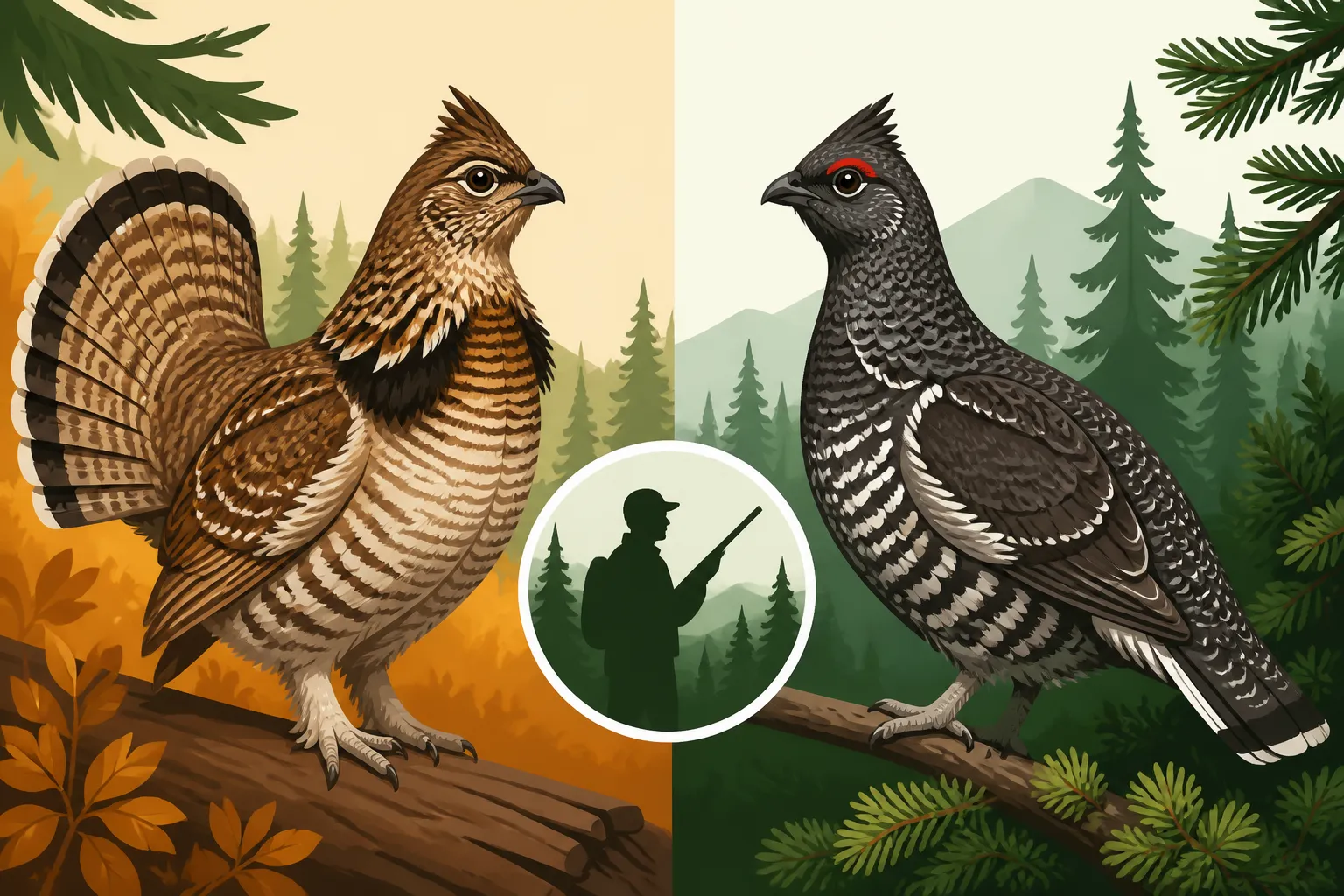
Ruffed grouse, often affectionately called "patridge" by many old-timers, are known for their incredibly varied plumage. They come in two main colour phases: the grey phase and the red (or rufous) phase. Grey phase birds tend to dominate in the northern and western parts of the province, blending seamlessly with the grey bark of poplars and birches. Red phase birds are more common in the south and east, matching the rich reds and browns of oak and maple leaves. Regardless of phase, they all share that distinctive fan-shaped tail with a broad, dark band near the tip, often called the "subterminal band." This tail is a dead giveaway. Look for the ruffs on their necks – these are dark, almost velvety feathers that they can puff out during display. They also have a slight crest on their heads, though it's not always prominent. Size-wise, they are generally larger than spruce grouse, often weighing a bit more and appearing more robust.
Spruce grouse, on the other hand, are built for life among the conifers. Their plumage is a mosaic of black, white, and grey, mimicking the dappled light and shadow of spruce and fir forests. The males are particularly striking with a bold black chest, white barring on their flanks, and often a patch of red skin above each eye during breeding season. Females are more mottled, a complex pattern of brown, black, and white that offers incredible concealment among the needles and branches. They lack the prominent neck ruffs and the distinct dark tail band of the ruffed grouse. Their tail feathers are generally dark with a few faint light bars. Spruce grouse are also noticeably smaller and more compact than ruffed grouse, appearing somewhat more delicate. Think of them as the smaller, darker, more secretive cousins.
Habitat Preferences: Where You'll Find Them
One of the most reliable ways to differentiate these two species, even before you see them, is by understanding where they like to hang out. Their names themselves give a big clue, but it’s more nuanced than just "woods."
Ruffed grouse are incredibly adaptable and thrive in a variety of mixed woodland habitats. You’ll find them in young, successional forests, especially those with a good mix of hardwoods and conifers, often near old logging cuts or overgrown farm fields. They love aspen and birch thickets, alder bottoms, and the edges of mature hardwood stands. They need a mosaic of cover – dense patches for hiding, open areas for dusting, and drumming logs for display. If you're walking an old bush road bordered by poplar and maple, with some cedar swamps mixed in, you're in prime ruffed grouse country. They are often found where food sources like berries, buds, and catkins are abundant. Consider where you might find Ruffed Grouse Hunting Ontario's Bush Roads, and you're likely in the right spot.
Spruce grouse, conversely, are much more specialized. Their preferred habitat is almost exclusively dense, mature coniferous forests. Think black spruce bogs, balsam fir thickets, and jack pine stands. They are creatures of the deep woods, often found far from open fields or even mixed forests. Their diet relies heavily on conifer needles, particularly spruce, which is reflected in their common name. If you're hunting in the vast northern reaches of Ontario, pushing through stands of dark spruce, especially near muskeg or rocky outcrops, you're far more likely to encounter a spruce grouse. They prefer areas with a dense understory of mosses and lichens, where they can forage quietly. Hunting Spruce Grouse in Black Spruce perfectly encapsulates their preferred domain. If you're in a mixed hardwood bush, the chances of encountering a spruce grouse are significantly lower.
Behavioural Clues for Field Identification
Beyond what they look like and where they live, how these birds act can tell you a lot. Their behaviours, particularly when disturbed, are starkly different and can be the deciding factor when visual cues are fleeting.
Flight Patterns and Temperament
The way a grouse reacts to your presence is often the most immediate identifier. This is where the term "fool hen" for the spruce grouse comes from.
Ruffed grouse are notorious for their explosive flush. One minute, the woods are quiet, the next, it sounds like a cannon going off right at your feet as a ruffed grouse bursts into flight. They typically fly with powerful, rapid wingbeats, often weaving through trees with remarkable agility before either landing in another thicket or, sometimes, sailing further away. This sudden, startling flush is a characteristic defense mechanism that often causes a hunter's heart to leap into their throat. They are wary birds, and their immediate reaction to perceived danger is to escape quickly. You'll often hear them before you see them, and then they're gone in a flash, leaving you with that adrenaline rush.
Spruce grouse, on the other hand, are considerably more docile. They are much less prone to flushing with the same explosive force as their ruffed cousins. When disturbed, a spruce grouse might simply walk a few steps further into the dense cover, or if it does fly, it will often make a short, weak flight, perhaps just to a nearby branch. They are known for their incredible tameness, often allowing hunters to approach quite closely before finally deciding to move. This lack of fear is why they are often called "fool hens" or "spruce chickens." If a grouse flushes quietly and lands on a low branch to observe you, chances are you've found a spruce grouse. They rely more on their camouflage to avoid detection rather than a sudden escape.
Vocalizations and Sounds
While visual and behavioural cues are primary, the sounds these birds make can also provide hints, especially the distinctive drumming of the ruffed grouse.
Ruffed grouse are famous for their drumming display, particularly in spring, but it can be heard at other times too. This sound, created by the male rapidly beating his wings against the air, starts slowly and then accelerates into a rapid thumping, resembling a distant, old one-cylinder engine starting up. It's a deep, resonant sound that carries well through the forest and is unmistakable once you've heard it. Aside from drumming, they might give a soft "cuck-cuck-cuck" when disturbed on the ground, but it's their drumming that truly sets them apart.
Spruce grouse are much quieter birds. They don't drum. Their vocalizations are far less dramatic, typically consisting of soft hoots, clucks, or hisses, often associated with breeding or alarm calls. These sounds are not nearly as loud or far-reaching as a ruffed grouse's drum, and you're less likely to hear them unless you're very close to the bird. When a spruce grouse is disturbed, you might hear a low "cluck" or a soft whistle, but nothing like the thundering explosion or the rhythmic drumming of a ruffed grouse.
Here's a quick comparison table to help you keep things straight:
| Feature | Ruffed Grouse | Spruce Grouse |
|---|---|---|
| Primary Habitat | Mixed deciduous/coniferous, young forest, edges | Dense coniferous forests (spruce, fir, jack pine) |
| Plumage | Grey or red phase, distinct dark neck ruffs, fan-shaped tail with broad dark band | Black, white, grey (males bold), mottled (females), no ruffs, dark tail with faint bars |
| Size | Larger, more robust | Smaller, more compact |
| Flight/Temperament | Explosive flush, wary, rapid flight through trees | Quiet flush or walks away, tame ("fool hen"), short, weak flights |
| Vocalizations | Loud drumming (males), soft "cuck-cuck" calls | Soft hoots, clucks, hisses, generally quiet |
| Tail | Prominent fan with subterminal dark band | Dark, less prominent, faint barring or uniform |
| Diet Focus | Buds, berries, catkins, leaves | Conifer needles, especially spruce |
Practical Tips for Confirmation in the Field
Even with all this knowledge, field conditions can make identification tough. Low light, dense cover, and fleeting glimpses are all part of the upland hunting experience. But there are ways to improve your chances of a positive ID.
Observing Distinctions Up Close
The best way to confirm your target is to get a good look, safely and ethically. This isn't always possible when a bird flushes, but sometimes a bird will offer a second chance. If a grouse flushes and lands within sight, use your binoculars or the zoom on your scope (if safe to do so) to quickly examine its features. Look specifically for the ruffs on the neck, the broad dark band on the tail, or the distinct black and white barring on a male spruce grouse's chest. Pay attention to its behaviour after landing: does it remain still and camouflaged, or is it nervously moving deeper into cover?
Consider the overall shape and how it relates to its surroundings. A ruffed grouse in a mixed woodlot will seem like a natural fit, while a spruce grouse there would be an anomaly. Conversely, a ruffed grouse in a pure, dense spruce bog would be out of place, making any grouse you see there almost certainly a spruce grouse. It's about combining all the clues, not just one. Sometimes, if you're Hunting an Ontario Bush Edge, you might find ruffed grouse, but if you push deeper into the dark spruce, you might just find a spruce grouse.
Using Technology and Resources
In today's hunting world, technology can be a fantastic aid. Before you even head out, spend some time scouting. Apps like GoHunt can provide detailed topographical maps and satellite imagery that help you identify different forest types. You can mark areas that look like prime mixed wood habitat for ruffed grouse versus dense conifer stands for spruce grouse. This pre-hunt scouting gives you a mental map of where to expect each species.
While in the field, if you get a photo (even a blurry one) on your phone, you can often cross-reference it quickly with images online or in a field guide. Many hunters also rely on digital tools, like those found on GoHunt, to cross-reference their observations with habitat maps and even local sightings data where available. This allows for real-time verification and learning. Don't forget, understanding Reading an Ontario WMU Map Before You Go and utilizing tools like GoHunt for Scouting With Satellite Imagery in Ontario can drastically improve your ability to predict where each species will be. This can often narrow down the possibilities before you even hear a flush.
Why Accurate Identification Matters
Beyond the thrill of a successful hunt, understanding the nuances between these species holds significant importance for every responsible hunter. This isn't just about bagging a bird; it's about respecting wildlife, adhering to regulations, and ensuring the health of Ontario's game populations.
Legal and Ethical Hunting Considerations
In Ontario, while both ruffed grouse and spruce grouse fall under the "grouse" category, and typically share similar Small Game Season Dates and Limits, there can be subtle differences in bag limits or specific regional rules that might apply. More importantly, understanding species-specific behaviour is crucial for ethical hunting. For instance, because spruce grouse are less wary, they are often easier to approach. Some hunters might find it less sporting to take a spruce grouse that holds tight, comparing it to shooting a bird on the ground, which many hunters avoid for ethical reasons.
It’s about making an informed choice. Knowing you’re targeting a challenging ruffed grouse that explodes from cover, offering a brief, demanding shot, is a different experience than taking a "sitting" spruce grouse. Respecting the animal means understanding its natural defenses and choosing your opportunities wisely. Always ensure you consult the latest Ontario Game Bird Seasons and Limits for your specific Wildlife Management Unit (WMU) to avoid any unintended violations.
Enhancing Your Ontario Hunting Experience
Ultimately, being able to confidently distinguish between a ruffed grouse and a spruce grouse enhances your entire hunting experience. It transforms a generic "grouse hunt" into a more targeted and nuanced pursuit. You learn to read the landscape better, understanding how different forest types support different species. This deeper connection to the environment makes you a more skilled and knowledgeable hunter.
Moreover, correctly identifying your target allows you to appreciate the unique characteristics of each bird. The explosive flush of a ruffed grouse is a heart-pounding moment, while the quiet stealth of a spruce grouse offers a different kind of reward, often a more intimate observation of nature. By mastering these distinctions, you'll not only avoid potential misidentification but also gain a richer understanding of the diverse upland bird hunting opportunities that Ontario proudly offers. Whether you’re Hunting Small Game in Ontario with a flushing dog or just enjoying a walk in the woods, knowing your birds adds an immeasurable layer to your outdoor adventures.
Disclaimer
This article is for general informational purposes only and does not constitute professional advice. Laws, prices and regulations vary by location and change over time. Consult a qualified professional for guidance on your specific situation.