Telling a Coyote From a Wolf
It's a familiar scenario for many Ontario hunters: you catch a glimpse of a greyish, dog-like animal darting through the treeline, or hear a distant howl echoing across the valley. Your heart quickens, but then the crucial question hits you—is that a coyote or a wolf? This confusion is incredibly common, and correctly identifying the animal before you pull the trigger isn't just about personal satisfaction; it's a critical legal and ethical responsibility. This guide will help you understand the key differences, allowing you to make an informed decision in the field.
Key Physical Distinctions: Size, Build, and Features
When you're trying to tell a coyote from a wolf in the Ontario bush, the most immediate and often the most reliable indicators are physical. These animals share a common ancestor, but centuries of divergent evolution have shaped them into distinct species with noticeable differences in size, build, and specific facial and body features. It’s not always as simple as 'big' versus 'small' when you don't have a direct comparison, but by breaking down the details, you can learn to pick up on the subtle clues.
Overall Size and Body Mass
The sheer size difference is usually the most significant giveaway, though it can be deceiving without something to compare against. A mature eastern wolf (which is the predominant wolf found across much of Ontario, sometimes referred to as an Algonquin wolf in specific regions) is substantially larger and more heavily built than even the largest coyote. Think of a wolf as having the stature of a large German Shepherd or a well-fed sled dog, weighing in significantly. They have a deep chest, powerful shoulders, and long legs that speak to their ability to cover vast distances and bring down large prey like moose or deer.
Coyotes, on the other hand, are much more slender and lighter-bodied. Picture a medium-sized retriever, perhaps a leaner Labrador, but with longer legs and a more agile frame. They are built for speed and endurance, but not the sheer power of a wolf. A big male coyote might approach the size of a smaller female wolf, which is where some of the confusion can arise, especially if you're glimpsing an animal in dense cover or at dusk. It's not just the length or height, but the overall bulk and robust musculature that sets a wolf apart. They simply carry more weight.
Head Shape, Ears, and Muzzle
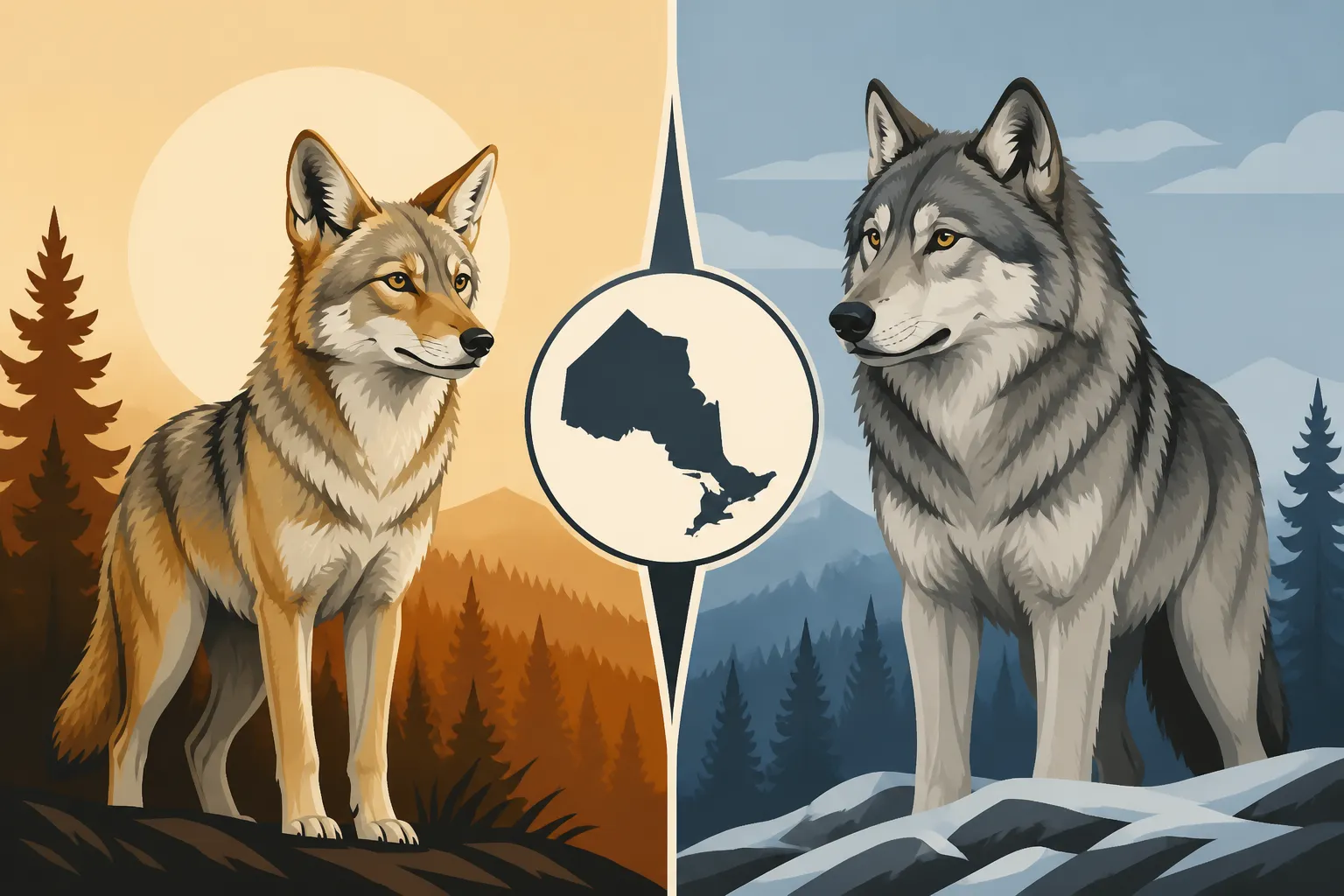
Look closely at the head, and you'll start to see more defining features. A wolf typically has a broad, powerful head with a wide forehead and a relatively short, blocky muzzle. Their ears are medium-sized, somewhat rounded at the tips, and proportional to their larger head. The eyes are usually amber to yellow, giving them an intense gaze. When you see a wolf's face, it often exudes a sense of raw power and intelligence.
Coyotes have a narrower, more pointed head. Their muzzle is longer and more slender, giving them a "foxier" appearance. Their ears are noticeably larger in proportion to their head, often looking quite prominent, and are more sharply pointed than a wolf's. Their eyes can also be amber, but their overall facial expression tends to be less broad and more angular. If you imagine drawing a line from the tip of the coyote's nose to the back of its head, it often looks more like a V-shape, whereas a wolf's head might appear more rectangular or square.
Tail and Gait
The tail is another excellent indicator. A wolf's tail is generally shorter relative to its body, quite bushy, and typically held low, often drooping or straight down, even when the animal is running. It rarely curls up over the back. The way a wolf carries its tail speaks to its confident, powerful stride. When they walk or trot, wolves have a very deliberate, ground-covering gait, often in a straight line, as if walking on a single track. This efficient movement helps them conserve energy over long distances.
Coyotes, conversely, tend to have a longer, thinner tail relative to their body size, often with a noticeable black tip. They typically carry their tail between their legs or slightly down, but it often has a more "droopy" or "bushy" appearance than a wolf's. When a coyote runs, especially at speed, its tail may be tucked further down. Their gait is often described as more "slinky" or "nervous," with a distinctive trot that can look bouncier and less linear than a wolf's. They often weave more, a reflection of their agility and tendency to avoid direct confrontation. Observe these patterns closely, especially when the animal is moving through cover, and you’ll start to discern the differences.
| Feature | Coyote | Wolf |
|---|---|---|
| Overall Size | Smaller, slender, dog-like (medium dog) | Larger, robust, powerfully built (large dog) |
| Weight | Typically 20-50 lbs | Typically 60-120 lbs |
| Head Shape | Narrow, pointed muzzle, "foxier" | Broad, blocky muzzle, powerful |
| Ears | Relatively large, pointed, prominent | Medium-sized, slightly rounded, proportional |
| Tail | Longer, thinner, often black-tipped, carried lower but can be bushy | Shorter, very bushy, usually carried straight down |
| Legs | Slender | Longer, thicker, powerful |
| Coat Colour | Generally grizzled grey-brown, tawny, reddish hues | Varies widely: grey, black, white, tawny |
| Vocalization | High-pitched yips, barks, howls (complex) | Deep, prolonged howls, less yipping |
Vocalizations and Behavioural Clues
Beyond their physical appearance, coyotes and wolves have distinct ways of communicating and interacting with their environment. If you're out in the bush and hear sounds in the distance, paying attention to the unique vocalizations can offer significant clues as to which canid is nearby. Their behaviour, too, often gives away their identity.
Howls, Yips, and Barks
Perhaps the most iconic sound of the wild is the howl, and both coyotes and wolves howl, but their styles are remarkably different. A wolf's howl is a deep, resonant, and prolonged sound, often starting low and rising in pitch, then holding for several seconds. These howls carry incredible distances, a powerful, almost mournful sound that speaks of vast wilderness. When multiple wolves join in, the chorus is rich and harmonious, a truly breathtaking experience if you're lucky enough to hear it in person. The sound is often described as feeling very "full" or "heavy." Hunters interested in Hunting Wolves in Ontario's North should definitely familiarize themselves with these distinct calls.
Coyotes, by contrast, are known for their much more complex and often frantic vocalizations. Their calls are a cacophony of high-pitched yips, short barks, and quick, warbling howls that often sound like they're being made by more animals than are actually present. This "yipping" often turns into a rapid, rising-and-falling "yip-howl-yip" chorus that is distinctly different from the sustained, deep howls of wolves. If you've ever heard a group of coyotes "singing" near your camp, you know it's an unmistakable sound that feels much lighter and more chaotic than a wolf pack's communication. You might hear this often when Calling Coyotes in Ontario Farm Country.
Social Structure and Pack Dynamics
Another key behavioural difference lies in their social structures. Wolves are highly social animals that live and hunt in well-organized packs, often consisting of a breeding pair, their offspring, and sometimes other non-breeding adults. These packs can be quite large, especially in core wolf territory, and they rely on cooperation to bring down large prey like moose or deer. Their movements are often coordinated, and you'll typically see them travelling together or, if alone, moving with a purposeful, powerful stride.
Coyotes, while sometimes seen in family units, are generally more solitary or form looser, less structured groups. They don't typically hunt large game in coordinated packs in the same way wolves do; instead, they often target smaller prey or scavenge. While a group of coyotes might hunt together, it's usually less organized and more opportunistic. If you see multiple canids together, observe their interactions. A tight, coordinated unit suggests wolves, whereas a looser, more independent scattering points towards coyotes. This difference in social structure influences everything from their hunting strategies to their movements through the landscape.
Habitat Preferences and Overlapping Ranges
Understanding where coyotes and wolves prefer to live in Ontario, and importantly, where their ranges overlap, is another crucial piece of the identification puzzle. While both are highly adaptable canids, they generally thrive in different environments, though there are plenty of areas where you might encounter either.
Core Wolf and Coyote Territories
Wolves, particularly the Eastern Wolf (which includes what some scientists classify as the Algonquin Wolf), are primarily creatures of deep, expansive wilderness. Their core territories are found in the vast, unbroken forests of Northern and Central Ontario, particularly in areas with large ungulate populations like moose and deer. Think of the rugged Canadian Shield country, the Boreal Forest, and the dense mixed woods surrounding iconic areas like Algonquin Provincial Park. These are the strongholds where wolf populations are most robust and where they play a vital role as apex predators. If you're Hunting Wolves in Ontario's North, you're very much in their primary domain.
Coyotes, on the other hand, are incredibly adaptable and have a much broader distribution across Ontario. They thrive in a mosaic of habitats, including agricultural lands, fragmented forests, suburban fringes, and even closer to human settlements. You'll find them throughout Southern Ontario's farmlands, in the mixed forests of Central Ontario, and even venturing into the more open areas of the North. Their ability to exploit diverse food sources, from rodents and rabbits to deer fawns and even agricultural refuse, has allowed them to colonize almost every corner of the province. They are particularly common around Hunting a Fencerow Between Two Fields or Hunting a Bush Lot Beside a Farm.
Areas of Overlap and Hybridization
The most challenging identification scenarios arise in the areas where wolf and coyote ranges meet and overlap. This is particularly true in Central Ontario and the southern fringes of the traditional wolf range, where the landscape transitions from vast wilderness to more settled, fragmented habitats. In these "hybrid zones," not only might you encounter both species, but there's also the genetic reality of hybridization. Eastern Wolves are believed to have a complex genetic history, with some level of past interbreeding with both Grey Wolves and Eastern Coyotes. This means that some individuals in these transition zones might display physical characteristics that blur the lines, making visual identification even trickier.
For instance, a large "coywolf" (a term often used colloquially for a coyote-wolf hybrid) might be significantly bigger than a typical coyote but still smaller and less robust than a pure wolf. They might have a mix of facial features, tail carriage, and coat patterns that defy easy categorization. This phenomenon means that relying on a single identifying feature isn't always enough. Instead, you need to consider the full suite of characteristics, their behaviour, and even the local ecology. Using tools like GoHunt to understand the specific regulations and common species in your chosen Wildlife Management Unit (WMU) can be incredibly helpful when navigating these complex overlapping zones. Regularly checking provincial updates on The Algonquin Wolf and Its Protection can also provide insights into specific management areas.
Why Positive Identification is Crucial for Hunters
Beyond the general satisfaction of knowing what animal you're looking at, for an Ontario hunter, the ability to correctly identify a coyote versus a wolf is not merely academic—it has serious legal, ethical, and conservation implications. Mistaking one for the other can lead to significant consequences, highlighting why this knowledge is so vital.
Legal Ramifications and Tagging Requirements
The most immediate and critical reason for precise identification lies in Ontario's hunting regulations. Coyotes and wolves have different management statuses, different open seasons, and different tagging requirements in various parts of the province. In many areas, coyotes can be harvested under a small game licence without a specific tag. However, Where a Wolf Tag Is Required and their seasons and limits can vary significantly by Wildlife Management Unit (WMU). Taking a wolf without the appropriate tag, or during a closed season, is a serious offence that can result in substantial fines, loss of hunting privileges, and even confiscation of equipment.
The distinctions are clearly outlined in the Ontario Hunting Regulations Summary, and it's every hunter's responsibility to know these rules for their specific WMU. Imagine the scenario: you're out hunting deer, see a large canid, and assume it's a coyote, only to realize after the shot that it's a wolf in an area where a specific wolf tag is required and you don't have one. This is exactly the kind of situation this knowledge aims to prevent. Always consult the most current Ontario Wolf and Coyote Season Rules before heading into the field.
Ethical Considerations and Conservation
Beyond the law, there's a deep ethical responsibility that comes with being a hunter. We are stewards of the land and its wildlife. Deliberately misidentifying an animal, or shooting without being certain of its identity, goes against the principles of ethical hunting. Wolves, particularly certain populations like the Algonquin Wolf, are subjects of specific conservation efforts and protection strategies in Ontario. Mistakenly harvesting a protected species, or one whose population requires careful management, undermines these efforts and reflects poorly on the hunting community as a whole.
Furthermore, understanding the roles these animals play in the ecosystem is part of being a responsible hunter. Coyotes, for example, have a significant impact on local deer populations, especially fawns, as detailed in What Coyotes Do to Fawn Survival. Wolves, as top predators, help keep ungulate populations healthy and balanced. Knowing which species you are observing contributes to a deeper understanding and appreciation of the natural world, reinforcing our commitment to sustainable hunting practices. Using resources like GoHunt to track sightings and understand local populations can help hunters contribute to this broader ecological awareness.
Confidence in the Field
Finally, and perhaps most importantly for your personal experience, having the confidence to accurately identify a coyote or a wolf allows you to make calm, informed decisions in the field. There's nothing worse than the doubt that creeps in after a shot, or the regret of passing on an animal because you weren't sure. By studying the physical characteristics, listening to the vocalizations, and understanding their typical habitats, you build a mental toolkit that helps you feel more prepared and confident. This confidence allows you to fully enjoy your time in the Ontario bush, focusing on the hunt and the experience, rather than second-guessing your every observation. Always ensure you have a clear, unmistakable identification before making the decision to harvest any animal. Reading an Ontario WMU Map Before You Go can also help reinforce your knowledge of what species are prevalent in your hunting area.
Disclaimer
This article is for general informational purposes only and does not constitute professional advice. Laws, prices and regulations vary by location and change over time. Consult a qualified professional for guidance on your specific situation.