Hunting a Field Corner at Dusk
One of the most frustrating things for any deer hunter in Ontario, especially those pursuing whitetails in agricultural areas, is trying to figure out exactly where those secretive animals will emerge from cover as evening approaches. It feels like they could pop out anywhere along a long field edge, making it tough to commit to a setup. This guide aims to take the guesswork out of that crucial transition time, focusing specifically on how to effectively hunt field corners at dusk, a strategy that can dramatically increase your odds of success.
Why Field Corners are Prime Real Estate at Dusk
Hunting a field corner at dusk isn't just about picking a random spot; it's about understanding deer behaviour and leveraging their natural tendencies as they shift from daytime bedding to nighttime feeding. These corners aren't just arbitrary points; they are often strategic bottlenecks in a deer's world.
Understanding Deer Movement Patterns
Deer are creatures of habit and efficiency. As the sun begins its descent, deer that have been bedded down in thick cover – perhaps a cedar swamp, a dense woodlot, or even a deep ravine – start to stir. Their primary motivation? Food. They need to move from their secure bedding areas to open feeding grounds, like agricultural fields, where they can browse on nutritious crops.
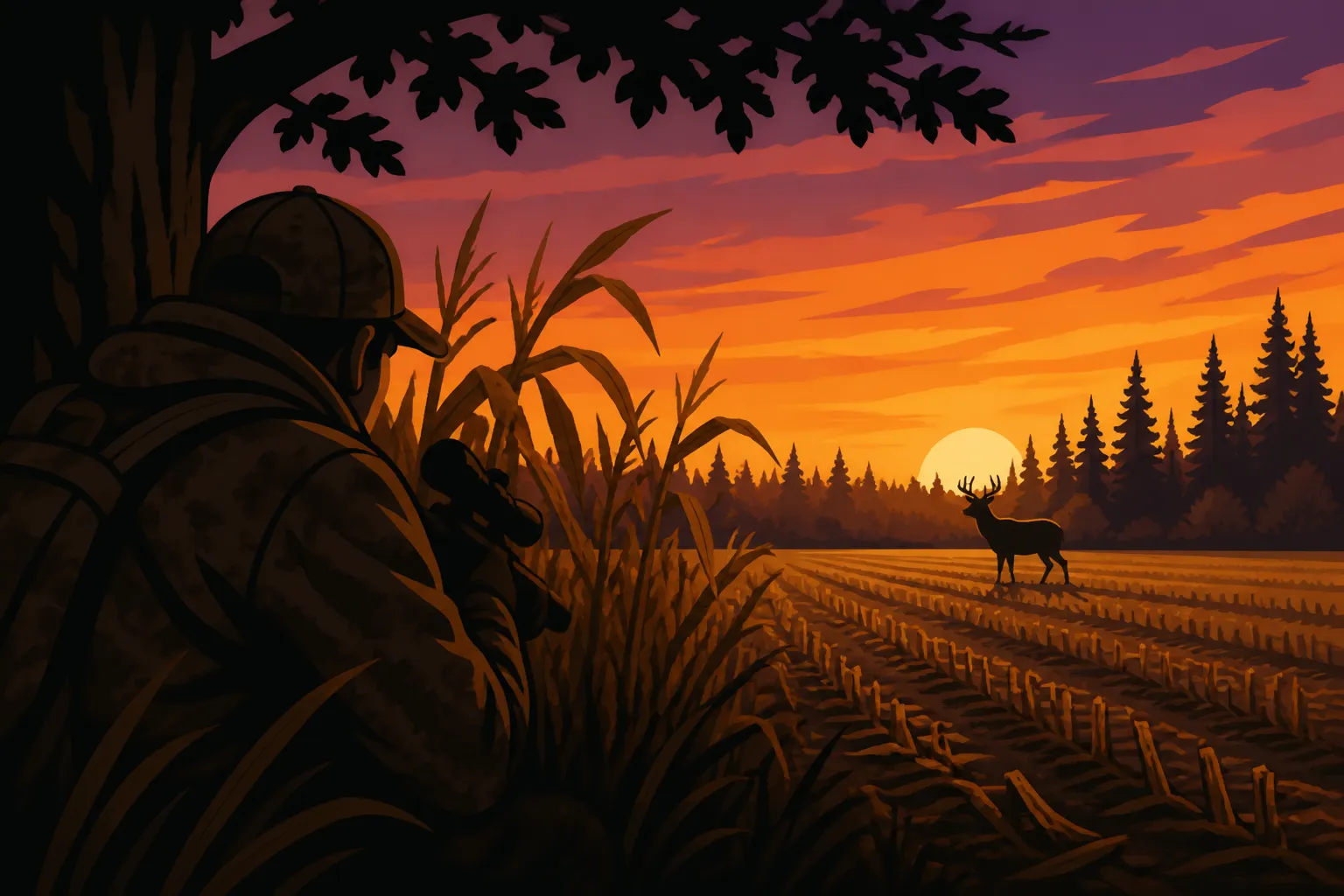
A field corner acts as a natural transition zone, a funnel where multiple travel corridors converge before animals commit to entering a wide-open space. Imagine a mature buck tucked away in a dense bush lot adjacent to a sprawling cornfield. He won't just burst out into the middle of the field. Instead, he'll often stage along the edge, using the last remnants of cover, scent-checking the wind, and surveying the field for any threats. Field corners offer precisely this kind of security and visibility, allowing deer to confidently ease into the feeding area. They provide a quick escape back into heavy cover if danger arises, making them a preferred entry and exit point. You'll often see distinct trails converging here, telling a clear story of consistent deer traffic. These animals aren't just wandering; they are purposefully using these corners.
The "Golden Hour" Phenomenon
There’s a reason why many hunters refer to the last hour of daylight as the "golden hour" – it's often when the woods truly come alive, especially for deer. As visibility drops, deer, which are naturally crepuscular (most active at dawn and dusk), feel increasingly safe to move. The diminishing light provides a natural cloak, making them harder for predators (and hunters!) to spot. This feeling of security encourages bolder movements and more consistent patterns.
For a hunter, this period means a flurry of activity. Deer that were hesitant during brighter daylight hours now feel comfortable venturing into the open. The low light levels, combined with the cooling air, trigger a biological response in deer that encourages feeding. This window, however, is fleeting. As soon as full darkness descends, deer can become almost invisible, and tracking a shot animal becomes exponentially harder. Therefore, maximizing your time and positioning during this specific period is absolutely critical. It's not just about being there, it's about being in the right spot during the right time, anticipating that natural shift in behaviour.
Scouting and Setup for Field Corner Success
Success at a field corner at dusk isn't accidental; it's the result of diligent scouting and meticulous setup. You can't just pick any corner and expect results. It requires investigation and strategic planning to ensure you're in the right place at the right time, completely undetected.
Reading the Sign: What to Look For
Before you even think about setting up, you need to become a detective. Start by walking the perimeter of any potential field corner, paying close attention to the transition zone between the field and the adjacent cover. Look for heavily worn deer trails leading directly into or out of the corner. These distinct paths, often worn smooth by countless hooves, are highways for deer movement. Fresh tracks are a goldmine; they tell you not only that deer are using the area, but also how recently. Large, distinct tracks suggest a mature animal.
Beyond tracks, look for scat (deer droppings). Its size, shape, and freshness can indicate the type of deer and how recently they were there. Rub lines and scrape lines are also crucial indicators. Rubs, where bucks have rubbed their antlers on saplings or small trees, signal active buck presence. Scrapes, patches of ground pawed clear with an overhanging branch often licked, are communication hubs, especially during the rut. A fresh scrape leading into a field corner is like a flashing neon sign for a dominant buck.
Trail cameras are invaluable tools for confirming deer presence and patterns. Place them strategically on main trails leading into the corner, or even directly facing the corner, ensuring you don't spook deer during setup. Check them regularly (but not too often, to minimize disturbance) to gather data on the timing of deer movement, the types of deer using the area, and their preferred entry points.
Modern mapping tools like onX Hunt or GoHunt can supercharge your scouting. Use their satellite imagery to identify subtle changes in topography, variations in cover density, and the exact boundaries of fields and woodlots. You can mark potential bedding areas, feeding zones, and existing trails, piecing together a comprehensive map of deer movement without ever setting foot on the property. These tools allow you to analyze the lay of the land, find pinch points that naturally funnel deer towards a corner, and even scout entry and exit routes remotely.
Optimal Stand or Blind Placement
Once you've identified a promising field corner, your setup becomes paramount. The golden rule here is wind direction – it is absolutely non-negotiable, especially at dusk. As the sun sets and the air cools, thermals often begin to fall, drawing your scent down into low-lying areas and across fields. You must position yourself so that your scent blows away from where you expect deer to approach. This often means being on the downwind side of the anticipated travel corridor. Never compromise on wind, even if it means sacrificing what seems like a perfect shot opportunity.
Concealment is equally vital. Whether you're in a treestand or a ground blind, you need to blend seamlessly into your surroundings. For a treestand, look for a mature tree that offers natural cover from leaves or branches, ideally one that allows you to see the entire corner and adjacent field edge without making excessive movement. Ensure your setup provides clear shooting lanes to the areas where deer are most likely to appear, while also maintaining an ethical and safe shot angle. A common mistake is to set up too close to the corner itself, making your entry and exit difficult without spooking deer. Sometimes, being 50-75 yards off the actual corner, but still with a clear view, is better for minimizing disturbance.
Consider your entry and exit routes meticulously. You need to be able to access your stand or blind before deer activity begins and leave after it has concluded, all without alerting any animals. This might mean walking a longer, circuitous route, using ditches, fencerows, or dense cover to conceal your approach and departure. A noisy or obvious entry or exit can ruin a hunt before it even starts. When Hanging a Stand on an Ontario Bush Edge, remember to choose a tree that hides your silhouette and allows for quiet access. For those preferring ground blinds, ensure it's brushed in thoroughly, camouflaged, and positioned to take advantage of natural features, following principles similar to Sitting All Day in an Ontario Blind.
Understanding Food Sources and Field Types
The type of crop in a field plays a massive role in when and how deer use a corner. Different crops become attractive at different times of the year and even at different stages of their growth.
- Standing Corn Fields: These are absolute deer magnets in early to mid-fall. Not only do cornfields offer a rich food source, but the tall stalks also provide incredible cover, allowing deer to move extensively within the field, even during daylight hours. A corner of a standing cornfield, especially one adjacent to thick woods, is a prime location. Deer will stage inside the corn, then emerge to browse the edges or nearby plots. Hunting a Standing Corn Field Edge requires careful consideration of deer entry points and wind, as deer can seemingly appear out of nowhere.
- Soybean Fields: After the soybeans have dropped their leaves and started to dry, they become a high-protein feast. Deer will gravitate to these fields, especially in the late afternoon and early evening, to gorge before winter. A corner where a soybean field meets dense woods can be incredibly productive. Timing is key here; deer might use these fields heavily for a few weeks, then move on as the beans are harvested or other food sources become more appealing. For more detail, refer to Hunting a Soybean Field at Dusk.
- Winter Wheat or Alfalfa Fields: These lush, green fields offer year-round forage. In the fall, they are particularly attractive as other green food sources diminish. Deer will often browse these fields extensively, making corners a natural entry point from adjacent cover. These fields can also be attractive during a mild late-season hunt. Knowing how deer interact with these persistent food sources is important for consistent success. You might find success with Hunting a Winter Wheat Field particularly as cold weather sets in.
- Fallow Fields or Pastures: Even fields left fallow or used for cattle can be productive if they are growing weeds, clover, or other natural browse. Deer will move through these areas, especially if they are part of a larger travel corridor between bedding and other prime food sources. The key is to find the specific forage that deer are targeting within these broader field types.
By understanding the seasonal attractiveness of various crops, you can better predict deer movement and select the most promising field corners for your dusk hunt. Combined with Reading Whitetail Sign in Ontario Hardwoods which can be applied to any bush edge, you'll paint a clearer picture of deer activity.
Tactics for Hunting the Dusk Shift
Once you've done your scouting and have your setup dialed in, it's time to execute. Hunting the dusk shift effectively involves more than just sitting quietly; it's about patience, strategic timing, and sometimes, knowing when to engage with subtle calls or decoys.
Patience and Timing Your Approach
This might sound obvious, but for a dusk hunt, getting into your stand or blind early is non-negotiable. You want to be settled, quiet, and completely camouflaged at least an hour, if not two, before you expect deer to start moving. This allows the woods to settle down after your entrance and gives any nervous animals in the vicinity time to relax. Imagine trying to catch a shy whitetail off guard when you're still clunking your way up a treestand! It just won't happen.
Equally important is sitting late. Many hunters make the mistake of packing up too soon. The last few minutes of legal shooting light, and even a bit beyond, can be incredibly productive. Deer often wait for the absolute cloak of darkness to step fully into the open. As soon as you begin to move, or your silhouette becomes visible against the darkening sky, you risk spooking animals that are just minutes away from appearing. You need to maximize every legal minute you have.
Minimizing noise and scent during your approach and while on stand is paramount. Wear scent-control clothing, shower with scent-free soap, and play the wind diligently. Any unnatural noise – a creaking stand, a dropped item, a cough – can carry surprisingly far in the still evening air and put deer on high alert. Use mapping tools like onX Hunt to plan your quietest route, perhaps along a ditch or fencerow. Knowing your WMU boundaries by consulting Reading an Ontario WMU Map Before You Go can also help ensure you're setting up legally.
Calling and Decoying Strategies
While field corner hunting at dusk often focuses on ambush, incorporating subtle calling or decoying can sometimes tip the scales in your favour, especially if you're targeting a buck during the rut.
- Subtle Grunts or Bleats: During the early to mid-fall, and particularly during the pre-rut and rut phases, a soft grunt or a doe bleat can pique a deer's curiosity. A single, soft grunt call might just be enough to get a cautious buck to step out into the field corner a little earlier, or divert his attention from another direction. Resist the urge to overdo it; a little goes a long way. If you’re hunting during the rut in early to mid-November, these calls can be particularly effective. Grunt Calls Late in Ontario's Rut can be especially convincing.
- Decoy Use: Decoys can be highly effective, but they need to be deployed correctly. A single doe decoy, positioned so it's visible from where deer are likely to emerge, can act as a magnet for bucks looking for companionship or a dominant buck looking to assert himself. Ensure your decoy is positioned to allow for a clear shot when a real deer approaches it. Be mindful of hunters in the area – safety is paramount when using decoys. The effectiveness of rattling and calling, as explored in Rattling Volume in Thick Bush, is often amplified when combined with a visual cue like a decoy, even if a field corner might be too open for full rattling sequences.
Post-Shot Considerations and Recovery
The excitement of a successful shot at dusk is incredible, but it's also where crucial decisions need to be made. After the shot, the most important thing is patience. Resist the urge to immediately jump out of your stand and pursue the animal. If you shot a deer during the low light of dusk, especially if you're not absolutely certain of the hit, waiting is usually the best course of action. Pushing a wounded animal into the deepening darkness can make recovery incredibly difficult, if not impossible. A deer that might otherwise bed down and expire quickly can be pushed miles away if pursued too soon.
Give the deer at least 30 minutes, or even an hour, if you suspect a good hit. If you suspect a marginal hit (e.g., gut shot), it’s often best to wait several hours, or even until morning, to take up the trail. Mark the exact spot where the deer was standing when you shot, and the last place you saw it. Use a flashlight (and perhaps flagging tape for morning) to mark the start of the blood trail.
When you do take up the trail, move slowly and deliberately. Look for blood, hair, bone fragments – any sign that indicates the direction of travel and the severity of the wound. If blood is sparse, expand your search pattern in wider circles from the last confirmed sign. Having a reliable tracking light is essential for evening recovery. If you're hunting in milder Ontario weather, quick recovery is vital for meat care, as discussed in Field Dressing in Warm Ontario Weather.
Remember, safety always comes first. Never track an animal into thick cover or swampy terrain alone at night. Let someone know where you are and what you're doing.
Here's a quick comparison of popular Ontario field types and their characteristics for dusk hunting:
| Field Type | Primary Attraction | Peak Attraction Time (Dusk) | Optimal Wind | Typical Stand Placement | Notes |
|---|---|---|---|---|---|
| Standing Corn | Food, Cover | Early-Mid Fall | Parallel | Edge of corn, adjacent timber | Excellent security, deer move inside. Crucial to identify entry points. |
| Soybeans | High-Protein Food | Mid-Late Fall | Parallel/Side | Timber edge, slight setback | Deer gorge on dried beans. Best after leaves drop. |
| Winter Wheat | Green Forage | Early Fall, Late Season | Parallel/Side | Cover edge, often elevated | Consistent food source, especially as other greens die off. |
| Alfalfa/Clover | Lush Forage | All Season | Parallel/Side | Transition zone, elevated | Deer often browse these pastures. Look for fresh growth. |
| Fallow Field | Natural Browse | Variable | Parallel | Thick cover edge, travel lanes | Depends on weed growth. Look for specific deer food plants. |
Disclaimer
This article is for general informational purposes only and does not constitute professional advice. Laws, prices and regulations vary by location and change over time. Consult a qualified professional for guidance on your specific situation.