Reading Sign After a Fresh Snow
There’s nothing quite like waking up to a fresh blanket of snow in Ontario's hunting season. For weeks, you might have been squinting at barely visible game trails on leaf litter, wondering if that scuff was a deer or just a falling branch. Then, overnight, the world transforms into a pristine canvas, suddenly making the movements of every creature glaringly obvious. This pristine white expanse isn't just beautiful; it's a giant, unspoken invitation to step into the woods and read the story laid out before you. This guide will help you decode that story, turning those fleeting tracks and subtle disturbances into actionable intelligence for a successful hunt.
Why Fresh Snow is a Game Changer for Hunters
Many hunters feel a sense of renewed hope when the first significant snowfall arrives. The woods that felt impenetrable or unreadable a day before suddenly reveal their secrets. This isn't just about pretty scenery; it's about the fundamental shift in how we approach scouting and hunting.
The Immediate Advantage of a White Blanket
Imagine a forest floor matted with dead leaves, pine needles, and undergrowth. Every step an animal takes might leave a faint impression, but differentiating fresh sign from old can be a frustrating guessing game. Was that rub made last week, or last month? Did a deer walk through here this morning, or was it yesterday? The arrival of fresh snow acts like a universal reset button, wiping away all the old, confusing clutter. Suddenly, any track, any disturbance, any bit of droppings you find is new. This immediate clarity is invaluable. It tells you, with certainty, where animals have been since the snow fell. You’re no longer sifting through history; you're reading the morning's newspaper, hot off the press. It simplifies your scouting efforts immensely, allowing you to focus on the truly relevant, current activity that will guide your hunt. It’s a psychological boost too – that feeling of knowing you're on fresh sign is unparalleled.
Understanding Snow Conditions and Their Impact on Sign
Not all snow is created equal, and understanding the nuances of different snow conditions is critical to reading sign accurately. A light dusting of powder is far different from a heavy, wet snowfall or a thick crust of ice. These conditions directly impact how tracks are laid, how long they remain visible, and even how animals move through the landscape.
Light, fluffy powder, for instance, makes for incredibly crisp tracks. Every detail, from the precise shape of a hoof to the drag of a dewclaw, can be perfectly preserved. However, light powder can also be easily disturbed by wind or subsequent light snow, making older tracks harder to discern after a few hours. Wet, heavy snow, on the other hand, creates deeper, more defined impressions that last longer. It's often easier to follow a trail in wet snow, as the tracks are more robust. But heavy snow can also accumulate on branches and brush, obscuring subtle signs like rubs or fresh browsing, or even making it harder for you to move quietly. Then there's crusted snow, which can be the bane of a hunter's existence. It's noisy to walk on, often sending game fleeing before you're in range, and tracks might just be shallow indentations rather than clear prints. The good news is that crusted snow also makes it difficult for animals to move silently, often leaving behind a trail of broken crust that's easy to spot. Knowing these differences helps you interpret what you're seeing. For example, a deer track in soft powder will have sharp edges, while one in slightly melting or refrozen snow will have softened, rounded edges, immediately telling you about its age.
Deciphering Fresh Tracks: What to Look For
The tracks themselves are the most obvious and compelling evidence of an animal's recent presence. Learning to differentiate species and estimate the age of a track is foundational to effective snow tracking.
Identifying Species and Age of Tracks
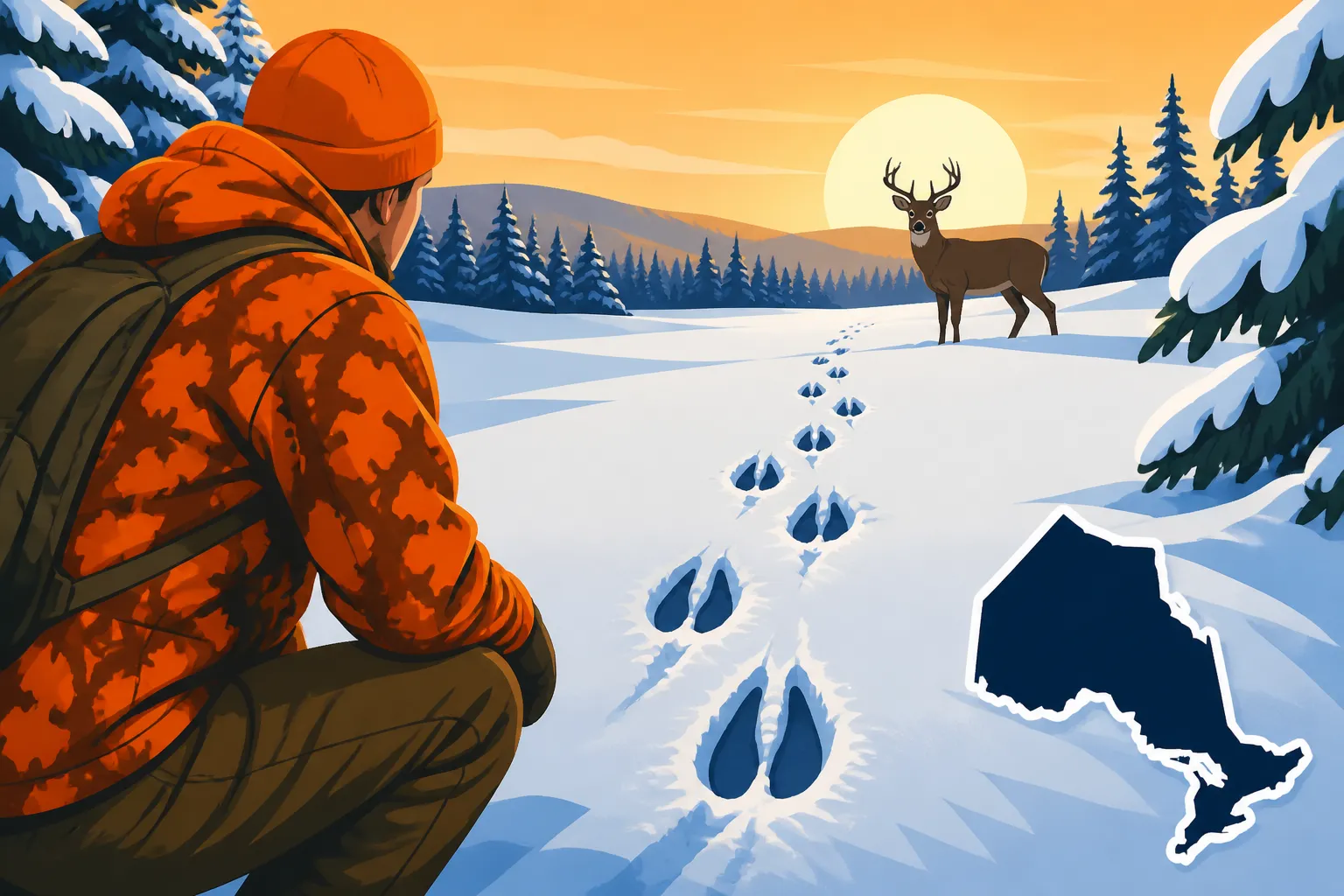
When you spot a track in fresh snow, the first questions that spring to mind are "What made this?" and "How long ago?" In Ontario, you'll encounter a variety of hoofed and pawed animals. Whitetail deer tracks are distinct: typically heart-shaped, about 2-3 inches long for a doe, and potentially larger (up to 4 inches) and blunter for a mature buck. The dewclaws, small hooves high on the leg, might show in deeper snow or when an animal is running. Moose tracks are significantly larger, often 5-7 inches long, and much wider, with prominent dewclaws almost always registering, even at a walk. Black bear tracks resemble large human footprints, with five toes and claw marks often visible, though they'll be hibernating during much of the deep snow season, so finding them is more likely during early or late season snowfalls.
Coyote and fox tracks are canid, resembling dog prints but often more elliptical and generally traveling in a straighter line with less wandering. Coyote tracks are usually 2.5-3.5 inches long, while fox tracks are smaller, around 1.5-2 inches. Small game like snowshoe hare will leave characteristic "H" patterns – two large hind feet landing ahead of two smaller front feet. Ruffed grouse, common in Ontario's bush roads, will leave distinct three-toed bird tracks.
Determining the age of a track is perhaps even more crucial than identifying the species. A track made moments ago will be incredibly crisp, with sharp, well-defined edges, almost as if carved. If it's starting to melt, refreeze, or be subtly filled in by wind-blown snow, you know it's been there for a few hours. The colder it is, the longer a track will remain "fresh." In extremely cold, dry conditions, tracks can look new for half a day or more. But on a sunny day near freezing, a track can lose its sharp edges in an hour. Look for subtle signs: does the track have a thin layer of fine snow blown into it? Are the edges starting to round off from solar radiation or slight melting? Is there any evidence of refreezing, making the edges harder and slicker? These details tell you if you're seconds, minutes, or hours behind your quarry. Many hunters rely on tools like the GoHunt app to understand general game movement trends in their specific Wildlife Management Unit (WMU), but nothing beats being on the ground, reading the fresh sign directly.
Analyzing Gait and Behavior Patterns
Once you've identified the species and confirmed the freshness of the tracks, the next step is to interpret what the animal was doing. The gait – how the animal was moving – and the overall pattern of the tracks can tell you a wealth of information about its intentions and current behavior.
A leisurely walking gait, where tracks are evenly spaced and in a relatively straight line, suggests an animal that's calm, possibly browsing or heading to a known bedding area. You might see evidence of them stopping to sniff or paw at the snow. If the tracks show a slight lope or a trot, with more pronounced spacing and perhaps a bit more dig in the hooves, the animal might be covering ground purposefully, perhaps heading to water, a different feeding area, or simply moving between cover. This could indicate it's not feeling immediately threatened but is certainly on the move. When tracks show a bounding or running gait, with long gaps between clusters of prints and deeper indentations, you know the animal was spooked. This usually means they detected something – perhaps you, or another predator – and have fled the area. Following a running track is often a losing battle unless you have multiple hunters for a drive.
Beyond gait, look for behavioral patterns. Are the tracks weaving through thick cover, or are they out in the open? Are there multiple sets of tracks converging, indicating a group, or a lone set? If you find a single deer track that abruptly veers off, then another, and another, it could mean a group of deer was startled and scattered. If you see signs of browsing – fresh twigs nipped off, bark scraped – it tells you they were feeding. Following a track that goes from feeding to a thicker stand of timber, like a cedar swamp, might indicate it’s heading to a bedding area. Similarly, a track leaving dense cover at dawn and heading towards an open field suggests it’s going to feed. Understanding these patterns is key to predicting where your quarry might be heading next and setting up an effective ambush.
Beyond Tracks: Other Crucial Snow Sign
While tracks are the most obvious indicators, fresh snow reveals a host of other critical signs that can unlock the mystery of animal activity. Learning to spot these subtle clues will significantly enhance your hunting prowess.
Browsing, Rubs, Scrapes, and Droppings in Snow
Fresh snow makes other forms of animal sign pop with remarkable clarity. Consider browsing: when deer, moose, or other herbivores feed, they nip off twigs or strip bark. On a bare forest floor, old browsing might blend in, but against white snow, fresh browsing stands out like a neon sign. Look for cleanly clipped branches, usually at deer-head height, with the branch tip often fallen into the snow below. This immediately tells you that animals have been feeding since the snowfall. Moose, for example, will often browse on willow, balsam fir, and poplar, and their distinct, ragged feeding pattern is easily visible on snow-covered vegetation. If you're looking for What Moose Eat Through the Year, fresh snow offers clear evidence.
Rubs and scrapes also become incredibly obvious. A deer rub is where a buck has rubbed its antlers against a tree, stripping bark. In fresh snow, you’ll often find fresh wood shavings at the base of the tree, clearly fallen recently. If there's snow on top of the wood shavings, the rub is older than the last snowfall. Scrapes, which are patches of disturbed earth where a buck paws the ground and often urinates, are likewise highlighted. Any scrape with fresh earth exposed against the snow, or even better, a track leading right to it and fresh urine discoloration in the snow, tells you it's current. And let's not forget droppings. While not glamorous, fresh droppings are a goldmine of information. Against white snow, they are unmistakable. Look for steam rising from them on a cold day, or a soft, moist consistency when poked with a stick (if you're brave enough). Frozen, hard droppings are older. The colour and consistency can also tell you about the animal's diet and health.
Beds, Trails, and Travel Corridors
Another critical sign revealed by fresh snow is the presence of beds. A deer bed, for instance, is a spot where an animal has laid down to rest. In snow, these appear as oval depressions where the snow has been compressed and often melted slightly from the animal's body heat. If you find a bed with a distinct melted area and no snow accumulation within the depression, it's very fresh, indicating the animal was likely there very recently. Sometimes, you'll even see a distinct melt-pattern where the animal's body warmed the snow.
Beyond individual beds, snow transforms subtle game trails into undeniable highways. What might have been a faint path through the undergrowth now becomes a clear, trampled depression in the snow. These well-used trails often connect feeding areas to bedding locations, or water sources to cover. Following these primary trails can lead you directly to where game is spending its time. Keep an eye out for where these trails cross natural features. A Hunting a Cedar Swamp Edge becomes a clear movement corridor for deer in winter, offering both food and shelter. Similarly, deer will often stick to a Hunting a Hardwood Ridge for Whitetails to navigate terrain efficiently, using the crests for easier travel and vantage points. When these trails intersect or parallel human features like fencelines, you've found a classic travel corridor. A Hunting a Fencerow Between Two Fields is a perfect example of how deer use linear cover to move undetected between open areas. Identifying these funnels is crucial for setting up an effective stand or planning a still-hunt.
Strategic Hunting Post-Snowfall
Fresh snow isn't just about finding game; it's about altering your hunting strategy to maximize the advantages it offers. How you approach the hunt changes fundamentally when the ground is white.
Following Tracks vs. Setting Up Ambushes
Once you've found fresh tracks, you're faced with a classic dilemma: do you follow them directly, or do you try to predict the animal's movement and set up an ambush? The answer often depends on the type of terrain, the freshness of the tracks, and your hunting style.
Still-hunting, or tracking, involves slowly and silently following a fresh set of tracks. This can be incredibly effective, especially in dense cover where you can get close before being detected. The snow muffles your footsteps, and a light snowfall can even help mask your scent. As you follow, constantly scan ahead, not just at the tracks. The animal might be bedded down or slowly browsing just out of sight. Pay close attention to changes in the track pattern – if a deer starts to meander and browse, it's likely relaxed. If the tracks suddenly tighten up or show signs of hesitation, it might be wary. A crucial aspect of tracking is understanding the wind. Always try to approach with the wind in your face or quartering, so your scent isn't blowing ahead to the animal. Sun angle also plays a role; tracking into the sun can make it harder to see details, while tracking with the sun at your back can cast long, revealing shadows. However, directly tracking can also lead to busting game, especially if you're not moving stealthily enough or if the animal is bedded in thick cover where it can easily slip away.
Alternatively, you can use fresh tracks to confirm game presence and general direction, then circle ahead to a likely travel corridor or bedding area and set up an ambush. This is particularly effective if you notice tracks heading towards a known bedding thicket or crossing point. Rather than pushing the animal directly, you anticipate its next move. For instance, if you find fresh tracks leading into a large block of cover, instead of plowing directly in, you could swing wide, get downwind, and set up on a known escape route or primary trail where the animal is likely to emerge. This strategy often works well if you're Sitting All Day in an Ontario Blind overlooking such a funnel. During the rut, knowing deer are on the move and seeing fresh tracks can also inform your calling strategy or stand placement, especially if you're Hunting the Rut in Early to Mid November.
Utilizing Technology and Topography with Snow Sign
In today's hunting world, technology isn't just a gadget; it's a vital tool that, when combined with natural sign like snow tracks, can give you a significant edge. Mapping apps, like GoHunt, allow you to visualize the terrain in incredible detail, even overlaying property lines and topographical features right on your phone.
When you find fresh tracks in the snow, don't just follow blindly. Pull out your mapping app. Trace the general direction of the tracks on your digital map. Where are they heading? Are they following a subtle ridge line, which becomes a key travel route for deer and moose? Are they dropping into a sheltered valley for bedding? Are they skirting the edge of a dense cedar swamp, using it for cover? By overlaying fresh track information with topographical maps, you can start to predict an animal's likely path and destination. For instance, if tracks are leading from a known feeding area towards a thick cedar swamp on a north-facing slope, your map will confirm this as a prime winter bedding location. You can then use the app to identify potential ambush points, such as pinch points, saddles, or creek crossings, that the animal will likely use to enter or exit that area. This combines real-time observation with strategic planning. Leveraging tools for Scouting With Satellite Imagery in Ontario before the snow even falls can give you a baseline understanding of prime habitat, which you then confirm and refine with fresh snow sign. Likewise, knowing how to interpret Reading an Ontario WMU Map Before You Go will help you understand the broader landscape, and how smaller topographical features fit into the larger movement patterns of game.
Timing Your Hunt for Optimal Snow Conditions
The timing of your hunt after a snowfall is almost as important as the snow itself. Not all snow conditions are equally beneficial, and understanding the ebb and flow of a winter storm front can greatly improve your chances of success.
The absolute best time to hunt after a fresh snow is often right at first light, immediately after the snow has stopped falling and settled. This is when the sign is freshest, and you have the best chance of catching an animal still on the move from nocturnal feeding, or heading to its morning bed. If the snow is still actively falling, especially a heavy, wet snow, tracks can be quickly covered, making tracking difficult. Animals might also be bedded down and waiting out the storm. However, a light, continuous snowfall can be a hunter's friend, as it muffles sound and can provide an excellent backdrop for still-hunting, as any new track will stand out instantly.
Consider what the animals themselves are doing. After a heavy snowfall, animals often become very active, needing to feed to replace calories lost in the cold and the effort of moving through deep snow. This can present an excellent opportunity, as they might be less cautious in their pursuit of food. If the temperature drops significantly after a snowfall, animals might seek out denser cover, like conifer stands, to conserve energy. This is where knowing Where Ontario Whitetails Yard in Deep Snow becomes critical. Furthermore, if the snow melts and refreezes, creating a noisy crust, animals will often try to avoid moving as much as possible, or stick to established trails where the crust is broken. Always monitor weather forecasts. A second wave of snow after a brief lull can "reset" the landscape again, giving you a fresh opportunity to read new movements and adapt your strategy.
Specific Ontario Game and Their Snow Sign
While general principles of snow tracking apply to many species, understanding the specific habits and unique signs of Ontario's most popular game animals is key. Each species leaves a slightly different story in the snow.
Whitetail Deer Sign in the Snow
Whitetail deer are, for many Ontario hunters, the primary focus, and their sign in the snow is abundant and telling. As mentioned, their tracks are typically heart-shaped, with the two hooves splayed slightly when moving quickly. Larger tracks, especially those with blunt toes and visible dewclaw impressions, often indicate a mature buck. Doe and fawn tracks will be smaller and more pointed. When deer are in soft snow, their hooves will often leave a distinct drag mark between steps, which is invaluable for following a trail.
Beyond tracks, deer feeding sign becomes incredibly obvious. What Whitetails Eat Through a Hard Winter includes browse on twigs and buds, and these clipped branches will be clearly visible against the snow. Look for fresh browse lines on saplings, especially in areas with good cover. In deep winter, deer will often yard up in dense cover like cedar swamps for protection from the elements and access to food. The trails leading into and out of these areas, and the concentrated browsing within, become very evident after a snowfall. If you're Hunting a Cedar Swamp Edge, the snow will clearly show you where deer are entering and exiting. During the rut, you'll find rubs with fresh bark shavings at the base of trees and scrapes with exposed earth, often with tracks leading right up to them. These are prime locations to set up a stand, as bucks will actively revisit them.
Moose and Bear Sign in Ontario's North
For hunters heading to Ontario's boreal forest, moose and black bear sign offer different but equally exciting challenges. Moose are massive animals, and their tracks reflect that: huge, cloven prints, often 5-7 inches long, with prominent dewclaws that almost always register, even in shallow snow. Their long strides create deep, purposeful trails. Like deer, moose are browsers, but their preferred forage differs. You’ll find them feeding on willow, balsam fir, and other conifers, often leaving ragged, stripped branches or broken saplings. What Moose Eat Through the Year can be largely inferred from their winter browsing habits. Finding large areas of disturbed snow where moose have pushed through thick brush or pawed for food under the snow is a clear indicator of recent activity. They often utilize old logging roads and cutovers for easier travel, and these pathways will be clearly defined in fresh snow. Following a fresh moose track through a heavy snowfall can be a challenging but rewarding endeavor, often leading you to bedding areas in dense stands of timber.
Black bear sign in fresh snow is less common during the deep winter months, as most bears are denned up. However, for those participating in Ontario’s spring or fall bear seasons, early or late snowfalls can reveal their movements. Bear tracks are distinct, resembling large, flat human footprints with five prominent toe pads and claw marks, though the claws may not always show. In the spring, when bears are just emerging, a light snow can show where they’ve been moving from their dens, foraging for early spring growth. When Bears Leave the Den in Spring, they'll be hungry and actively seeking food, and snow can reveal their initial movements. Look for scat (droppings) which, in spring, might still contain evidence of their last fall meals or early spring vegetation. In the fall, fresh snow can highlight their movements as they bulk up for winter, often feeding heavily on berries or acorns. Finding a bear track in late fall snow near a known berry patch or acorn-producing stand is an excellent lead.
| Species | Typical Track Length (Inches) | Hoof/Paw Shape | Key Distinguishing Features | Other Common Sign in Snow |
|---|---|---|---|---|
| Whitetail Deer | 2-4 | Heart-shaped, cloven | Pointed toes (doe/fawn), blunter (buck), dewclaws in deep snow | Fresh browse (clipped twigs), rubs (shavings), scrapes (exposed earth), beds |
| Moose | 5-7 | Large, broad, cloven | Prominent dewclaws always show, long strides | Ragged browse (stripped bark/broken saplings), pushed-over brush, large beds |
| Black Bear | 5-9 | Human-like paw | 5 toes, claw marks often visible, flat foot | Scat (droppings), disturbed ground near food sources (spring/fall) |
| Coyote | 2.5-3.5 | Oval, canid | Straighter travel, paws often register cleanly | Scat (often contains hair/bone), urine marks on prominent features |
| Snowshoe Hare | 1.5-2.5 (hind) | Distinct "H" pattern | Large hind feet land ahead of smaller front feet | Clipped vegetation, tunnels under snow |
| Ruffed Grouse | 1.5-2 | Three-toed bird | Distinct print, often in groups | Wing prints from landing/taking off, droppings |
Disclaimer
The information provided in this guide is for general educational purposes only and is not a substitute for official regulations. Hunting laws and seasons in Ontario can change. Always consult the most current Ontario Hunting Regulations Summary available from the Ministry of Natural Resources and Forestry (MNRF) before heading afield. Safety should always be your number one priority.