Shooting Distances in Thick Bush
The dense, tangled bush of Ontario presents a unique challenge for hunters. It's not like those wide-open prairies or western mountains where you can see for hundreds of yards. Here, you often find yourself with mere seconds to react, and the deer, moose, or bear can materialize out of nowhere, leaving you scrambling to find a clear line of sight. This guide is all about navigating that challenge, understanding realistic shooting distances in thick cover, and preparing yourself and your gear for success when that big game animal steps into your world at spitting distance.
The Reality of Thick Bush Hunting in Ontario
Let's face it, Ontario's hunting landscape is, in many places, a thick, gnarly proposition. You're not always glassing distant hillsides. Often, you're picking your way through dense regenerating forest, navigating cedar swamps, or trying to peer through tangled alder thickets. This reality dictates a different approach to shot distances and engagement scenarios compared to what you might see on hunting shows set in other regions.
What "Thick Bush" Truly Means Here
When we talk about "thick bush" in Ontario, we're picturing anything from dense stands of young poplar and birch that sprang up after a cut, to mature mixed hardwoods with a tangled understory of ferns and saplings, or even vast, impenetrable cedar and spruce swamps. Imagine trying to see more than 30 or 40 yards in places like the Haliburton Highlands or the vast tracts of Crown land up north, especially in areas where logging has occurred recently, leaving behind a dense, young regrowth. Visibility is often measured in tens of yards, not hundreds.
This isn't a minor difference; it’s a complete paradigm shift. Hunters accustomed to open country might find the sheer lack of clear sightlines frustrating or even disorienting. You learn to appreciate a 50-yard shot as a long one, and often, you're hoping for something much closer. The terrain forces animals to use specific travel corridors, and it forces hunters to slow down, listen more, and hunt smarter. If you're Hunting an Ontario Bush Edge, you'll quickly realize how quickly visibility can drop off just a few feet into the cover.
Why Most Shots Are Close Range
Given the nature of the cover, it’s no surprise that most shot opportunities in Ontario's thick bush happen at relatively close ranges. Deer, moose, and bear rely on this cover for safety and movement, using natural funnels, ridges, and low-lying areas to travel unseen. As hunters, whether we're still-hunting slowly through the woods or sitting patiently on a stand, our encounters with game are almost invariably up close and personal.
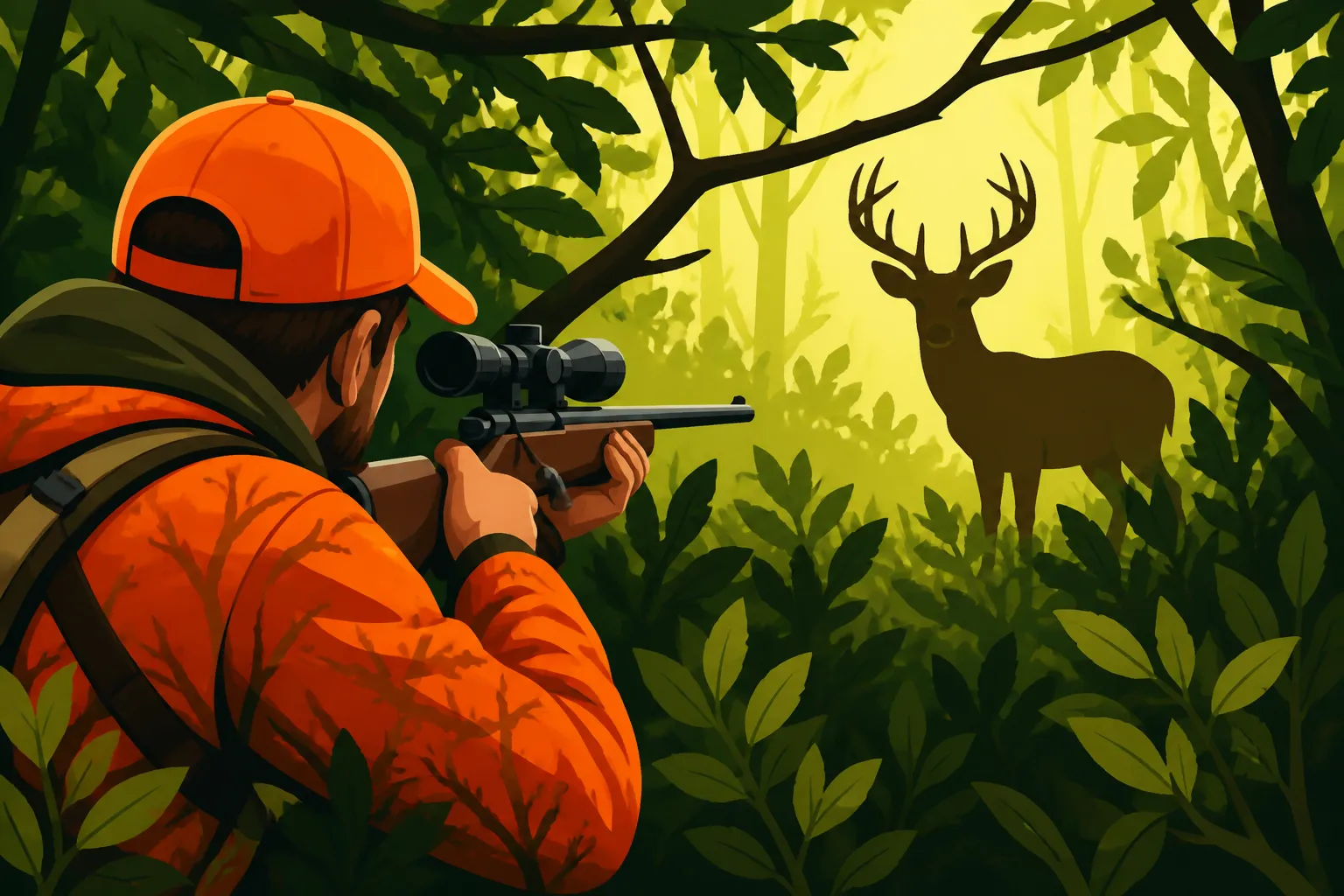
Consider a typical scenario: you're walking slowly through a mixed forest, trying to Read Whitetail Sign in Ontario Hardwoods. The crack of a twig might alert you to a deer, but by the time you pinpoint its location, it's often only 20 or 30 yards away, possibly moving, and giving you only a fleeting window through the trees. The "sound barrier" plays a huge role here; animals often hear you long before they see you, and in such dense cover, they might just melt away without ever presenting a shot. This makes quick target acquisition and precise shooting at close distances paramount. It's about being ready for the close ambush, not the distant stalk.
Equipment Considerations for Close Quarters
When you're dealing with the close-range encounters typical of Ontario's thick bush, your gear choices become even more critical. You need equipment that is quick to deploy, accurate in tight spaces, and effective at short distances. Forget about those long-range precision setups designed for wide-open spaces; here, it's all about speed and knockdown power at conversational ranges.
Rifles and Ammunition Choices
For rifle hunters in the thick stuff, quick-handling firearms are king. A compact rifle with a shorter barrel (say, 20-22 inches) is much easier to maneuver through dense alders or when swinging on a moving animal. When it comes to calibers, while many popular choices work, some hunters prefer cartridges known for delivering a solid punch at closer ranges, like .30-30, .30-06, .45-70, or even larger bore options. The focus isn't on ultra-flat trajectories over hundreds of yards, but rather on reliably transferring energy into the animal within 100 yards.
Bullet choice is also crucial. At close range, some fast-expanding, thin-jacketed bullets can fragment too quickly, leading to extensive meat damage or a lack of penetration on quartering shots. Conversely, a hard, non-expanding bullet might pencil through without delivering enough hydrostatic shock. Aim for bullets designed for controlled expansion, ensuring good penetration and energy transfer without excessive fragmentation.
For optics, low-power scopes are invaluable. A 1-4x, 1.5-5x, or even a simple fixed 2.5x or 3x scope provides a wide field of view, making it easier to acquire a target quickly. Many seasoned bush hunters even opt for open sights or a red dot sight for the fastest possible target acquisition, especially for shots where the animal might be on the move. There's little point in a 20x magnification if your shot is 40 yards through a tangle of poplars.
Bows and Arrow Setup for Bush Hunting
Bowhunters in Ontario's thick bush need gear that prioritizes maneuverability and kinetic energy for those up-close encounters. A compact compound bow with a shorter axle-to-axle length (around 30-32 inches) can be a godsend when you're tucked into a ground blind or wedged against a tree. It's less likely to snag on branches when drawing or settling into your shot.
Arrow setup demands attention to detail. While speed is always appealing, a heavier arrow setup can be beneficial in dense cover. It carries more kinetic energy, which aids in penetration, and is less prone to deflection from minor brush contact (though any contact can still ruin a shot). When considering broadheads, many bush hunters lean towards fixed-blade broadheads. While mechanicals are popular in open country for their flight characteristics, fixed blades offer robust construction and reliable penetration, especially if there's any chance of minor contact before impact.
For sights, a single-pin adjustable sight or a simple multi-pin setup with pins set for close distances (e.g., 20, 30, 40 yards) is common. A rangefinder is helpful, but in the heat of the moment, quick mental estimation or pre-ranging landmarks from a stand is often necessary. The focus is on being able to react instantly and confidently when that animal appears within spitting distance, whether you're Hunting a Cedar Swamp Edge or still-hunting through a hardwood stand.
Mastering the Shot in Dense Cover
The difference between a successful hunt and a missed opportunity in Ontario's thick bush often comes down to two things: your ability to accurately estimate range and find a clear shooting lane, and your discipline in shot placement. This isn't where you take Hail Mary shots; it's where precise execution, even under pressure, makes all the difference.
Estimating Range and Identifying Shooting Lanes
In the bush, a rangefinder is a fantastic tool for scouting and confirming distances, but you won't always have time to use it when an animal bursts into view. Developing your skill at range estimation is paramount. Practice by picking out various trees or boulders in the woods and guessing their distance, then verify with a rangefinder. Over time, you'll build a reliable internal "rangefinder." You might even consider using a helpful tool like those offered by GoHunt to practice this skill, looking at topographical maps and mentally "walking" the distances.
Just as important is the ability to quickly identify a clear shooting lane. This is where pre-hunt scouting and stand placement truly pay off. If you're Hanging a Stand on an Ontario Bush Edge, make sure you've meticulously cleared any small branches or saplings that might impede a shot at likely travel routes. When an animal appears, your first instinct should be to find that unobstructed path for your bullet or arrow. Even a tiny twig can deflect a projectile enough to cause a complete miss or, worse, a wounding shot. Often, you'll need to wait for the animal to take another step, or shift its body, to open up that perfect window.
Shot Placement and Follow-Through
In dense cover, with limited visibility and often less-than-ideal shooting positions, perfect shot placement becomes even more critical. The "kill zone" on a deer, moose, or bear isn't suddenly smaller, but the obstacles making it harder to hit effectively shrink your target. You must aim for a broadside or slightly quartering-away shot that targets the vital organs – the lungs and heart. These shots maximize the chance of a quick, humane kill and leave a good blood trail for tracking in difficult terrain.
Mental discipline is key. It's easy to get target panic when a massive buck suddenly appears at 30 yards. But rushing the shot is almost always a mistake. Take that extra half-second to confirm your target, identify your lane, and focus on a precise aiming point. Breathe, squeeze, and follow through. Remember, even a short blood trail in thick bush can be incredibly challenging to follow if the shot wasn't true. Practicing your shooting from awkward positions – kneeling, sitting, or quickly shouldering your rifle – can prepare you for the real-world scenarios you’ll encounter. Guides who assist hunters, often found through services like BookYourHunt, will always emphasize the importance of making that clean shot, especially in tight quarters.
Strategies for Optimizing Close-Range Opportunities
Hunting in thick Ontario bush is less about covering vast distances and more about strategic positioning, stealth, and preparation for those sudden, close encounters. It requires a different mindset and a set of tactics geared towards maximizing your chances when game is practically on top of you.
Still-Hunting and Stand Placement
One of the most effective strategies in thick cover is still-hunting. This involves moving incredibly slowly, taking one or two steps, then stopping to look and listen for several minutes. Think of it as hunting at a snail's pace. This allows you to pick apart the cover, detect subtle movements or sounds, and gives you time to react if an animal is feeding or moving nearby. When you're still-hunting, use the terrain to your advantage: walk into the wind, use dense pockets of cover to break up your silhouette, and move through areas where you've noticed Reading Whitetail Sign in Ontario Hardwoods.
When it comes to stand placement, focus on natural funnels, pinch points, and edges where game is forced to travel. This could be the edge of a Hunting a Beaver Meadow Crossing, a narrow ridge between two swamps, or a fencerow bordering a field. Pay close attention to wind direction and thermal currents; animals will almost always use the wind to their advantage. Setting up an elevated stand helps with visibility over some of the underbrush and can also help carry your scent above the primary travel lanes. Ground blinds, well-camouflaged, are also excellent choices for thick cover, offering concealment and comfort for long sits.
Practice Makes Perfect
There’s no substitute for practice, especially when the stakes are high. Don't just shoot at a static target in an open field. Set up a range that simulates the conditions you’ll face in the bush. Place targets at varying, unknown distances (20, 30, 45 yards) with brush or small trees in between. Practice shooting quickly and accurately. Work on your rapid target acquisition skills, getting your sights or scope on the target in a couple of seconds.
It's also beneficial to practice shooting from less-than-ideal positions. You might not always have a perfect, textbook shooting stance in the bush. Practice kneeling, sitting, or even shooting from one knee. These simulations build muscle memory and confidence, so when that moment of truth arrives, your body instinctively knows what to do. Consider scouting for outfitters and guides through platforms like BookYourHunt or GoHunt; many will tell you that the most prepared hunters are those who practice specifically for the conditions they'll face, not just for maximum distance. Practicing Before a Guided Hunt can greatly enhance your success rate and overall experience.
Finally, while we talked about the importance of range estimation, a reliable rangefinder is still an excellent tool for practice. Use it to check your estimations. This reinforces your internal gauge and helps you become more accurate in the field, even when you don't use the device for every shot.
Here's a quick comparison of equipment considerations for different terrains:
| Feature | Thick Bush Hunting (Ontario) | Open Country Hunting (General) |
|---|---|---|
| Rifle/Bow | Compact, quick-handling (shorter barrels, smaller bows) | Longer barrels, heavier bows (for stability) |
| Optics | Low-power scope (1-4x), red dot, open sights | High-magnification scope, binoculars, spotting scope |
| Ammunition | Controlled expansion, heavier bullets for penetration | High ballistic coefficient, flat-shooting bullets |
| Broadheads | Fixed blade often preferred for reliability | Mechanicals common for flight accuracy |
| Rangefinding | Mental estimation, pre-ranging key points, quick use | Frequent use of rangefinder for precise shots |
| Shot Distance | Typically 10-60 yards, rarely over 100 | 100-500+ yards, depending on caliber and skill |
| Movement | Slow, deliberate still-hunting, patient stand hunting | Stalking, glassing, long-range shooting positions |
Always remember that success in the thick bush comes from adapting your mindset and your gear to the environment. It's about preparedness for the intimate encounter, not the distant engagement.
Disclaimer
This article is for general informational purposes only and does not constitute professional advice. Laws, prices and regulations vary by location and change over time. Consult a qualified professional for guidance on your specific situation.