Hunting a Pine Plantation Block
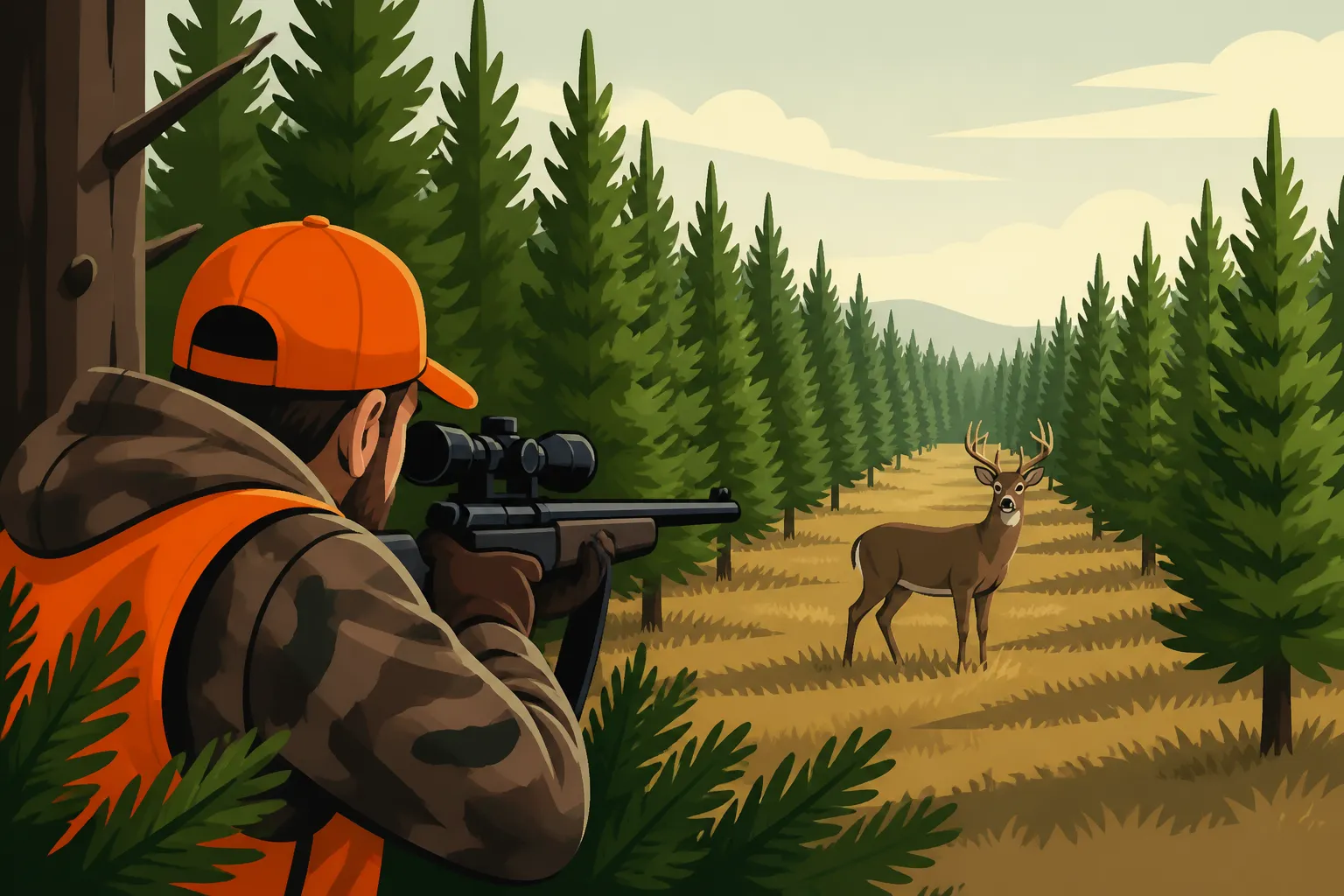
Hunting a pine plantation block can feel like stepping into a labyrinth, a dense, uniform world where visibility shrinks to mere yards and every tree looks the same. It’s easy to feel overwhelmed and just pass these areas by, assuming deer won't use them or that hunting them is simply impossible. But seasoned Ontario hunters know that these often-overlooked blocks of evergreens can be incredible sanctuaries for deer, especially when hunting pressure mounts elsewhere. This guide will help you decode the secrets of hunting pine plantations, turning what seems like an impenetrable fortress into a strategic hunting ground where you can find success.
Understanding Pine Plantations as Deer Habitat
Pine plantations, whether they're red pine, white pine, or spruce, are essentially monoculture forests planted by humans, often in neat, straight rows. While they might seem devoid of natural diversity, deer use these areas extensively for very specific reasons, making them prime spots for hunting if you know what to look for.
Why Deer Seek Out Pine Plantations
Deer are creatures of comfort and security, and pine plantations offer both in spades. First and foremost, these dense stands provide exceptional thermal cover. When the cold winds howl and the snow begins to pile up in late fall or winter, those tightly packed conifers trap heat and block the wind, creating a much warmer microclimate than an open hardwood bush. This is especially true in a place like Ontario, where winters can be truly brutal. Deer will often bed down deep within these blocks to conserve energy and escape the biting cold. They also offer excellent visual cover; a deer can disappear into a pine plantation and feel incredibly secure, even from a hunter just a few yards away. This sense of security makes them ideal bedding areas, and during high-pressure times, deer will often retreat into these thickets to escape the activity in more open areas. Think of it as their safe room.
Secondly, plantations often grow on more marginal soils, and while they might not offer a smorgasbord of food, they often border agricultural fields, hardwood ridges, or swamps. These edges become critical travel corridors, allowing deer to move from the deep cover of the pines to feeding areas or other bedding locations. They can offer a quick escape route when danger arises in adjacent, more exposed habitat. When you're scouting, it's not just about the pines themselves, but how they connect to the broader landscape. Hunting an Ontario Bush Edge is a great way to capitalize on these transitional zones.
Identifying Key Areas Within the Uniformity
Even within the seeming uniformity of a pine plantation, there are usually subtle features that deer will utilize more than others. The first thing to look for is subtle topography. Even a slight dip or rise can create a micro-shelter or funnel deer movement. A small knoll within the pines might offer a deer a slightly better vantage point while still being concealed, or a low-lying area might collect more moisture, leading to different undergrowth.
Next, pay close attention to any breaks in the canopy or changes in tree density. Maybe a patch of trees was harvested differently, or there was a natural blowdown that created a sunnier opening. These areas can encourage a bit more understory growth, offering some browse. But more importantly, deer will almost always create their own trails through these dense blocks. Look for faint game trails, especially those that parallel the tree rows but also those that cut diagonally, connecting different sections or leading to the edge. These trails are your highways and byways in an otherwise trackless forest. Using a mapping app like onX Hunt or GoHunt can be incredibly helpful here, especially if you can get satellite imagery that shows slight variations in tree density or ground cover, allowing you to mark potential travel routes before you even step foot in the woods. You can also sometimes identify older skidder trails or fire breaks that have grown in but still offer easier travel for deer.
Scouting and Strategy for Pine Plantation Hunting
Effective scouting is paramount when hunting pine plantations. Because visibility is so limited during the hunt, you need to have a strong understanding of deer movement before you ever sit down or start still-hunting. This isn't a place for casual, "wing it" hunting.
Pre-Season Reconnaissance and Sign Reading
Before the season even begins, or during quiet periods between hunts, get into those plantations and explore. This is where your boots-on-the-ground effort really pays off. Look for fresh rubs and scrapes, particularly along the edges where the pines meet other habitat types, but also occasionally deeper inside if there's a small opening or a significant trail. Fresh droppings are a dead giveaway that deer are using the area currently. Pay attention to how trails connect different points – are they leading to a nearby field? A water source? Another bedding area? Look for distinct bedding areas within the densest parts of the plantation. These might be slightly flattened spots in the pine needles, often on a small rise or where a few trees have created an extra-thick pocket of cover. You might even find sheds here in the late winter or early spring, indicating a consistent bedding site. Reading Whitetail Sign in Ontario Hardwoods offers some excellent insights that can also be applied to the edges of pine plantations.
Satellite imagery, available through platforms like onX Hunt, can be a game-changer for your pre-season scouting. You can often see the distinct lines of the planted pines, and sometimes even subtle variations in canopy cover. This allows you to identify potential travel corridors, openings, or edges without disturbing the area. Mark these points on your digital map, and then verify them on the ground. This combination of aerial and ground-level intel is incredibly powerful for deciphering deer movement within these tricky environments.
Choosing Your Approach: Still-Hunting vs. Stand Hunting
When it comes to the actual hunt, you'll generally have two primary approaches: still-hunting or stand hunting. Each has its pros and cons in a pine plantation.
Still-Hunting: This involves moving incredibly slowly and deliberately through the plantation, stopping frequently to observe and listen. The dense cover that hinders visibility also offers excellent concealment for you, the hunter. The key is to move at a snail's pace, taking one or two steps, then pausing for several minutes to scan, listen, and look for any movement or subtle detail that seems out of place. This is especially effective during the rut when bucks are cruising for does, or in colder weather when deer are bedded tight. You'll need to pay extreme attention to wind direction, as deer can easily smell you long before you see them. Hunting Ontario's Mixed Hardwood Bush discusses similar concepts that translate well to moving through dense cover.
Stand Hunting: While still-hunting offers flexibility, stand hunting can be highly effective if you've identified a consistent travel corridor or a transition zone. Setting up a treestand or ground blind along the edge where the pines meet another habitat type, or overlooking a key internal trail, can put you in a prime position. The challenge here is ensuring your stand placement allows for adequate shooting lanes in the dense growth. You'll often need to do some trimming (where permitted) to open up sightlines. Consider a ground blind for maximum concealment within the pines, especially if there's a slight depression or a cluster of blowdowns that can augment your setup. When hanging a stand, remember the dense cover often means shorter shot distances, so be prepared for a quick, close-range opportunity. Hanging a Stand on an Ontario Bush Edge provides excellent advice applicable to these scenarios.
| Hunting Method | Best for Conditions | Pros in Pine Plantations | Cons in Pine Plantations |
|---|---|---|---|
| Still-Hunting | Rut, cold weather, fresh snow, when deer are bedded tight | Maximizes ground covered, allows adapting to fresh sign, stealthy movement with cover | Requires extreme patience, difficult to maintain wind advantage, very short shooting windows |
| Stand Hunting | Identified travel routes, feeding/bedding transitions, ambush points | Stationary advantage, better visibility from elevation (treestand), good for sustained sits | Limited visibility (need clear lanes), commitment to one spot, deer can easily skirt your location |
| Small Drive | Late season, deep snow, multiple hunters | Can push deer out of thick cover, effective for specific blocks | Requires coordination, noisy, deer can easily slip back into cover or go in unexpected directions |
Tactics for Hunting Pine Plantations
Once you've done your scouting and decided on your approach, it's time to put those plans into action. Hunting pine plantations demands patience, keen observation, and often a willingness to adapt.
Navigating the Density and Maintaining Orientation
Walking into a dense pine block, it's easy to get turned around. Everything looks the same, and your sense of direction can quickly become skewed. This is where technology truly shines. Your GPS, whether a dedicated unit or a mapping app like onX Hunt on your phone, is your best friend. Always mark your entry point and keep track of your movement. Many hunters will walk a compass bearing to stay straight, but with the dense canopy, GPS can be more reliable. Plotting your route beforehand using satellite imagery can help you identify subtle landmarks, even if they're just slight variations in tree height or gaps in the canopy. Some hunters will even tie small, non-obtrusive pieces of flagging tape on their way in, removing them on the way out, just to maintain a visual trail. This prevents you from inadvertently circling or getting completely disoriented when focused on a deer. What to Do If You Get Turned Around offers critical advice for any dense bush hunting.
When moving, focus on being as quiet as possible. Pine needles can be noisy underfoot, especially if they're dry. Lift your feet rather than dragging them, and use the softest ground you can find. Don't be afraid to take detours around particularly noisy sections. Every rustle and snap will carry further in the quiet stillness of the pines.
Utilizing Wind and Entry/Exit Strategies
The wind is your most critical ally and your greatest foe in a pine plantation. Deer rely heavily on their sense of smell, and in close quarters, a slight shift in wind can blow your entire hunt. Always hunt with the wind in your favour, blowing your scent away from where you expect deer to be. This might mean making a much longer approach to your stand or planning a looping still-hunt route to keep the wind correct. Don't compromise on wind direction, especially in these dense areas. If the wind isn't right for your chosen spot, either change your spot or change your plan.
Your entry and exit routes are just as important. Avoid walking directly into or out of the core bedding areas. Instead, approach from downwind, circling wide to get to your stand or to begin your still-hunt. The goal is to minimize your disturbance and keep deer from knowing you were ever there. If you spook deer on your way in, you've likely blown that spot for the day. Similarly, when you leave, try to do so quietly and discreetly, especially if you've been hunting a bedding area. Hunting a Cedar Swamp Edge offers similar considerations for navigating tricky, dense cover.
Patience, Slow Movement, and Keen Observation
Hunting pine plantations requires a whole new level of patience. You simply cannot rush it. If you're still-hunting, you might cover only a hundred yards in an hour, stopping every few steps for minutes at a time. This slow movement allows you to truly pick apart the cover, looking for the horizontal line of a deer's back, the flick of an ear, or the glint of an antler. Use your binoculars, even in tight cover, to scrutinize shadows and dense patches of branches.
When you stop, don't just stand there; let your eyes and ears do the work. Listen for subtle sounds: a twig snap, a rustle in the needles, the soft blowing of a deer. Often, you'll hear a deer before you see it. Be ready for quick shots; because of the density, most opportunities will be at close range, and the deer will likely be moving through quickly. Practice quick, fluid movements with your firearm or bow so you can capitalize on those fleeting chances. It's truly a game of cat and mouse where the slightest advantage goes to the most patient hunter.
Equipment and Safety Considerations
Hunting in dense pine plantations isn't just about strategy; it also requires the right gear and a strong emphasis on safety. The environment itself presents unique challenges that you need to be prepared for.
Appropriate Clothing and Footwear
Forget the silent, leafy camo that works so well in hardwoods. In a pine plantation, you need clothing that is durable enough to push through thick branches and quiet enough not to announce your presence. Brush pants or sturdy hunting pants are essential to protect your legs from snags and thorns. Consider layering, as moving slowly can still generate heat, but standing still for long periods in cool weather will make you feel the cold quickly. Good quality rain gear is also crucial, as the canopy might hold moisture for a long time after a rain or snowfall.
For footwear, stability and waterproofness are key. Tall, stiff-soled boots will help you navigate uneven ground hidden under pine needles and protect your ankles from twisting. Waterproof boots are a non-negotiable, as even in dry conditions, you'll often be walking through areas where moisture collects, or where dew sits heavy on low branches. A solid pair of leather or rubber boots, broken in and comfortable, will be your best friend.
Navigational Tools and Communication
As mentioned, a reliable GPS or mapping app is absolutely essential. Carry a portable charger for your phone if you're relying on an app like onX Hunt or GoHunt, as GPS usage can drain batteries quickly. Don't rely solely on your phone; a dedicated GPS unit or at least a compass and map (and knowing how to use them) should always be part of your kit. The dense canopy can sometimes interfere with satellite signals, so having redundant navigation is smart. Scouting With Satellite Imagery in Ontario is great background reading here.
Communication is another big one, especially if you're hunting with a partner or in a group. Cell service can be spotty to non-existent deep within some of these plantations, particularly in more remote Ontario areas. Consider carrying a satellite messenger or a two-way radio to stay in touch. If hunting alone, tell someone exactly where you're going and when you expect to be back. Safety first, always.
Blaze Orange and Field Dressing in Dense Cover
Even though you're in dense cover, blaze orange is still mandatory during most gun seasons in Ontario and is a smart safety practice for any season when other hunters might be around. It can feel counter-intuitive when you're trying to be concealed, but remember, the point of blaze orange is to be seen by other people, not necessarily by deer. Wear as much as legally required, and often more, especially if you're moving. A blaze orange hat and vest are minimal requirements, but consider adding more if you're actively still-hunting or participating in a small drive. How Much Blaze Orange Ontario Requires is a must-read for specific regulations.
Finally, consider the challenge of field dressing a deer in thick pine cover. It's not like field dressing in an open field. You'll need extra light, a sharp knife, and a plan for getting the animal out. Clearing a small area for working can be helpful. Think about how you'll drag or haul the animal out of the dense cover; having a deer cart might be impossible, so a good drag rope or a game sled (if there's snow) will be essential. If you're fortunate enough to tag out, your real work often begins after the shot. Field Dressing in Warm Ontario Weather offers advice relevant to meat care regardless of the cover.
Disclaimer
This article is for general informational purposes only and does not constitute professional advice. Laws, prices and regulations vary by location and change over time. Consult a qualified professional for guidance on your specific situation.