Ontario Spring Turkey Season Dates
The thrill of chasing a gobbling tom in the Ontario spring woods is unmatched, but nothing sours the excitement faster than realizing you've misread a season date or missed a crucial deadline. Many of us have felt that pang of confusion trying to navigate the provincial regulations, wondering exactly when we can hit the bush. This comprehensive guide is here to clear up all that uncertainty, walking you through Ontario's spring turkey season dates and ensuring you're ready when that first gobble echoes through the timber.
Understanding Ontario's Spring Turkey Season Structure
Spring turkey hunting in Ontario isn't just about picking up a tag and heading out; it's a carefully structured season designed to align with the birds' natural breeding cycles while ensuring sustainable populations for years to come. Getting a handle on this structure is your first step to a successful hunt.
Why Dates Matter So Much for Spring Turkeys
For the avid turkey hunter, the precise timing of the spring season is everything. Unlike some other game species, wild turkeys have a relatively short, intense breeding period, and the season dates are set to coincide with the peak of gobbling and strutting activity. If you're out too early, before the gobblers are actively seeking hens, the woods can feel silent and barren. Go out too late, after most hens are on their nests and the gobblers have become "henned up," and those vocal birds you heard earlier in the season might now be impossible to pull away.
The Ontario spring season specifically targets male turkeys, or "bearded" turkeys, allowing the hens to nest and raise their broods undisturbed. This focus ensures that the crucial reproductive phase of the turkey lifecycle is protected, contributing to healthy populations for future seasons. Missing the prime window means missing the action, and frankly, that's a frustrating experience after months of anticipation. Every day in May brings subtle shifts in turkey behaviour, from the early season frenzy of multiple gobblers to the later season challenge of picking off a solitary longbeard whose harem is already accounted for.
Provincial vs. Local Unit Variations
While there's a general provincial framework for the spring turkey season, it's absolutely crucial to understand that Ontario's Wildlife Management Units (WMUs) can sometimes have slight variations. Most of the prime turkey habitat across Southern and Central Ontario generally follows a similar opening and closing, typically running throughout the month of May. However, it’s not a uniform blanket rule. For instance, some of the more northern WMUs, where turkey populations are still establishing or the spring thaw arrives later, might have slightly different start or end dates, or even specific restrictions.
This is where your homework really pays off. Never assume the dates are the same everywhere. Always double-check the current year's Ontario Hunting Regulations Summary for the specific WMU you plan to hunt. Tools like GoHunt can be incredibly useful for visualizing WMU boundaries and quickly cross-referencing information, helping you avoid a costly mistake. For those looking to hunt in specific regions, understanding the local nuances is key to a legal and successful hunt. You might find that a WMU just a short drive away has a different set of rules, which could impact your hunt plans significantly.
The Evolution of Ontario's Spring Turkey Hunt
It’s easy to forget that spring turkey hunting wasn't always a staple in Ontario. The resurgence of wild turkeys in the province is a true conservation success story, a testament to dedicated restoration efforts that began decades ago. Turkeys were extirpated from Ontario by the early 1900s, victims of habitat loss and unregulated hunting. Beginning in the late 1980s, a massive restoration program, primarily involving trap-and-transfer initiatives, reintroduced turkeys to suitable habitats across the province.
These efforts paid off handsomely, leading to the establishment of regulated spring and fall turkey seasons. The spring season, in particular, has seen a steady increase in popularity, with more hunters participating each year. This growth has also led to a more refined understanding of turkey biology and population dynamics, allowing the Ministry of Natural Resources and Forestry (MNRF) to fine-tune season dates and bag limits. The rules have evolved from those early, tentative seasons to the robust, well-managed opportunities we have today. Understanding this history gives you an appreciation for the privilege of pursuing these magnificent birds in Ontario's beautiful landscapes. You can learn more about this journey in the post on Ontario's Wild Turkey Restoration Story.
Key Season Dates and How to Track Them
Knowing the exact dates is non-negotiable for spring turkey hunting. Getting it wrong can mean anything from missing prime gobbling action to facing legal repercussions, and no one wants that kind of stress on a hunt.
General Spring Season Openers and Closers
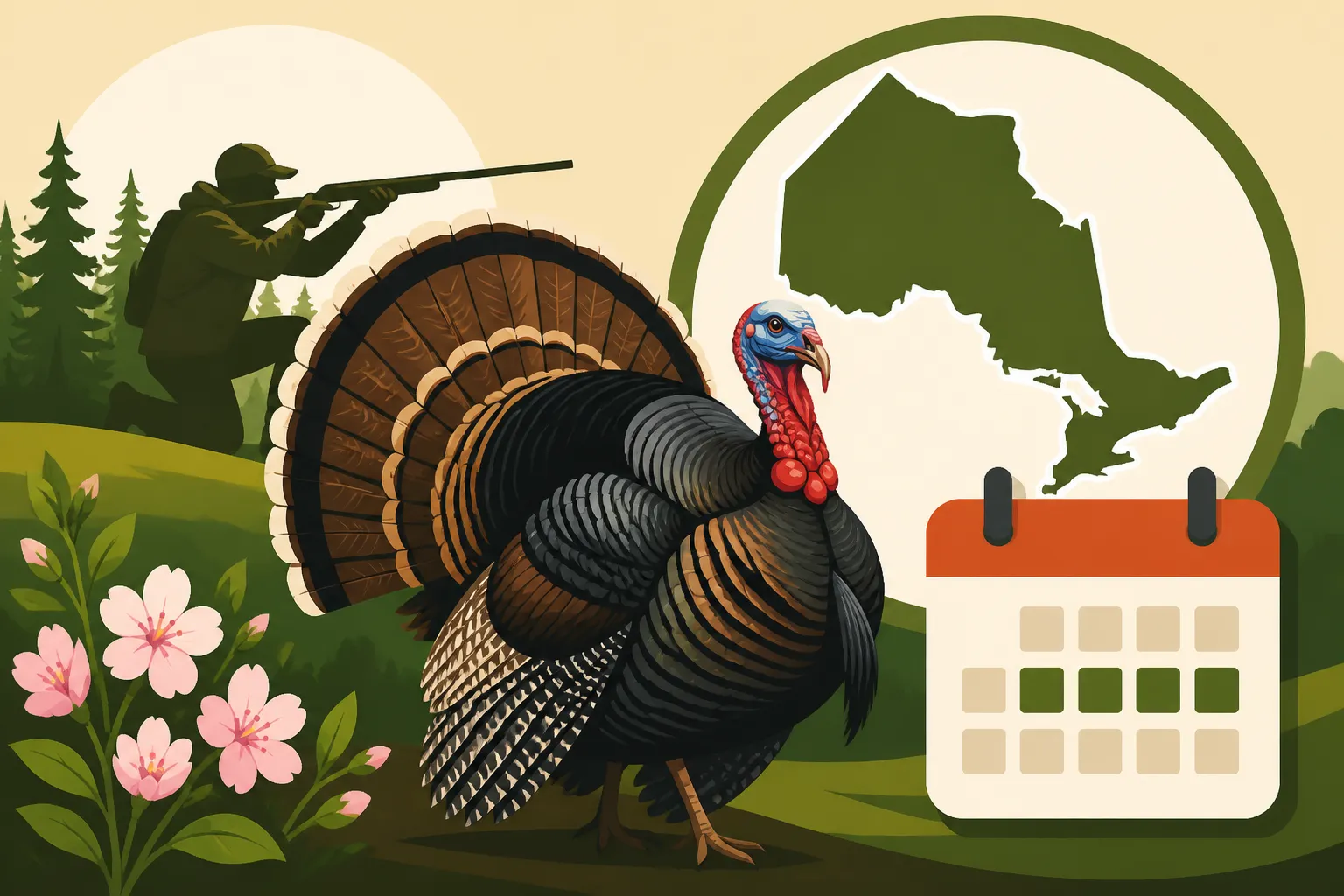
For most of the prime wild turkey range in Ontario, the spring gobbler season typically opens on May 1st and runs through to May 31st. This month-long window is a fantastic opportunity, allowing hunters to experience different phases of the turkey breeding cycle. Early May often brings aggressive gobblers fresh off the roost, eager to find hens. As the month progresses, hens begin to nest, and gobblers might become more selective or "henned up," making them a greater challenge to call in.
While May 1st to May 31st is the standard for a vast majority of the province, it's always best practice to confirm the exact dates for the specific year you intend to hunt. The Ontario Hunting Regulations Summary, available online and at licence issuers, is your definitive source for this information. This general timeframe ensures that hunters are in the woods when gobblers are most active, giving us the best chance to hear that thunderous call and work a bird.
Specific WMU Nuances and Considerations
As mentioned earlier, while the May 1st to May 31st window is broadly applicable, specific Wildlife Management Units can have slight differences. These variations are usually in more northern or peripheral turkey ranges where populations might be smaller or still expanding, or where habitat conditions lead to a later spring. For example, some far northern WMUs might have a shorter season or even be closed to spring turkey hunting.
It’s your responsibility as a hunter to confirm the exact dates for the WMU you plan to hunt. Here’s a basic table showing the typical provincial dates, but please note this is a general guide and always verify with the official regulations:
| Aspect | Detail (Ontario Spring Turkey Season) |
|---|---|
| Typical Season Dates | May 1st to May 31st (Provincial Average) |
| Permitted Species | Male Wild Turkey or Bearded Wild Turkey Only |
| Bag Limit | One (1) wild turkey per hunter per spring season |
| Legal Hunting Hours | Half-hour before sunrise to half-hour after sunset |
| Hunting Method | Shotgun (10-20 gauge, certain shot sizes), Bow, Crossbow |
| Mandatory Reporting | Yes, within 7 days of harvest |
If you're unsure about your WMU, online resources and mapping tools like GoHunt can help you pinpoint your location and cross-reference with the regulations. Don't risk a fine or losing your privilege to hunt by assuming. It's not uncommon for a new hunter to mistakenly believe all seasons are uniform across the province, only to find out their chosen WMU had a different opener. Take the time to confirm your Ontario Deer Season Dates and Tags and all other regulations as well.
Important Application and Licensing Deadlines
Beyond just knowing the season dates, you need to be aware of the administrative side of things. There are no "applications" per se for spring turkey tags like there are for moose or elk; it's generally an over-the-counter purchase. However, you do need a valid Outdoors Card and a Resident Small Game Licence, which includes a spring wild turkey tag, before you can head into the field.
These licences and tags can be purchased online through the Fish and Wildlife Licensing Service or at authorized licence issuers. The key here is not to leave it to the last minute. Technical glitches happen, licence issuers might be closed, or you might find yourself in a rural area without access. Get your licence and tag well in advance of May 1st. This ensures you’re ready to go as soon as the season opens. Having your Ontario Wild Turkey Licences and Tags sorted beforehand means less stress and more time scouting and practicing your calls.
Rules Beyond Just the Dates
While knowing when to hunt is critical, understanding the how and what of spring turkey hunting is equally important. Ontario has specific regulations that govern everything from the type of equipment you can use to how you must tag your bird.
Permitted Equipment and Methods
Ontario's spring turkey season allows for the use of shotguns, bows, and crossbows. However, there are specific requirements for each:
- Shotguns: You can use a shotgun no smaller than 20 gauge and no larger than 10 gauge. The shot must be non-toxic and can be lead shot sizes 4, 5, or 6, or non-toxic shot sizes 2, 3, 4, 5, or 6. This means you can't be out there with buckshot or slugs. The goal is a clean, ethical kill on a bird, and these smaller, denser shot sizes are designed for that.
- Bows: Traditional bows and compound bows are permitted, but there are minimum draw weight requirements to ensure enough kinetic energy for a humane harvest. Make sure your setup meets these standards.
- Crossbows: Crossbows are also legal, and similar to vertical bows, they have minimum draw weight and bolt specifications. It's a good idea to confirm if When a Crossbow Is Legal to Use aligns with turkey hunting regulations specifically, as rules can vary between species.
When hunting, you're generally permitted to use calls and decoys, which are essential tools for spring turkey hunting. Using natural cover for concealment is also a must. The primary method involves calling a gobbler into range, often using a variety of yelps, clucks, and purrs to imitate a hen. Learning to effectively use these tools is a game-changer, as detailed in articles like Calling a Gobbler Off an Ontario Roost or Decoy Placement for Pressured Ontario Gobblers. Remember, it’s all about fair chase and ensuring a safe, ethical hunt.
Bag Limits and Tagging Requirements
For the spring wild turkey season in Ontario, the bag limit is one (1) wild turkey per hunter. Crucially, this one bird must be a male wild turkey or a bearded wild turkey. This distinction is vital because some hens can grow beards, and these are legal to harvest in the spring. However, the intent is to protect the breeding hens, so always positively identify your target.
Once you harvest your bird, tagging is mandatory and must be done immediately. The tag that comes with your licence must be securely affixed to the turkey's leg. The specific instructions for notching your tag (date of harvest, time of day) are printed directly on the tag itself and are vital for compliance. Failure to properly tag your bird could result in significant fines or loss of hunting privileges. Beyond the tag, you are also required to report your harvest within seven days. This can usually be done online or through a licence issuer. This data is critical for wildlife managers to monitor turkey populations and ensure sustainable hunting opportunities in the future.
Legal Hunting Hours and Safety Protocols
Spring turkey hunting in Ontario adheres to specific legal hunting hours, which are typically half-hour before sunrise to half-hour after sunset. This timeframe covers the periods when turkeys are most active, both coming off and going onto the roost. Hunting outside these hours is illegal and dangerous. Always consult the sunrise/sunset tables for your specific location, which are widely available online or through hunting apps.
Regarding safety, while blaze orange is often mandatory for big game gun seasons like deer, it is generally not required for spring turkey hunting when actively hunting. This is because turkeys have excellent eyesight and would spot blaze orange instantly. However, it is always a good idea to wear blaze orange when walking to and from your hunting spot or when retrieving a bird, especially on public land, to enhance visibility to other hunters. It’s always better to be safe than sorry. You can refer to Ontario Blaze Orange Requirements for more information on when and where it's needed for other species.
Additionally, always remember the fundamentals of firearms safety:
- Treat every firearm as if it were loaded.
- Always point the muzzle in a safe direction.
- Be sure of your target and what is beyond it.
- Keep your finger off the trigger until ready to shoot.
These rules, coupled with knowing your legal Ontario Shooting Hours for Big Game (and small game), are paramount for a safe and enjoyable hunt.
Maximizing Your Spring Turkey Opportunity
The spring turkey season is short and sweet, and making the most of it involves more than just showing up. Strategic planning, understanding turkey behaviour, and refining your skills are all part of the equation.
Scouting and Pre-Season Prep
The saying "you can't shoot a turkey from the couch" is absolutely true, but you also can't consistently shoot one without putting in the legwork beforehand. Pre-season scouting is arguably the most critical component of a successful spring turkey hunt. This means hitting the woods weeks, even months, before opening day. Look for signs like tracks, droppings, and dusting bowls. More importantly, listen for gobbling at dawn and dusk to pinpoint roosting areas.
Identifying key features like open fields where birds might strut, transition zones between timber and agriculture, and potential travel corridors will give you a massive advantage. Pay close attention to food sources, even if they aren't obvious in early spring. Mapping tools from GoHunt can help you identify potential habitat and access points. By the time May 1st rolls around, you should have several spots identified where you've seen or heard turkeys, giving you options if your first choice doesn't pan out. Remember, finding where turkeys live before the pressure starts is key.
Effective Calling Strategies During the Season
Calling is the art and science of spring turkey hunting. It's not just about making noise; it's about imitating the language of turkeys to entice a gobbler within shooting range. Early in the season, when gobblers are actively seeking hens, aggressive calling with yelps and cutts can be very effective. As the season progresses and hens start nesting, gobblers can become "henned up," meaning they're often with real hens, making them less responsive to calls. At this point, softer, more subtle calls like clucks and purrs might work better, aiming to pique his curiosity rather than challenge him.
Don't be afraid to experiment with different calls – slate calls, box calls, diaphragm calls – and vary your cadence and volume. Sometimes, a quiet hen yelp in heavy cover is all it takes. Other times, you need to be louder to get a bird's attention across a field. Knowing when to call, how loudly, and when to just listen is a skill developed over time. Consider reading up on advanced techniques like Calling a Gobbler Off an Ontario Roost or even how to adjust your setup, for instance, Setting Up Against a Big Maple, to maximize your chances.
Understanding Turkey Behavior as the Season Progresses
Turkeys are dynamic creatures, and their behavior shifts significantly throughout the month of May. Understanding these changes can help you adapt your strategy and increase your success rate.
- Early May (Opening Week to Mid-May): This is often the most exciting time. Gobblers are usually eager to breed, less wary, and more responsive to calls. They're often seen strutting openly in fields. This is when multi-gobbler flocks might be seen, and competition among males is high. You might find more success with aggressive calling early on. This is When Ontario Gobblers Start Strutting is in full swing.
- Mid to Late May (After the Second Week): As hens begin to nest, gobblers become more solitary or "henned up." They're still receptive to breeding but might be less inclined to leave a real hen for a locator call. This is when patience and subtle calling are key. Focus on areas where you know turkeys are regularly passing through, or try to catch a gobbler after he's dropped off his hens at the nest. This is often When Ontario Gobblers Go Quiet in Late May, making it a tougher but still rewarding hunt.
- Weather Influences: Don't forget how weather affects turkey behavior. Rainy, windy days can make birds less vocal, while clear, calm mornings often lead to more gobbling. Adjust your expectations and tactics accordingly.
By paying attention to these behavioral patterns, you can increase your chances of punching your tag during Ontario's fantastic spring turkey season.
Disclaimer
Please note that hunting regulations are subject to change. While this guide provides comprehensive information based on current knowledge, it is the hunter's responsibility to consult the most recent Ontario Hunting Regulations Summary published by the Ministry of Natural Resources and Forestry (MNRF) before heading afield. This guide is for informational purposes only and should not be considered a substitute for official government regulations.