What a Velvet Buck Looks Like in August
That moment you catch a glimpse of a buck through the August foliage and see that fuzzy, almost ethereal glow on its rack? It's a truly special sight, but it also sparks a lot of questions. For many Ontario hunters, trying to decipher what that velvet-clad rack signifies for the upcoming season can be a real puzzle. This guide is here to unravel the mystery, helping you understand precisely what a velvet buck looks like in August and why those observations are so valuable for your hunting plans.
The Mystery of Velvet: What It Is and Why It Matters in August
For those new to deer hunting or just starting to pay close attention to antler growth, "velvet" can seem a bit enigmatic. It's far more than just a fuzzy coating on a buck's antlers; it's a living tissue, absolutely essential for the incredible growth that happens each year. Understanding what velvet actually is, and why August is such a pivotal time for observing it, can dramatically improve your scouting efforts and your overall understanding of whitetail deer.
What Exactly Is Velvet?
Think of velvet as a buck's antler-growing engine. It's a highly vascularized skin that covers the developing antlers, rich with blood vessels, nerves, and soft hair. This blood supply is absolutely critical, acting like a superhighway delivering all the necessary nutrients, minerals, and oxygen to the rapidly growing bone underneath. Antlers are among the fastest-growing tissues in the animal kingdom, and without that velvet, that incredible yearly transformation wouldn't be possible. As the summer progresses, the antlers underneath are solidifying from cartilage into bone.
By August, the antlers have reached almost their full length and most of their mass. The velvet is still alive, still working its magic, but its primary job of rapidly building length is mostly complete. Now, it's more about solidifying and thickening the bone structure. This is why you see such impressive racks, still soft and dark, moving through the bush. The buck's body is pouring resources into those antlers, sometimes at the expense of its own body condition, especially in areas with poorer forage.
Why August Is a Peak Time for "Velvet Observations"
August is arguably one of the most exciting months for buck hunters who enjoy scouting. After months of growth, the antlers are now substantial, often displaying what will become their final shape and points. Early in the summer, antlers are small, fragile, and often hidden by dense spring and summer foliage. By July, they're more visible, but still growing rapidly and often look lumpy or unfinished. August, however, is when things really start to take shape.
This is the month when you can truly start to assess a buck's potential for the coming season. You're no longer guessing at what those little nubs might turn into. You're seeing near-mature racks, still draped in that unique, blood-filled velvet. It's a critical window before the velvet is shed, and the bucks undergo their dramatic behavioural shift with the onset of the rut. Observing bucks in velvet in August gives you a chance to pattern them before they become fully preoccupied with breeding, when their routines often change drastically. Many hunters use tools like GoHunt to mark these sightings on aerial maps, helping them build a picture of buck movement.
The Visual Changes from Early Summer to Late Summer
The transformation of a buck's antlers from early summer to late summer is quite remarkable. In May and June, antlers start as small, soft nubs, often barely noticeable. They're extremely tender and easily damaged, which is why bucks are usually very careful with them during this stage. By July, they've elongated significantly, but still often appear somewhat bulbous or "clubby," and the velvet is thick and very dark, almost black in some cases, reflecting the intense blood flow.
Come August, particularly late August, the growth rate begins to slow. The antlers have filled out substantially, and the velvet might appear a little thinner or less "puffy" in some areas as the bone underneath hardens. You might even notice subtle changes in texture. The overall size, mass, and general configuration of the rack are now largely established. This is the last chance to see the full, intact velvet before it dries up and begins to peel away, signalling the approach of the hunting season. You can almost feel the anticipation in the air, knowing those magnificent racks will soon be hard. Reading Antler Growth After a Wet Year can give you even more insight into how different conditions affect this development.
Key Characteristics of a Velvet Buck in August
When you're out scouting in Ontario during August, identifying a velvet buck isn't just about seeing fuzz on its head. It's about recognizing a combination of visual and behavioural cues that tell you exactly what stage that deer is in. Understanding these characteristics will help you better assess the deer you're seeing and make more informed decisions about your hunting strategy.
The Look: Texture, Colour, Sheen
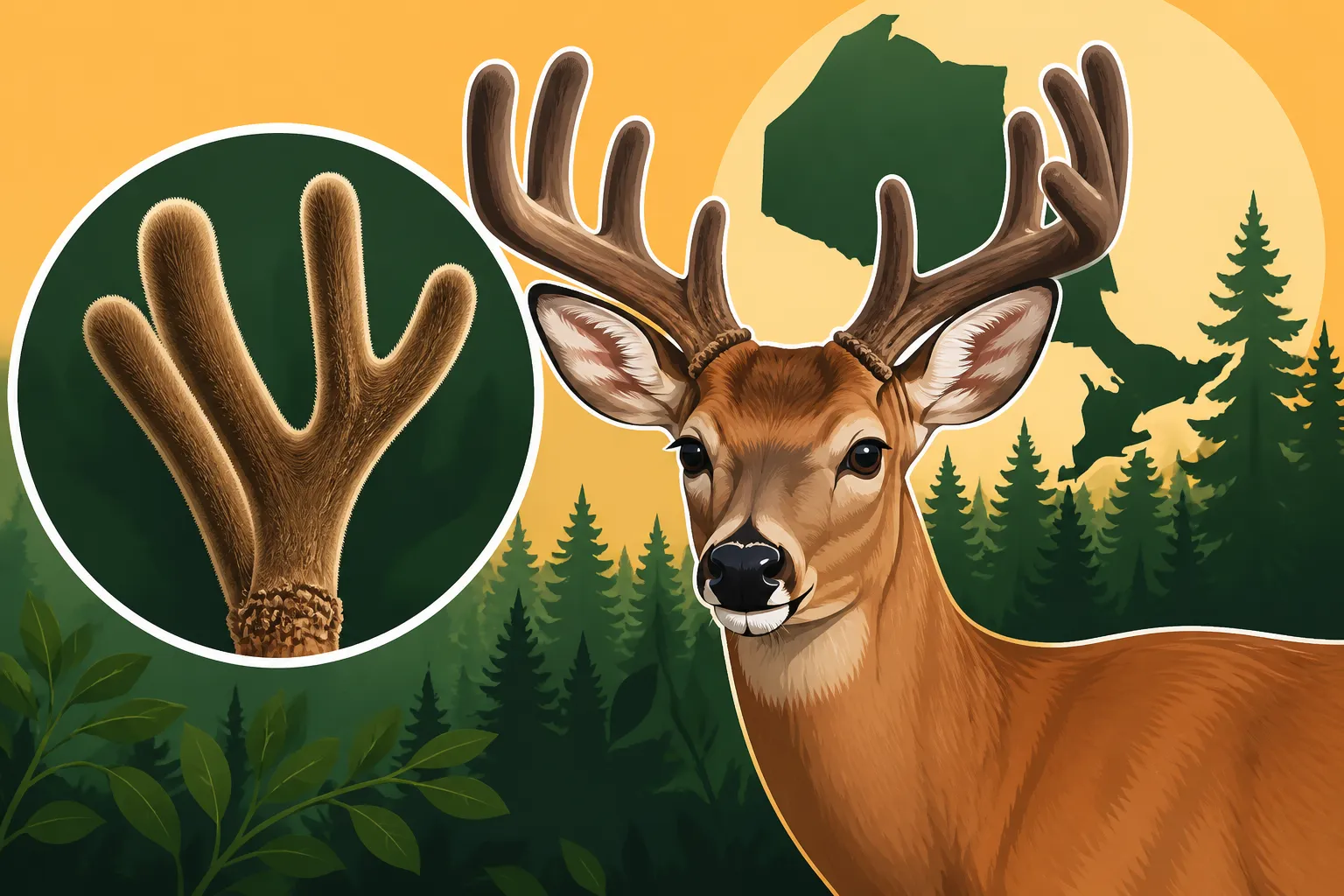
An August velvet buck has a distinct appearance that sets it apart. The texture is perhaps the most obvious clue: it's soft, almost downy, like felt. Imagine feeling the velvet on an old chair, but a bit coarser. This "fuzz" covers every inch of the antler. It's not smooth, shiny bone, but rather a matte, slightly fluffy surface.
The colour of velvet can vary, but in August, it typically ranges from a rich, dark brown to almost black, sometimes with reddish undertones. This dark colour is due to the dense network of blood vessels just beneath the surface. You won't see the light, bone-coloured antlers until the velvet is shed. The sheen is also unique; it's not the polished gleam of hard antlers, but rather a soft, velvety luster that absorbs light rather than reflecting it. Sometimes, especially in direct sunlight, the small hairs can catch the light, giving the entire rack a unique glow. It's a very alive, organic look, distinctly different from the dead, bony appearance of a hard antler.
Antler Size and Shape: Nearly Finalized, But Still Developing
By August, a buck's antlers are typically very close to their maximum annual size. The main beams will have reached most of their length, and the tines will be well-defined. You'll often see them looking quite robust and impressive. What's still happening is the hardening process, as the cartilage fully ossifies into bone, and often a final "swelling" at the base and along the beams, adding mass.
While the overall structure is largely set, there can still be minor changes. For instance, sometimes a brow tine might gain a bit more length, or a kicker point might become more pronounced. The buck's genetics, age, and nutritional intake throughout the spring and summer all play a huge role in this final size and shape. A healthy diet from good forage, especially in richer areas like Southern Ontario farmland, can contribute to impressive growth. This is the stage where you can pretty confidently size up a buck for the season. If you're a trophy hunter, this is when you're making mental notes, perhaps even getting out your spotting scope to assess potential.
Behavioural Clues: Still Somewhat Social, Less Aggressive
During August, bucks are still generally pretty chill. They haven't yet felt the full surge of testosterone that accompanies the rut, so their behaviour is noticeably different from what you'll see in October and November. They're often still quite social, forming bachelor groups. You might spot three, four, or even more bucks hanging out together, sometimes even with does and fawns, feeding peacefully in fields or along bush edges.
These bachelor groups are typically very focused on feeding, trying to pack on as much weight as possible before the strenuous rut period. They're not sparring aggressively, though you might see some light-hearted pushing or shoving, almost like playful roughhousing. There's usually no serious antler-to-antler combat like what you'd witness later in the year. Observing these groups can be an excellent way to Scouting a Wildlife Management Unit and learn about multiple deer in an area. However, as August progresses, and especially towards the end of the month, you might start to see bachelor groups disbanding as the hormonal changes begin and individual bucks become a bit more solitary, preparing for the velvet shed.
Distinguishing August Velvet from Hard Antlers or Early-Season Growth
Accurately identifying a buck's antler stage is critical for effective scouting and hunting. Misinterpreting what you're seeing can lead to wasted time or missed opportunities. Knowing the subtle (and sometimes not-so-subtle) differences between August velvet, hard antlers, and earlier growth stages is a skill every Ontario hunter should cultivate.
How to Tell It Apart from a "Hard-Horned" Buck
This is perhaps the most important distinction. A "hard-horned" buck is one that has shed its velvet, revealing the hardened, bony antlers underneath. The difference is stark.
Key Differences:
- Texture: Hard antlers are smooth, cold, and bony to the touch (if you could touch them!), often with visible ridges and grooves. Velvet antlers are soft, fuzzy, and feel organic.
- Colour: Hard antlers are typically bone-coloured, ranging from ivory to deep browns, stained by sap, dirt, and blood from the velvet shedding process. Velvet antlers are dark, purplish-brown or black.
- Sheen: Hard antlers have a natural, often polished sheen, especially on the tips or where they rub against brush. Velvet antlers have a matte, light-absorbing appearance.
- Blood: Hard antlers have no blood flow. Velvet antlers are alive, filled with blood, which gives them their characteristic dark colour and softness.
- Behaviour: Bucks with hard antlers, especially as September turns to October, become more aggressive, rubbing trees, scraping the ground, and challenging other bucks. Velvet bucks are generally more placid.
Imagine looking at a buck in late September versus one in mid-August. The September buck's antlers will be clean, possibly stained with sap from rubbing, and you'll see the distinct bony structure. The August buck's rack will appear soft, dark, and fuzzy. If you're unsure, look for any signs of peeling or dried-up velvet, which means the hardening process is complete or nearly so. This typically happens in late August or early September in Ontario.
Comparing Early-Season Velvet to August Velvet
While all velvet is fuzzy, there's a noticeable progression throughout the summer.
-
Early-Season Velvet (May-June):
- Size: Much smaller, often just nubs or short spikes.
- Shape: Lumpy, bulbous, less defined, still very much in the early stages of development.
- Fragility: Extremely tender and easily damaged. Bucks are very careful.
- Colour/Texture: Very dark, often almost black, and very thick or "puffy" due to rapid growth.
-
August Velvet (Late Season Velvet):
- Size: Near full size for the year, impressive and well-developed.
- Shape: Mostly finalized, with clear main beams and tines.
- Fragility: Still vulnerable to damage, but less so than earlier stages.
- Colour/Texture: Still dark but might appear slightly less puffy or more contoured as the bone hardens underneath. The fuzz might seem a little shorter or less dense in some areas as the shedding process approaches.
The difference is essentially seeing a blueprint versus a nearly completed structure. Early-season velvet is about raw, rapid expansion, while August velvet is about refinement and hardening before the big reveal. Knowing these differences can help you track individual deer throughout the summer, observing their growth progression. When Ontario Bucks Drop Their Antlers and Where to Look for Sheds in Ontario can provide valuable context for understanding the full antler cycle.
Mistakes Hunters Make in Identification
It's easy to get excited and make mistakes, especially when the light is poor or the buck is far away. Here are some common pitfalls:
- Mistaking Broken Tines for Velvet Shed: Sometimes, a buck might have a broken tine or a portion of its antler damaged. This can look uneven or oddly textured from a distance, leading some to mistakenly think the velvet is peeling. Always look at the entire rack for consistency.
- Poor Lighting Conditions: At dawn or dusk, or in dense shadows, it can be hard to discern fine details. A hard antler might look darker and less shiny than it is, especially if wet or covered in mud. Use binoculars or a spotting scope like those often recommended by resources like GoHunt to get a clearer view.
- Antler Deformities: Some bucks have unusual antler growth, often called "nontypical" points. These can sometimes appear lumpy or irregular, leading to confusion about velvet status. These are genetic or injury-related, not a stage of velvet growth.
- Rushing to Judgment: Patience is key. If you're unsure, observe the buck for a longer period if possible, or try to get another look at a different time of day or from a different angle. Don't assume based on a fleeting glimpse.
- Forgetting Behavioural Cues: If a buck is actively rubbing small trees or sparring fiercely with another buck, it's almost certainly hard-horned, regardless of what the visual might suggest through poor optics. Behaviour is often the ultimate tell.
| Antler Stage | Typical Appearance in August | Key Characteristics | Behavioural Clues |
|---|---|---|---|
| Early-Season Velvet | Small, lumpy, very dark nubs or short spikes. | Rapid growth, very tender, primary growth. | Very careful, solitary or small bachelor groups. |
| August Velvet | Near-final size and shape, dark brown/black, fuzzy texture. | Hardening underneath, mass development, almost complete. | Still somewhat social (bachelor groups), feeding focused, minimal aggression. |
| Hard Antlers | Bone-coloured, smooth, shiny, often stained. | No velvet, fully hardened, ready for rubbing/sparring. | Aggressive, territorial, rubbing, scraping, seeking does. |
Why Seeing Velvet in August Is Important for Ontario Hunters
Beyond the sheer beauty of witnessing a magnificent buck in velvet, these August sightings hold immense practical value for any dedicated Ontario hunter. This isn't just a pretty picture; it's a window into the deer's world that can directly influence your success when the season opens.
Scouting Opportunities: Pattern Bucks Before the Rut
August is prime time for intel gathering. While bucks are still in their summer patterns and bachelor groups, they tend to be more predictable. They're primarily focused on feeding, bedding, and moving between these two areas. This makes them easier to observe and pattern. If you see a particular buck consistently using a certain field edge or crossing a specific beaver dam in August, there's a good chance he'll continue to use that area, or at least be nearby, until the hormonal changes of the rut truly kick in.
Using scouting cameras during this period can be incredibly effective. Place cameras on trails leading to food sources, water, or bedding areas you've identified. By studying the time stamps and images, you can begin to understand daily routines, travel corridors, and even identify individual bucks by their unique racks. Tools like GoHunt can help you overlay these camera locations onto maps, tracking your sightings and building a comprehensive picture of deer activity in your chosen Hunting a Hardwood Ridge for Whitetails or Hunting a Standing Corn Field Edge. This pre-rut data is gold, allowing you to establish a starting point for your hunt plans before the chaos of the breeding season.
Understanding Antler Potential: Assessing a Buck's Growth
For hunters who appreciate mature deer, August is the moment of truth for antler assessment. This is your best chance to gauge a buck's potential before the season even begins. You can see the full spread, the number of points, and the mass that will likely be there once the velvet is shed. While minor changes can occur, the vast majority of the antler growth is complete.
This assessment helps you decide which bucks you'd be interested in pursuing. Is it a young buck with great potential for next year? Is it a mature animal carrying a truly impressive rack? This is also the time when you might identify a truly unique or nontypical antler configuration. Knowing what's out there allows you to fine-tune your harvest goals and focus your efforts. For hunters participating in specific tag draws or controlled hunts, understanding the size and presence of antlered deer in an area before When Ontario's Archery Season Opens can be a major advantage.
Planning for the Upcoming Season: Target Specific Animals
With the information gathered from your August velvet observations, you can start to formulate a highly targeted hunting plan. If you've identified a particular buck you want to pursue, you now have a starting point for where he's likely spending his time. This doesn't mean he'll be in the exact same spot two months later, but it gives you a crucial foundation.
For example, if you've been seeing a bachelor group of impressive bucks feeding in a particular alfalfa field in the evenings, you know that area is productive. You can then start thinking about stand placements for the early season, considering wind directions, access routes, and potential bedding areas nearby. You might decide to focus on Hunting an Ontario Bush Edge near that field.
| Scouting Advantage | Benefit of August Velvet Observation | How it Helps Hunters |
|---|---|---|
| Patterning | Bucks are in more predictable summer feeding/bedding routines. | Establishes initial travel routes and core areas before rut-induced movement changes. |
| Antler Assessment | Antlers are near full size and shape, allowing for accurate judgment of potential. | Helps set harvest goals, identify target bucks, and determine trophy potential for the season. |
| Stand Placement | Identifies key feeding, bedding, and travel corridors used daily. | Allows for strategic early-season stand setup, considering prevailing winds and deer entry/exit points. |
| Pre-Season Strategy | Provides critical information on deer presence, health, and distribution in a WMU. | Informs decisions on where to focus hunting efforts, whether to pursue a specific animal, or simply enjoy the hunt. |
| Early Season Readiness | Identifies potential food sources that will be active when Ontario Deer Season Dates and Tags begin. | Focuses scouting for early season bowhunting on specific fields or water sources where bucks are known to frequent. |
This August intel is invaluable, whether you're planning for Bowhunting Ontario's Long Archery Season or getting ready for the rifle hunt. It's about building a connection with the land and its wildlife, understanding the rhythms of nature, and preparing yourself for a successful and rewarding hunt in Ontario's diverse landscapes.
Disclaimer
This article is for general informational purposes only and does not constitute professional advice. Laws, prices and regulations vary by location and change over time. Consult a qualified professional for guidance on your specific situation.