Rules on Hunting From a Vehicle
We've all been there, pushing deep into the Ontario bush, perhaps on a well-worn logging road or an ATV trail, and the thought might cross your mind: wouldn't it be easier if I could just hunt right from here? It’s a tempting idea, especially after a long day of walking. But the rules around hunting from a vehicle in Ontario are very strict, and for good reason. This guide will clarify exactly what's permitted and, more importantly, what's definitely not, helping you stay safe and legal in the field.
The Foundation: Safety, Ethics, and Fair Chase
When we talk about hunting from a vehicle in Ontario, it’s not just about what feels right; it’s about concrete regulations designed to uphold the principles of safety, fair chase, and responsible wildlife management. These aren't just arbitrary rules; they're the bedrock of ethical hunting.
Why These Rules Exist
The primary reasons behind Ontario's stringent rules against hunting from vehicles boil down to three core pillars: public safety, wildlife conservation, and the fundamental concept of fair chase.
First, public safety is paramount. Discharging a firearm or bow from an unstable platform like a moving vehicle, or even a stationary one with an engine running, introduces significant risks. You have reduced control over your shot, a higher chance of a ricochet, and a greater potential for accidents involving other hunters, landowners, or the general public who might be recreating nearby. Imagine a scenario where a hunter takes a quick shot from the window of their truck at a deer by the roadside; the projectile could travel much further than intended, or hit an unseen object, leading to a dangerous situation. These rules are in place to prevent such tragic outcomes and ensure everyone can enjoy the outdoors safely.
Second, for wildlife conservation and management, using a vehicle to pursue or corner game undermines the natural challenge and skill involved in hunting. It would give hunters an unfair advantage, potentially leading to overharvesting and stress on animal populations. Ontario aims to maintain healthy, sustainable wildlife populations, and part of that involves ensuring hunting remains a challenging and respectful pursuit.
Lastly, the concept of fair chase is central to ethical hunting. Fair chase dictates that a hunter should not have an improper advantage over the animal. Hunting from a vehicle, in most circumstances, provides such an advantage, reducing the hunt to little more than a drive-by shooting. It diminishes the experience, the respect for the animal, and the hunter's connection to the wild. We're out there to pit our skills against the keen senses of wild animals, not to simply drive up and pull the trigger.
Understanding the Legal Definition of a "Vehicle"
In Ontario, when the regulations talk about a "vehicle," they're not just referring to your everyday pickup truck or SUV. The definition is broad and encompasses a wide array of conveyances, both motorized and, in some cases, even non-motorized when used in a specific way related to hunting.
This includes, but isn't limited to:
- Motorized vehicles: Cars, trucks, ATVs (All-Terrain Vehicles), UTVs (Utility Terrain Vehicles), side-by-sides, snowmobiles, motorcycles, and even boats with a motor.
- Aircraft: Helicopters or fixed-wing planes are strictly prohibited for hunting purposes, including spotting game with the intent to hunt the same day.
- Other conveyances: In some contexts, even a bicycle, horse, or horse-drawn carriage could fall under scrutiny if used to actively pursue or corner game in a manner that creates an unfair advantage.
The critical distinction often lies not just in the type of vehicle, but in its status and use at the time of hunting. For instance, an ATV doesn't need to be roaring down a trail for you to be in violation. If you're sitting on your ATV with a loaded firearm, even if the engine is off and you're just using it as a seat, you could still be considered to be "occupying a vehicle" while hunting. The intent and action are key. This is particularly important when considering things like ATV Rules on Ontario Crown Land, which often have additional regulations about where you can even operate these vehicles.
Specific Prohibitions and What They Mean for You
Understanding the "why" behind these rules is one thing, but knowing the precise "what" is crucial for any hunter in Ontario. The regulations are quite explicit about what you cannot do when it comes to vehicles and hunting.
Discharging a Firearm or Bow from a Vehicle
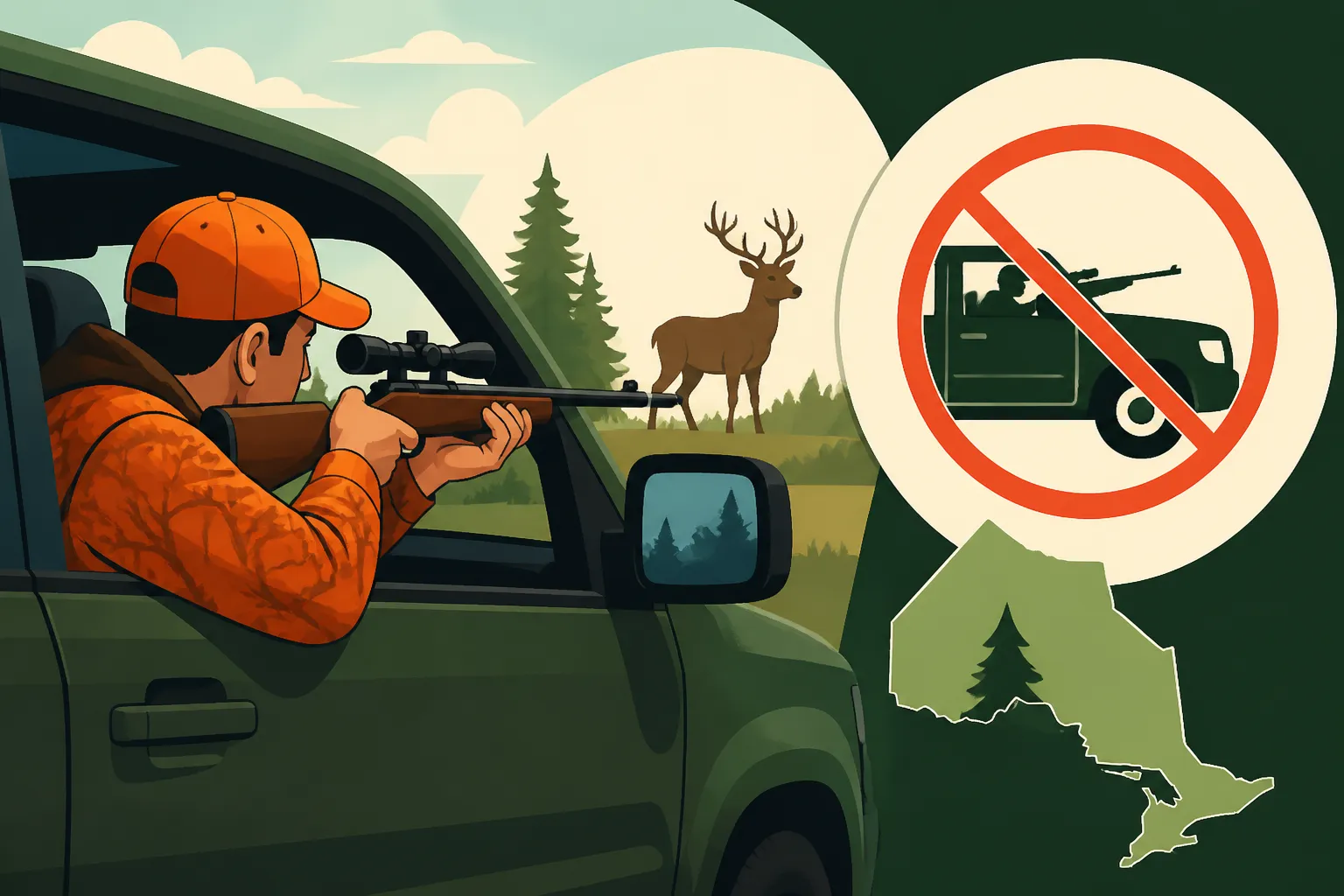
This is perhaps the most widely known prohibition: you cannot discharge a firearm or bow from a vehicle. This rule is practically iron-clad, with very few, highly specific exceptions.
Let's break down what "from a vehicle" means in practice:
- Sitting in or on the vehicle: Whether you're in the driver's seat, passenger seat, on the back of an ATV, or even just sitting on the hood of your truck, if you are part of the vehicle, you cannot shoot. This includes leaning against it while your feet are on the ground but your body is still supported by the vehicle. The law aims to prevent any situation where the vehicle is used as a hunting platform.
- The vehicle's engine status is irrelevant: It doesn't matter if your truck is idling, turned off, or in park. If you're physically in or on it, discharging a weapon is illegal.
- Any part of the vehicle: This extends to shooting over or under any part of a vehicle. Your shot must originate from outside the vehicle, with your feet on the ground, completely separate from the conveyance.
Consider this common scenario: You're driving slowly down a bush road, spot a grouse flush, and instinctively grab your shotgun. Even if you stop the truck, get out, and close the door, if you then shoot immediately from beside the vehicle without taking a few steps away, you might still be in violation. The expectation is that you disengage entirely from the vehicle before preparing to shoot. This often ties into the broader rules about Rules on Shooting Across a Road, which add another layer of complexity when you're hunting near any public thoroughfare.
Hunting While Occupying a Vehicle
This regulation goes a step further than just discharging a weapon. It states that you cannot hunt while occupying a vehicle if you have a loaded firearm or strung bow. This is a critical distinction and often misunderstood.
What does "occupying a vehicle" entail?
- Physically being in or on the vehicle: Again, this means sitting in the seat of a truck, on an ATV, or even in a boat (if it’s under power or not anchored for hunting).
- Loaded firearm or strung bow: This is the key element here. If you are in a vehicle and your firearm is loaded (magazine in, round chambered, or shotgun plugged but shells in the tube) or your bow is strung (ready to fire), you are hunting from a vehicle.
Let's imagine you're deep in the wilderness on a Moose Hunting Ontario's Northern Bush expedition. You're riding in a side-by-side with a guide, heading to a known moose crossing. Your rifle is in a soft case, unloaded, in the back. This is perfectly legal. However, if you have the rifle across your lap, loaded, ready to go, and you're still moving, you are in violation. The moment you spot game and intend to harvest it, you must exit the vehicle, ensure your firearm is properly handled (if loaded, carefully and safely), and establish yourself on foot.
This rule is designed to prevent opportunistic shooting and to ensure that a hunter is actively engaged in the hunt on foot, not merely using a vehicle as a mobile hunting blind. Even when actively Calling Moose in Ontario's Boreal Forest, you should always be on foot, away from your vehicle, to ensure you're in compliance.
Transporting Loaded Firearms in Vehicles
This is a specific element within the larger framework of firearm safety and transportation, and it's particularly relevant to hunting from a vehicle. Generally, in Ontario, it is illegal to transport a loaded firearm in any vehicle, including cars, trucks, ATVs, and snowmobiles.
What constitutes "loaded"?
- For shotguns and rifles: A firearm is considered loaded if there is a live round in the chamber, magazine, or attached tubular magazine (even if the action is open).
- For muzzleloaders: A muzzleloader is considered loaded if it contains powder and projectile, whether or not the primer is installed or percussion cap is on.
- For bows: A bow is considered strung if it is set up and ready to shoot, even without an arrow nocked.
The rules specify how to transport firearms safely. They must be unloaded and, ideally, cased or securely fastened in a non-readily accessible manner (e.g., in a trunk or behind the seat, out of immediate reach). This is not just a hunting regulation but a fundamental firearms safety law in Canada.
For non-residents, these rules are particularly important to understand, especially when considering Bringing Firearms Into Ontario and filling out documentation like The Non-Resident Firearm Declaration. Any deviation from these strict transport rules can lead to serious legal issues, regardless of whether you are actively hunting.
Using a Vehicle to Pursue Game
This regulation targets the unethical practice of using a vehicle to actively chase, herd, or drive wildlife, whether it's for hunting purposes or not. You cannot use a vehicle to pursue, harass, or scare game animals.
This includes:
- Chasing animals: Directly following an animal with a vehicle to tire it out, corner it, or bring it into range.
- Herding animals: Using a vehicle to intentionally move animals towards other hunters, a property line, or a specific area.
- Harassing wildlife: Driving aggressively near animals, making loud noises, or otherwise disturbing them with a vehicle.
This rule emphasizes the respect for wildlife and the principle of fair chase. Animals should be pursued through skill, stealth, and knowledge of their habits, not through the mechanical advantage of a vehicle. This applies whether you're deer hunting in southern Ontario farmland or Hunting Moose Off a Bush Road in the north. The road is for access, not for active pursuit of game. Even when simply observing wildlife, maintaining a respectful distance is key.
Limited Exceptions and Nuances
While the rules are generally strict, there are a few very specific situations where hunting from a vehicle, or having a loaded firearm in one, might be permitted. However, these are exceptions, not the norm, and come with their own set of stringent requirements.
Disabled Hunter Permits
Ontario recognizes that hunters with mobility impairments might require accommodations to continue participating in the sport they love. For this reason, the province offers Disabled Hunter Permits. These permits can grant specific exemptions to the general rules about hunting from a vehicle.
To qualify for a Disabled Hunter Permit, an individual must have a permanent mobility impairment that significantly restricts their ability to walk or move independently. This isn't just for a sprained ankle; it's for permanent conditions.
The permit, when issued, may allow a hunter to:
- Discharge a firearm or bow from a stationary vehicle: This means the vehicle must be completely stopped, with the engine off, and the hunter must still be in control of the shot. The specific conditions will be outlined on the permit itself.
- Transport a loaded firearm in a vehicle: Again, under very specific conditions, usually when the hunter is accompanied by an able-bodied individual who can assist, and the firearm remains pointed in a safe direction.
It's absolutely crucial that any hunter with a Disabled Hunter Permit understands its exact limitations and conditions. These permits are not a blanket allowance to disregard all vehicle hunting rules. They are typically tied to specific equipment or a designated assistant. Hunters should always carry their permit with them and be prepared to present it to a Conservation Officer. For more details, resources like the GoHunt app or website can be invaluable for looking up the specific criteria and application process for these permits.
Farmers and Livestock Protection
Another narrow exception exists for farmers or landowners protecting their livestock or crops from nuisance wildlife, often specific to species like deer, coyotes, or bears causing damage. These exemptions are usually granted under a specific permit or authorization from the Ministry of Natural Resources and Forestry (MNRF).
Key aspects of this exception include:
- Specific animal and situation: The permit will typically specify the species of animal, the property where the activity is permitted, and the conditions under which the animal can be harvested. This is not a general hunting licence.
- Prevention of damage: The intent is solely to prevent or mitigate damage to agricultural property or livestock, not for recreational hunting.
- Reporting requirements: Any animals harvested under such a permit usually require mandatory reporting to the MNRF.
For instance, a farmer experiencing significant crop damage from deer might obtain a permit to harvest deer outside regular seasons or with methods usually prohibited, which might include specific allowances for shooting from a vehicle in certain contexts on their own property, under strict controls. However, this is distinct from general recreational hunting.
Unloaded and Cased Firearms for Transport
While transporting a loaded firearm in a vehicle is prohibited, the legal and proper method for moving your hunting equipment to and from your hunting grounds is to have your firearms unloaded and cased or securely fastened.
Here's what this means in practice:
- Unloaded: As discussed, no ammunition in the chamber, magazine, or tubular magazine. For muzzleloaders, no powder and projectile.
- Cased: Firearms should be stored in a proper gun case (soft or hard). This offers protection for the firearm and clearly signals that it is not in use.
- Securely fastened or not readily accessible: If not cased, the firearm should be secured in a way that it cannot be easily reached or accidentally discharged, such as in the trunk of a car, or behind the seat of a truck, out of immediate reach. The goal is to prevent quick access.
Following these transportation rules is not just about compliance; it's a cornerstone of responsible gun ownership and ensures safety for everyone on the road. Whether you're driving to a deer camp for Rifle Hunting Ontario's Deer Season or heading out for Spring Turkey Hunting in Ontario, always ensure your firearms are transported legally.
Consequences of Non-Compliance
Ignoring Ontario's hunting regulations, especially those pertaining to vehicles and firearms, isn't just a minor infraction. The Ministry of Natural Resources and Forestry (MNRF) takes these rules very seriously, and violations can lead to significant penalties.
Penalties and Fines
The consequences for illegally hunting from a vehicle, transporting a loaded firearm improperly, or using a vehicle to pursue game can be severe, reflecting the serious nature of these offenses.
- Substantial Fines: You could face significant monetary penalties. Fines for such infractions can range from hundreds to thousands of dollars, depending on the specific charge, the severity of the offense, and whether it's a first-time or repeat offense. For example, discharging a firearm from a vehicle is a serious charge that typically carries a hefty fine.
- Loss of Hunting Privileges: One of the most impactful penalties for hunters is the automatic suspension of your hunting licence and Outdoors Card. This can mean being prohibited from hunting in Ontario for a period of one to five years, or even longer in severe cases. Imagine missing several seasons of Whitetail Hunting in Ontario because of one ill-advised decision. This loss can be particularly frustrating for dedicated hunters who have spent years building their skills and knowledge.
- Seizure of Equipment: Conservation Officers have the authority to seize any equipment used in the commission of an offense. This can include your firearm, ammunition, hunting gear, and even the vehicle itself (your truck, ATV, or snowmobile). While some seized property might be returned after fines are paid, in serious cases, it can be permanently forfeited to the Crown. Losing your prized hunting rifle or the ATV you use for access can be a devastating financial blow, on top of the fines and licence suspension.
- Criminal Charges: In extreme cases, especially if there's gross negligence, public endangerment, or repeat offenses, you could face criminal charges, not just provincial offenses. This could lead to a criminal record, which has far-reaching implications beyond hunting, affecting employment, travel, and personal freedom.
It's a stark reminder that hunting is a privilege, not a right, and it comes with serious responsibilities. Always consult the official Ontario Hunting Regulations Summary, easily accessible online or through resources like GoHunt, to ensure you are up-to-date with all rules. It's also critical to understand general provincial rules regarding Ontario Penalties for Hunting Violations for a broader perspective on legal repercussions.
Reporting Violations
The ethical hunting community in Ontario plays a crucial role in ensuring these rules are upheld. If you witness a violation, such as someone obviously hunting from a vehicle or harassing wildlife, you have a responsibility to report it.
- "Report a Poacher" Line: Ontario has a dedicated, toll-free telephone line for reporting natural resource violations. This is the MNRF Tips Line, often referred to as the "Report a Poacher" line. The number is 1-877-TIPS-MNR (1-877-847-7677).
- Online Reporting: You can also submit reports online through the Ontario government website. This is particularly useful for non-urgent observations or when you have detailed information and perhaps photos or video (taken safely and legally).
- What to Report: When reporting, try to gather as much detail as possible, safely and without putting yourself at risk. This includes:
- Date, time, and specific location of the incident (e.g., road name, nearest intersection, WMU).
- Description of the individuals involved (clothing, distinguishing features).
- Description of the vehicle (make, model, color, licence plate number).
- Type of suspected violation (e.g., shooting from vehicle, loaded firearm).
- Any other relevant observations.
- Anonymity: You can choose to remain anonymous when making a report. Conservation Officers rely heavily on public assistance to enforce regulations and protect Ontario's wildlife resources.
Reporting violations is not about being a "snitch"; it's about safeguarding the future of hunting and demonstrating a commitment to responsible wildlife management. It helps protect honest hunters and ensures that our shared natural resources are respected. For more information on this process, check out the guide on Reporting a Poacher in Ontario.
Disclaimer
This guide provides general information about hunting from a vehicle in Ontario and is not a substitute for the official hunting regulations. Hunters are responsible for understanding and complying with all current provincial and federal laws. Always consult the most recent Ontario Hunting Regulations Summary published by the Ministry of Natural Resources and Forestry (MNRF) before heading afield. Laws can change, and specific situations may have unique interpretations or requirements.