Ontario Posted Land and Signage Rules
It can be incredibly frustrating to be out hunting, feeling like you've found the perfect spot, only to suddenly encounter a "No Trespassing" sign or realize you've strayed onto private land. The confusion around what constitutes legally posted land, what signs mean, and a hunter's responsibilities is a common challenge for many in Ontario. This guide will clarify Ontario's rules regarding posted land, signage, and your obligations as a hunter to ensure a respectful and legal hunt.
Understanding Ontario's Trespass Act for Hunters
One of the biggest misunderstandings for hunters, especially those new to Ontario or coming from jurisdictions with different rules, is the fundamental principle of trespass. It's not always about seeing a sign; sometimes, the law assumes land is private even without explicit posting. This can lead to honest mistakes with potentially serious consequences.
The Core Principle: Permission is Key
In Ontario, the default assumption for private land is that access is not granted unless you have explicit permission from the landowner or occupier. This is a crucial distinction from some other places where land is considered open to public access until it is specifically posted as private. Here, if it's not Crown land or public access land, it's generally considered private, and you need to have a clear understanding of your whereabouts.
Imagine you're tracking a deer in what seems like endless bush, only to find a well-maintained logging road that suddenly feels different. You might assume it's public access, but it could very well be a private logging company's road on their land. Without permission, even if there's no visible sign right at that moment, you could be trespassing. Always err on the side of caution.
What happens if you realize you've accidentally crossed a boundary onto private land? The immediate action is to unload your firearm, turn around, and leave the property by the most direct route. Don't try to hide, don't try to continue your hunt, and certainly don't argue if you encounter someone. An honest mistake can still be a trespass, but demonstrating your immediate intention to rectify it goes a long way.
What Constitutes "Posted" Land in Ontario?
While the core principle is that private land is generally off-limits without permission, actual "posting" solidifies this and serves as a clear warning. The Trespass to Property Act defines what constitutes "posted" land, making it abundantly clear when entry is prohibited. It's not just about a flimsy paper sign tacked to a tree; there are various ways land can be legally posted, both explicitly and implicitly.
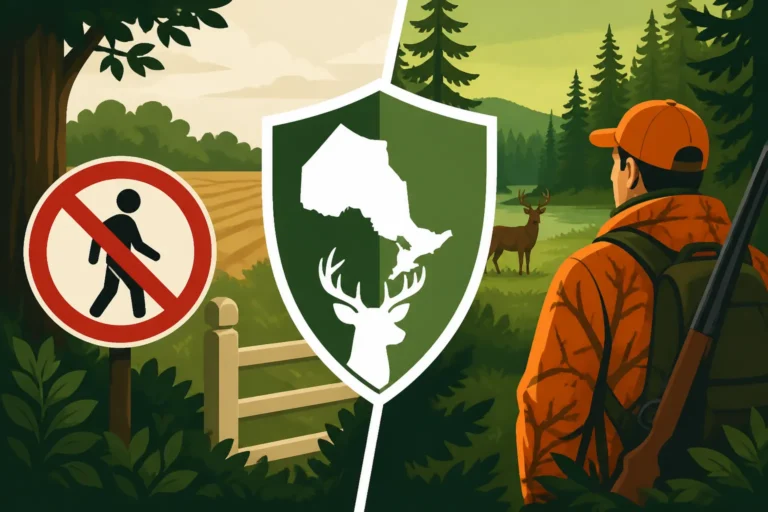
One common method is, of course, the physical sign. These signs usually state "No Trespassing," "Private Property," or "Hunting Prohibited." However, the absence of such a sign doesn't automatically mean permission. For instance, if you're looking at a well-maintained field with crops growing, or a fenced-in pasture with livestock, these areas are considered "posted" by their very nature, even if no signs are present. It's a matter of reasonable expectation – anyone can see that these are actively managed private lands.
Knowing these nuances is critical. It forces hunters to not just look for signs, but to understand the characteristics of the land itself. Is it cultivated? Is it fenced? Are there buildings nearby? All these factors play into whether an area is considered private and off-limits without specific authorization. This is where tools that show property boundaries can be incredibly helpful, taking some of the guesswork out of the equation.
Legal Requirements for Signs and Posting
When a landowner decides to explicitly post their property, there are certain standards and expectations for those signs to be legally effective. These aren't just suggestions; they're part of ensuring clear communication about property boundaries and prohibited activities.
The Specifics of "No Trespassing" Signs
For "No Trespassing" signs to hold legal weight, they generally need to be clearly visible and of a reasonable size. While the Trespass to Property Act doesn't specify exact dimensions, common sense dictates that a sign should be easily seen by someone approaching the property. They should be strategically placed at obvious access points, such as driveways, trails, and property corners, and along the boundaries at reasonable intervals. You wouldn't expect a sign every ten feet in dense bush, but you would expect them at regular points where someone might reasonably enter the property.
The wording on these signs is also important. "No Trespassing" is the most common and direct. "Private Property" also clearly indicates that the land is not public. Sometimes, landowners might add "Hunting Prohibited" or "No Hunting or Trapping" to be even more specific about the activities they wish to prevent. These signs serve as a legal warning, and ignoring them can lead to charges under the Trespass to Property Act, which can include fines and potential loss of hunting privileges. Always take these signs seriously.
It's also worth noting that signs can be a simple colour marker. While less common for "No Trespassing," sometimes specific colours are used by landowners or land trusts to indicate boundaries or specific rules. However, for a clear "No Trespassing" message, written signs are the most unambiguous and legally sound. When in doubt, a physical sign explicitly stating "No Trespassing" is the clearest indicator of prohibited entry.
Beyond Physical Signs: Implied Trespass
This is where things can get a little tricky for hunters who are used to looking only for signs. In Ontario, several scenarios imply that land is private and off-limits, even without a single "No Trespassing" sign in sight. This concept of "implied trespass" puts the onus on the individual to recognize private property by its characteristics.
One major category is cultivated land. Think about a farmer's field, an orchard, a vineyard, or even a neatly kept garden plot. These areas are inherently understood to be private and actively managed. You wouldn't expect to walk into someone's cornfield during hunting season without permission, just because there isn't a sign on every stalk. The act of cultivation itself serves as a clear indication that the land is private and not open for public access. This applies whether the crops are actively growing or the field is lying fallow after harvest.
Similarly, fences and enclosures often imply private property. A well-maintained fence around a pasture or a woodlot, or a gate across a private lane, signals that the area is not public access. While a broken-down old fence might be less clear, substantial fencing generally indicates a landowner's intention to control access. Furthermore, the immediate vicinity of a dwelling house or other buildings (like barns, sheds, or cottages) is automatically considered private. You don't need a "No Trespassing" sign plastered on the side of a barn to know that walking right up to it without permission is a violation. These areas are considered part of the landowner's curtilage and are off-limits.
These implied postings are just as legally binding as physical signs. A landowner doesn't need to spend a fortune on signs if their property visibly falls into these categories. It means hunters must be observant and understand the landscape, not just read signs. This is why tools that display property ownership are so valuable in helping hunters make informed decisions before they even step foot on the land.
Navigating Private vs. Public Land: Hunter's Responsibilities
As hunters, the responsibility for knowing where we are and whose land we are on falls squarely on our shoulders. Ignorance of boundaries is not a valid defence, and respecting property rights is fundamental to maintaining a positive public image for hunting.
Scouting and Due Diligence Before the Hunt
Before you even think about setting up a stand or still-hunting an area, meticulous scouting and due diligence are absolutely essential. This isn't just about finding game sign; it's about understanding the land tenure. You need to know exactly where Crown land ends and private land begins, where different landowners' properties meet, and any specific restrictions that might apply.
This is where modern technology has become an absolute game-changer. Digital mapping applications like onX Hunt or GoHunt allow you to overlay property lines onto satellite imagery or topographic maps. You can see who owns what, identify potential access points, and plan your hunt to avoid trespassing altogether. Before I head out, I spend hours poring over these maps, identifying every boundary, every parcel of private land, and every possible Crown land access point. It's truly empowering to have that level of information at your fingertips. Remember to verify with physical signs when possible, as map data can sometimes have slight discrepancies or not reflect recent changes.
Failing to do this homework can lead to awkward encounters, legal trouble, and a black eye for all hunters. It’s also wise to check for specific regulations pertaining to a Wildlife Management Unit (WMU), as some areas might have unique rules regarding public access or hunting methods. Being prepared means you've done your research, you know your route, and you understand the ownership of the land you intend to hunt. For more on preparing for your hunt, you might want to read Scouting With Satellite Imagery in Ontario.
What to Do If You Accidentally Trespass
Despite your best efforts and careful planning, mistakes can happen. You might follow a game trail too far, or a boundary marker might be obscured. If you find yourself on private land without permission, it's crucial to react correctly and immediately.
Your first action should be to make yourself safe and clearly demonstrate your intention to leave. Unload your firearm and secure it, then immediately leave the property by the most direct and least intrusive route. Do not try to sneak out, do not try to finish your hunt, and absolutely do not attempt to harvest any game you might have seen while trespassing. If you encounter a landowner or their representative, be polite, apologetic, and explain that it was an honest mistake, and you are in the process of leaving. Do not argue or become confrontational, regardless of how you feel about the situation. Your primary goal is to de-escalate and rectify the situation by removing yourself from their property.
A common scenario involves retrieving game. What if you shoot a deer on public land, but it runs onto private property? In Ontario, you absolutely cannot pursue or retrieve that animal without first obtaining explicit permission from the landowner. Entering private land, even to retrieve game, without permission is still considered trespassing. This can be a tough pill to swallow, especially after a successful shot, but respecting property rights always comes first. You must make every effort to contact the landowner, explain the situation, and respectfully ask for permission to retrieve your animal. Sometimes they'll grant it, sometimes they won't, and you have to be prepared for either outcome. For detailed guidance on this, check out Retrieving Game From Private Land in Ontario.
Landowner Perspective and Building Relationships
Understanding why landowners post their land is crucial for hunters. It’s not always about being anti-hunting; often, there are very practical and understandable reasons behind their decisions. Building positive relationships with landowners is vital for the future of hunting in Ontario.
Why Landowners Post Their Land
Landowners post their properties for a variety of reasons, and it's rarely just to be difficult. Often, it comes down to genuine concerns about safety. They might have children or pets, or simply want to know who is on their land, especially when firearms are involved. The liability associated with someone getting injured on their property is a serious concern for many.
Privacy is another major factor. People want to enjoy their land without unexpected visitors, and a "No Trespassing" sign clearly communicates that desire. Unfortunately, some landowners have also had bad past experiences with hunters: littering, leaving gates open, damaging property, or driving off-road where they shouldn't. These incidents, even if isolated, can quickly lead to an entire property being posted for all future hunters. Finally, some landowners want to manage the game populations on their own land, perhaps for wildlife viewing, or they have specific management goals that don't align with public hunting pressure. Empathizing with these reasons, rather than dismissing them, is the first step toward fostering better hunter-landowner relations.
Seeking Permission: The Right Way
If you're interested in hunting private land, the only way to do it legally and ethically is to obtain permission from the landowner. This isn't just a formality; it's a demonstration of respect and a way to build trust. Don't wait until the last minute or show up on opening day. Plan ahead.
Approach landowners respectfully and well in advance of the hunting season. A face-to-face conversation is always best, if possible. Be prepared to introduce yourself, explain why you're interested in hunting their land, and show them you're a responsible hunter. You might offer to show them your hunting license, proof of insurance, or even references from other landowners if you have them. Offer to share some of your harvest, or help with small chores on their property. Be clear about what you intend to hunt, what dates you'd like to be there, and what entry points you would use. Make sure you understand their specific rules regarding access, areas to avoid, and any expectations they might have.
Most importantly, be prepared to accept "no" gracefully. A landowner is under no obligation to grant you access, and badgering them will only solidify their decision. A polite "thank you for your time" is far more likely to leave a positive impression, perhaps opening the door for future consideration. Building these relationships takes time and effort, but the rewards—access to prime hunting ground and a strong reputation for hunters—are well worth it. You can learn more about how to approach this process in Getting Private Land Permission in Ontario and Asking an Ontario Landowner for Permission.
Special Considerations for Crown Land Edges and Managed Forests
Ontario is blessed with vast tracts of Crown land, offering incredible hunting opportunities. However, even with Crown land, there are nuances, especially where it borders private property or where special designations apply.
Identifying Crown Land Boundaries
While Crown land is generally open for public hunting (with proper licensing and adherence to regulations), pinpointing its exact boundaries, especially in remote areas, can be surprisingly difficult. Unlike private land, Crown land often lacks explicit signage marking its edges. This means hunters must rely heavily on maps and technology to confirm they are indeed on public land.
This is precisely why tools like onX Hunt and GoHunt are indispensable for hunting in Ontario. They allow you to accurately identify Crown land parcels, distinguish them from adjacent private holdings, and navigate within those boundaries. Without such resources, you could easily drift onto private property without realizing it, especially in areas with a checkerboard of ownership or along old, ill-defined survey lines. Always assume that land is private until you can confirm it is Crown land using reliable mapping sources. It's not uncommon for old logging roads or trails to traverse both Crown and private land, so continuous vigilance is key. For more on this, consult Reading Ontario Crown Land Layers on onX and Hunting Ontario's Crown Land.
Managed Forest Tax Incentive Program Lands
Another area of potential confusion for hunters is land that is part of the Managed Forest Tax Incentive Program (MFTIP). These are privately owned lands, but because they are managed for forestry, they can sometimes resemble Crown land, with vast stretches of bush and logging trails.
However, despite their appearance, MFTIP lands are still private property. While some landowners participating in the program might allow public access for certain activities, this is not a universal rule. You absolutely cannot assume that because a forest appears "managed" or looks like Crown land, it is open for hunting. Trespassing rules still apply. Always look for signage, and if you are interested in hunting these lands, you must seek and obtain explicit permission from the landowner, just as you would for any other private property. The onus is entirely on the hunter to know the status of the land they are on. Don't let the look of the forest fool you into thinking it's public access.
This scenario underscores the importance of not making assumptions based on visual cues alone. Always verify land ownership using reliable maps, and if a property is private, always get permission. It’s the responsible and respectful way to hunt in Ontario.
Here's a quick reference table outlining the key aspects of posted land:
| Type of Land/Posting | Description | Hunter's Responsibility |
|---|---|---|
| Explicit "No Trespassing" Signs | Clearly visible signs stating "No Trespassing," "Private Property," etc. | Do not enter without explicit permission. Legal consequences for violation. |
| Cultivated Land | Fields, orchards, gardens, active agricultural areas (even if fallow). | Considered implicitly private. Do not enter without permission, even without signs. |
| Fenced/Enclosed Land | Substantial fences, gates, or enclosures around properties or pastures. | Implies private property. Do not enter without permission. |
| Vicinity of Dwellings | Areas immediately surrounding houses, cottages, barns, or other buildings. | Automatically considered private. Do not approach or enter without permission. |
| Crown Land | Publicly owned land managed by the provincial government. | Generally open for hunting (with proper licenses), but confirm boundaries carefully using maps/GPS. |
| Managed Forest (MFTIP) | Private land managed for forestry, may resemble Crown land. | Still private property. Always seek explicit permission from landowner; do not assume public access. |
Disclaimer
This article is for general informational purposes only and does not constitute professional advice. Laws, prices and regulations vary by location and change over time. Consult a qualified professional for guidance on your specific situation.