Setting a Goose Spread in Cut Corn
There's nothing quite as frustrating as spending hours setting up in a goose field, only to have flock after flock of big Canada geese flare at the last minute, their keen eyes picking out something unnatural in your spread. It’s a common scenario for many waterfowl hunters, especially when those birds have been educated by a few weeks of hunting pressure. This guide is all about helping you overcome that challenge, diving deep into the art and science of setting an effective goose spread specifically in cut cornfields here in Ontario, where weary birds demand a little extra finesse.
Understanding Goose Behavior in Cut Corn
Geese are creatures of habit, driven by hunger and safety. In Ontario, once the corn choppers and combines have done their work, those vast fields become prime feeding grounds, littered with delicious, high-energy kernels. But it’s not just about the food; it’s about how they access it and where they feel secure doing so. Understanding these nuances is the first step to truly fooling them.
Why Cut Corn is a Goose Magnet
Cut cornfields are an absolute buffet for Canada geese. After harvest, there's always plenty of shattered grain left on the ground, a veritable goldmine of carbohydrates that these birds need to fuel their long migrations or simply get through a cold Ontario day. Unlike fields with standing crops that hide potential predators, a cut cornfield offers wide-open visibility, giving geese a sense of security. They can see danger approaching from a distance, which is a huge factor in their choice of feeding locations.
Think about it from a goose's perspective: a big, open field with easy access to food and a clear view all around. It's the perfect combination. They'll often feed in tight family groups, moving across the field methodically, hoovering up every available kernel. This feeding behavior is crucial to mimic with your decoy spread. When they come into a field, they're not just landing anywhere; they're looking for a comfortable spot within an existing "flock" where they can quickly get to eating. Recognizing these prime feeding areas is part of the extensive groundwork involved in Scouting Fields for Ontario Waterfowl.
Reading the Birds: Flight Paths and Feeding Patterns
Before you even think about throwing out your first decoy, spend time observing the geese. This might sound obvious, but many hunters rush this step. Watch where they enter the field, how they approach it, and where they seem to want to settle. Do they consistently come in from a certain direction, perhaps over a low rise or a treeline? Are they avoiding a particular corner of the field? These observations are gold.
Pay attention to wind direction, too. Geese, like all waterfowl, land and take off into the wind. This is non-negotiable for them. Your spread needs to be set up so that your landing zone is directly into the prevailing wind direction, guiding them exactly where you want them to be. They'll also often fly over areas where they've fed successfully before, even if they don't land there every time. Noticing these little patterns can give you a significant advantage, helping you decide where to concentrate your spread and hide your blinds.
Essential Gear for Your Cut Corn Spread
Successfully hunting geese in cut corn isn’t just about having some decoys; it’s about having the right decoys and supporting gear, and knowing how to use them. The details matter, especially when dealing with intelligent, wary birds. Investing in quality gear pays off in the long run.
Decoy Selection: The Foundation of Your Spread
The sheer variety of goose decoys out there can be overwhelming. For cut corn, realism and movement are key. You'll want a mix to create a believable scene.
- Full-Body Decoys: These are the backbone of any serious goose spread. They offer three-dimensional realism that can be hard to beat, especially on calm days or when birds are scrutinizing your spread from a distance. Set them up in lifelike poses – feeders, sentries, resting birds. The more natural they look, the better. Manufacturers like Avian-X, Tanglefree, and GHG Gorhilla make excellent full-body decoys. However, they are bulky and expensive. You’ll need a decent trailer or truck bed to haul a significant number of these.
- Shell Decoys: These are half-shells that sit directly on the ground. They're less realistic than full-bodies but offer a great way to add bulk to your spread without breaking the bank or your back. They're fantastic for filling in the middle ground of your spread, creating the illusion of a larger flock. Some hunters use them to represent birds with their heads down, feeding.
- Silhouettes: Flat, two-dimensional decoys that are super lightweight and portable. While they lack the 3D realism, they can be incredibly effective in certain situations, especially on windy days when they flicker and appear to move. They're excellent for expanding the perceived size of your flock and can be deployed quickly to adjust to changing flight patterns. GoHunt often features articles on budget-friendly decoy options where silhouettes might be highlighted.
- Socks/Windsocks: These are lightweight, fabric decoys that inflate and move with the slightest breeze, creating fantastic motion. They're very affordable and can add a ton of realism to your spread's movement. They are particularly effective when placed on the downwind side or edges of your spread, as their constant motion can catch a goose's eye from afar.
- Motion Decoys: Anything that adds dynamic movement. Flapping wing decoys (e.g., Mojo), S-curve motion stakes, or even simple bouncers that make a full-body decoy sway in the wind. Movement breaks up the static look of your spread and simulates live birds. Just don't overdo it; too much unnatural motion can sometimes spook birds.
A typical cut corn spread might utilize 1-2 dozen full-bodies as the core, surrounded by 3-5 dozen shells and another 3-5 dozen socks or silhouettes to create depth and volume.
Blinds and Concealment: Becoming Invisible
Geese have incredible eyesight. If they see you, your hunt is over before it begins. Flawless concealment is non-negotiable.
- Layout Blinds: These are your best friend in a wide-open cut cornfield. They lay flat on the ground, allowing you to hide completely. Modern layout blinds are comfortable and effective, but they must be brushed in meticulously. This means stuffing them with natural material from the field itself – cornstalks, stubble, weeds – until they virtually disappear into the environment. Don’t be lazy; a poorly brushed blind is a guaranteed bust. Many hunters often discuss their experiences and tips for Hunting Canada Geese on Ontario Farmland where these blinds are indispensable.
- Natural Cover: Sometimes, if you're lucky enough, a field might have a fencerow, a ditch, or a patch of unharvested cover nearby that you can utilize. If you can hunt from the edge of such cover, it often provides the best concealment. Just remember to break up your outline and ensure you have a clear shooting lane.
- Vehicles/Trailers: In some areas and situations, particularly with experienced birds, using a vehicle as a blind can work if it blends into the agricultural landscape. However, rules vary, and it's generally less effective than a well-brushed layout blind for wary geese. Always check local regulations regarding hunting from or near a vehicle.
Calls and Other Accessories
Beyond decoys and blinds, a few other items can make or break your hunt.
- Goose Calls: A quality short-reed goose call is essential. Practice, practice, practice! Being able to replicate realistic honks, clucks, and moans is crucial for bringing birds in the last 100 yards. Don't just blast away; learn to read the birds and call to them accordingly. Sometimes less is more, especially with pressured birds.
- Flags: Goose flags, which mimic a goose flapping its wings, are highly effective for grabbing distant birds' attention. They create visual movement that can pull birds off a distant flight path or give them confidence as they approach. They're a fantastic way to add motion without the battery dependence of electronic decoys.
- Bags and Transport: Decoy bags are vital for protecting your investment and making setup/teardown more efficient. For full-body decoys, slotted bags keep them from rubbing and scratching. For shells and socks, large mesh bags work well. When it comes to getting all this gear to the field, a reliable ATV or side-by-side, or even a good old-fashioned sled, can be invaluable.
- Non-Toxic Shot: Don't forget that Non-Toxic Shot Requirements for Waterfowl are strictly enforced in Ontario. Steel, bismuth, or tungsten loads are mandatory for goose hunting. Always carry enough shells for the hunt, factoring in misses and multiple flocks.
Crafting the Perfect Spread in Cut Corn
This is where the art truly comes in. It's not just about throwing decoys out; it's about arranging them in a way that tells a story, making approaching geese believe they're seeing a relaxed, feeding flock.
The Core Spread Design: Telling a Story
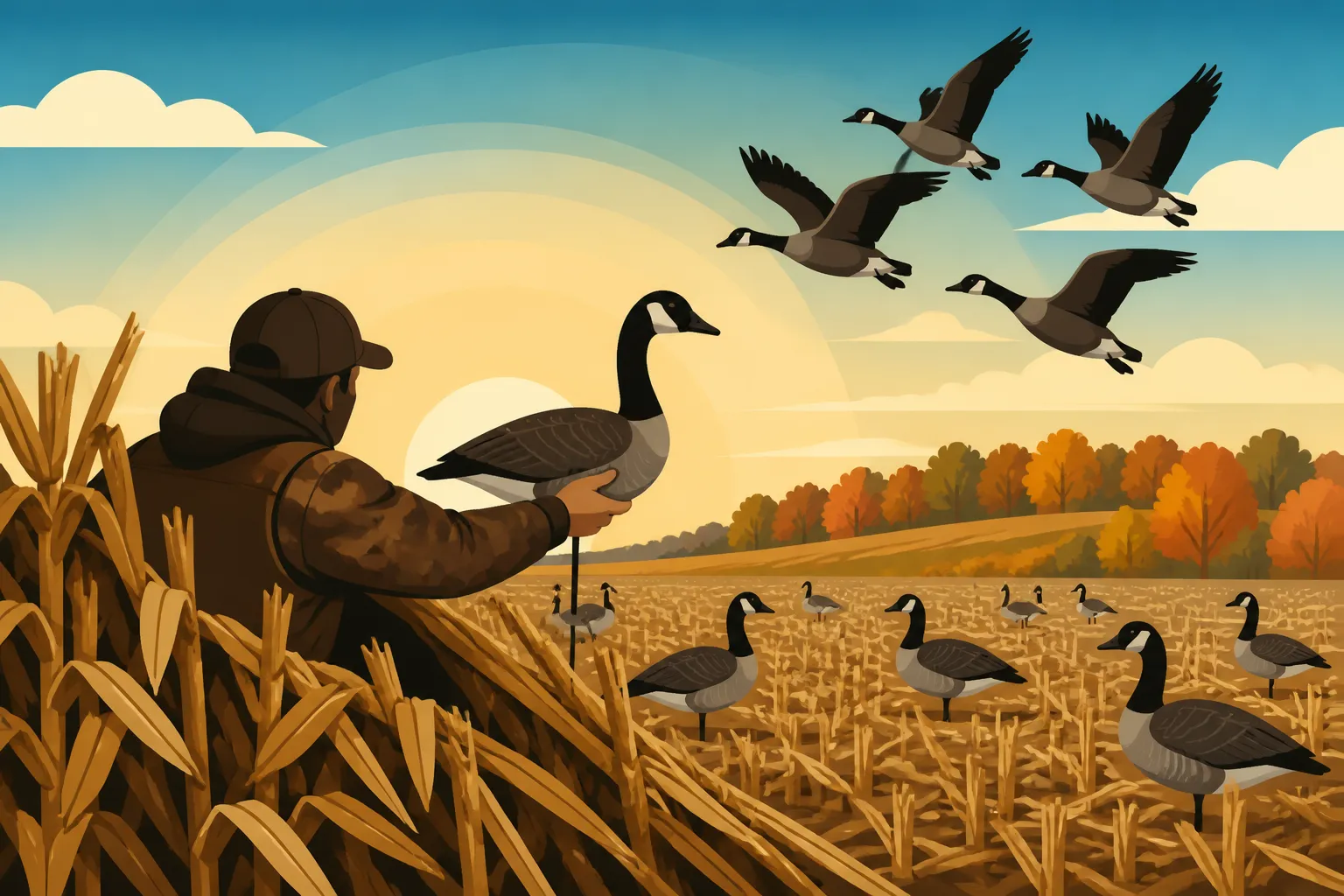
The goal of your spread is to create an inviting "landing zone" where geese feel safe to commit. This zone should be directly in front of your blinds, into the wind, and at an optimal shooting distance (typically 25-35 yards).
Common effective spread designs for cut corn include:
- The J-Hook/U-Shape: This is a classic for a reason. You create the main body of your flock, perhaps a large blob of feeding geese, and then extend a "hook" or "arm" of decoys downwind, forming a J or U shape. The open part of the "J" or "U" is your landing zone, facing directly into the wind. Geese will naturally want to land in this open space, flying past the "hook" of decoys.
- Family Groups: Instead of one giant, uniform mass, arrange your full-body decoys into smaller, realistic family groups of 3-7 birds. Space these groups out a bit, but not too far. This looks more natural than a tightly packed blob, as real geese rarely feed shoulder-to-shoulder unless there's an extremely concentrated food source. Within these groups, mix feeder, sentry, and resting poses to enhance realism.
- Staging Area: Some hunters like to place a few decoys, often silhouettes or shells, a fair distance upwind of the main spread. These act as "staging" birds, suggesting that the flock extends further out, or that some birds are just arriving. This can give approaching flocks more confidence.
| Decoy Type | Best Use Cases | Pros | Cons |
|---|---|---|---|
| Full-Bodies | Core of the spread, close to blinds, high realism | Most realistic, good visibility, builds confidence | Expensive, bulky, heavy to transport, time-consuming |
| Shells | Filling gaps, adding bulk, simulating feeding birds | More affordable, lighter than full-bodies, easy to set | Less realistic from certain angles, can look flat |
| Silhouettes | Expanding perceived size, outer edges, windy conditions | Very lightweight, portable, affordable, good in wind | Two-dimensional, less realistic than 3D decoys |
| Windsocks/Socks | Adding movement, downwind side, increasing volume | Excellent motion, affordable, very lightweight | Can look unrealistic in no wind, lower realism up close |
| Motion Decoys | Eye-catching movement, breaking up static look | Draws attention, highly effective for wary birds | Can be expensive, battery-dependent, some are noisy |
Mixing Decoy Types for Realism
The key to a truly convincing spread is variety. Use your most realistic full-body decoys closest to your blinds and in your primary landing zone. These are the birds that incoming geese will scrutinize the most. As you move further out from the blinds, you can begin to incorporate shells, silhouettes, and windsocks to create the illusion of a massive flock.
Don't forget the power of motion. Place a few windsocks or motion decoys strategically on the edges or slightly downwind of your primary feeding area. The subtle movement they provide can be the difference between a flare-up and a committed approach. If you’re hunting in a large landscape, like those found when Hunting Northwestern Ontario's Big Bush, you might need to carry fewer, more versatile decoys due to transport challenges, whereas in Southern Ontario farmland, you can often haul a small trailer.
Adapting to Conditions
No two days are the same, and your spread needs to be dynamic.
- Wind: Always, always set your landing zone directly into the wind. If the wind shifts, you must be prepared to move decoys and blinds to re-orient your setup. A strong crosswind can make birds approach from unexpected angles.
- Light: On bright, sunny days, minimize shine. Anything reflective – a shiny gun barrel, a glossy decoy, even a reflective patch on your clothing – can spook birds. On overcast days, you might get away with slightly less perfect concealment, but it’s never an excuse to be sloppy.
- Pressure: This is huge in Ontario. Early in the season, geese might be less wary. Later, after they've been shot at, they become incredibly smart. Highly pressured birds often require smaller, more realistic spreads, with fewer motion decoys and impeccable concealment. They'll circle higher and closer attention to detail is paramount. You can really see this difference when Hunting Ontario's November Gun Season compared to early season hunts.
Execution and Finesse: Bringing it All Together
Having the right gear and a smart layout plan are crucial, but the final touches and execution are what truly seal the deal. This is where your attention to detail and calling skills come into play.
Optimal Hunter Placement and Concealment
Your hide needs to be absolutely perfect. Position your layout blinds downwind of your primary landing zone, facing into the wind. This puts the geese coming into the landing zone directly in front of you, wings cupped, offering the ideal shot opportunity. For optimal effectiveness, your blinds should be spaced out enough to cover the landing zone comfortably, usually 15-20 yards apart, depending on the number of hunters.
Brush your blinds in until they are practically invisible. Use actual cornstalks, broken leaves, and whatever natural debris is available in the specific field. Don't use material that clashes with the field's natural colour. If the field has some green weeds, incorporate them. If it's bone-dry stubble, stick to that. Get down into your blind before the sun comes up and scan your surroundings. Are there any shiny spots? Any unnatural outlines? Get rid of them. Your face should be camouflaged, and any exposed skin covered. Even a flicker of light off a pair of glasses can send birds flaring. When it comes to Hunting a Field of Standing Corn, the concealment tactics are similar, albeit with different natural materials.
Calling Strategies: The Voice of the Flock
Effective calling is less about loud, aggressive honking and more about subtle communication.
- Lure Calls: When geese are far off, a series of loud "hail calls" can grab their attention. Once they acknowledge you by turning or heading your way, ease up.
- Come-Back Calls: If they seem to be losing interest or flying past, a sharp, urgent "come-back" call can sometimes turn them around.
- Greeting Calls: As they get closer, switch to softer, more inviting "greeting calls" – a series of honks and clucks that sound like a happy, relaxed flock.
- Feeding Calls: Once they're circling and scrutinizing the spread, light, contented clucks and moans, mimicking feeding birds, can be incredibly effective at building confidence and drawing them in. This is where the short-reed call truly shines.
- Read the Birds: The most important rule of calling: read the birds. If they're honking back aggressively, be aggressive. If they're silent and wary, be subtle. Sometimes, no calling at all is the best calling strategy. Don't overcall, especially when birds are already committed and coming in. Too much noise can just sound like a warning.
Final Checks and Adjustments
Even after you've set everything up, the work isn't over. As the light changes, or as the wind shifts, or as birds fly over, you might need to make adjustments.
- Wind Shifts: If the wind changes direction significantly, you might need to quickly re-orient your landing zone and even some of your blinds. This is a hassle, but it's essential.
- Shiny Spots: Continuously scan your spread and blinds for anything that might catch the light unnaturally.
- Decoy Positioning: Sometimes, a decoy gets knocked over, or turns sideways. If you have a lull in the action, quickly pop up (when no birds are in sight!) and fix anything that looks out of place.
- Confidence Boosters: Sometimes, just adding a flag or a bouncer when birds are at a distance can give them that extra nudge to commit.
- Adapt to Pressure: If early flocks are flaring, try making your spread smaller, or more spread out, and become even more meticulous with your concealment and calling. You might even consider having fewer hunters in the field.
Remember, every hunt is a learning experience. Pay attention to what works and what doesn't, and adjust your strategies accordingly. Good luck out there in the Ontario cornfields, and may your landing zones be full of cupped wings!
Disclaimer
Hunting is an activity that carries inherent risks. Always prioritize safety, adhere to all local, provincial, and federal regulations, and obtain proper licensing and training before engaging in any hunting activities. The information provided in this guide is for informational purposes only and should not be considered a substitute for professional instruction or official government resources. Always confirm current regulations with the Ontario Ministry of Natural Resources and Forestry (MNRF) or other relevant authorities before planning your hunt.