Hunting Beside a National Park Border
It's a common dream for many of us, gazing at a map of Ontario, to see those vast, protected swaths of green that represent our National Parks. We know the wildlife thrives within those borders, and it's only natural to imagine what incredible hunting opportunities might exist just outside them. But let's be honest, the line between legal hunting ground and federal park land can feel like navigating a minefield, filled with anxiety about accidentally stepping across an invisible boundary and facing serious legal repercussions. This guide is here to shed light on how to confidently and legally approach hunting right beside a National Park border in Ontario, ensuring your experience is both fruitful and free from worry.
Understanding National Park Borders and Their Unique Zones
When you're planning a hunt near a National Park in Ontario, it's absolutely critical to understand that these aren't just any old lines on a map. National Parks fall under federal jurisdiction, which means the rules and regulations within them are entirely different from the provincial laws governing hunting on adjacent Crown land or private property. This distinction is paramount, and confusing the two can lead to severe consequences.
Think of it like this: a National Park is a completely separate entity, a sanctuary where hunting is generally prohibited, save for specific exceptions often related to Indigenous rights. The wildlife inside these parks benefits from consistent protection, often leading to populations that can be robust and healthy. This natural abundance is, of course, a huge draw for hunters looking for nearby opportunities, as animals frequently move in and out of these protected zones, especially during seasonal migrations or when food sources dictate. However, the mere presence of abundant game doesn't give you license to pursue them into protected territory. Your responsibility as a hunter is to know precisely where that boundary lies and to respect it with unwavering diligence.
Why Knowing the Exact Boundary is Crucial
The frustration here is real. You might be standing in what feels like vast, open bush, but just a few paces away could be an invisible line that shifts you from legal hunter to federal offender. This isn't a situation where "close enough" counts. Errors in boundary identification can result in heavy fines, confiscation of equipment, loss of hunting privileges, and even criminal charges. It's not just about staying out of trouble; it's also about upholding the integrity of hunting as a responsible and ethical pursuit.
Many hunters have stories, or know someone who does, about inadvertently crossing onto private land or, even worse, into a no-hunting zone. When those zones are federal park lands, the stakes are significantly higher. You're not just dealing with a local landowner; you're dealing with federal park wardens and potentially the RCMP. Furthermore, respecting these boundaries helps maintain a positive relationship between the hunting community and conservation agencies. Ontario Trespass and Landowner Law covers the nuances of private land, but National Parks operate under a different legal framework entirely.
Tools for Pinpointing Park Edges
Gone are the days when a crumpled paper map with a vague red line was your only guide. Today, technology is your best friend when hunting near any significant boundary. Modern mapping applications are absolutely invaluable for pinpointing exactly where a National Park begins and ends. Using a reliable GPS unit or a smartphone app with GPS capabilities, loaded with detailed topo maps and land ownership layers, is no longer a luxury—it's a necessity.
Many hunters swear by applications like onX Hunt, which offers incredibly detailed property lines, including federal land designations, right on your phone or GPS device. These apps can even show you in real-time if you're approaching or have crossed a boundary, often with customizable alerts. Before you even set foot in the woods, spend significant time scouting with these tools. Zoom in, trace the boundaries, understand the terrain features that coincide with those lines. Look for natural breaks like significant ridges, old fence lines, or major changes in vegetation that might correspond with the mapped boundary. This pre-hunt preparation is the single most important step to prevent accidental trespass and ensure a legal and enjoyable hunt. Scouting With Satellite Imagery in Ontario can be combined with these tools for an even more comprehensive overview.
Navigating the Legalities: Federal vs. Provincial Rules at the Edge
Hunting in Ontario already comes with its own set of rules and regulations, governed by the provincial Ministry of Natural Resources and Forestry (MNRF). These cover everything from season dates and bag limits to legal equipment and reporting requirements. However, once you introduce the proximity of a National Park, another layer of law comes into play: federal legislation. This dual jurisdiction is where many hunters get tangled up, and understanding which set of rules applies where is paramount.
National Parks in Canada are administered by Parks Canada, a federal agency. Their primary mandate is conservation and public enjoyment, and hunting is generally not compatible with this mission. While provincial rules dictate what you can hunt and how on provincial Crown land or private property, federal laws strictly prohibit hunting within National Park boundaries. There is no grey area here. You cannot even carry an uncased, loaded firearm within a National Park unless you have specific authorization, which is incredibly rare for recreational hunting.
Federal Laws and Their Implications
The Canada National Parks Act is the cornerstone of federal jurisdiction over these protected areas. This Act, along with its associated regulations, clearly outlines activities that are prohibited within a National Park. For hunters, the most significant implication is the absolute ban on hunting and the strict control over firearms. Even if you have a valid provincial hunting licence and appropriate tags, those are meaningless once you cross into federal park land.
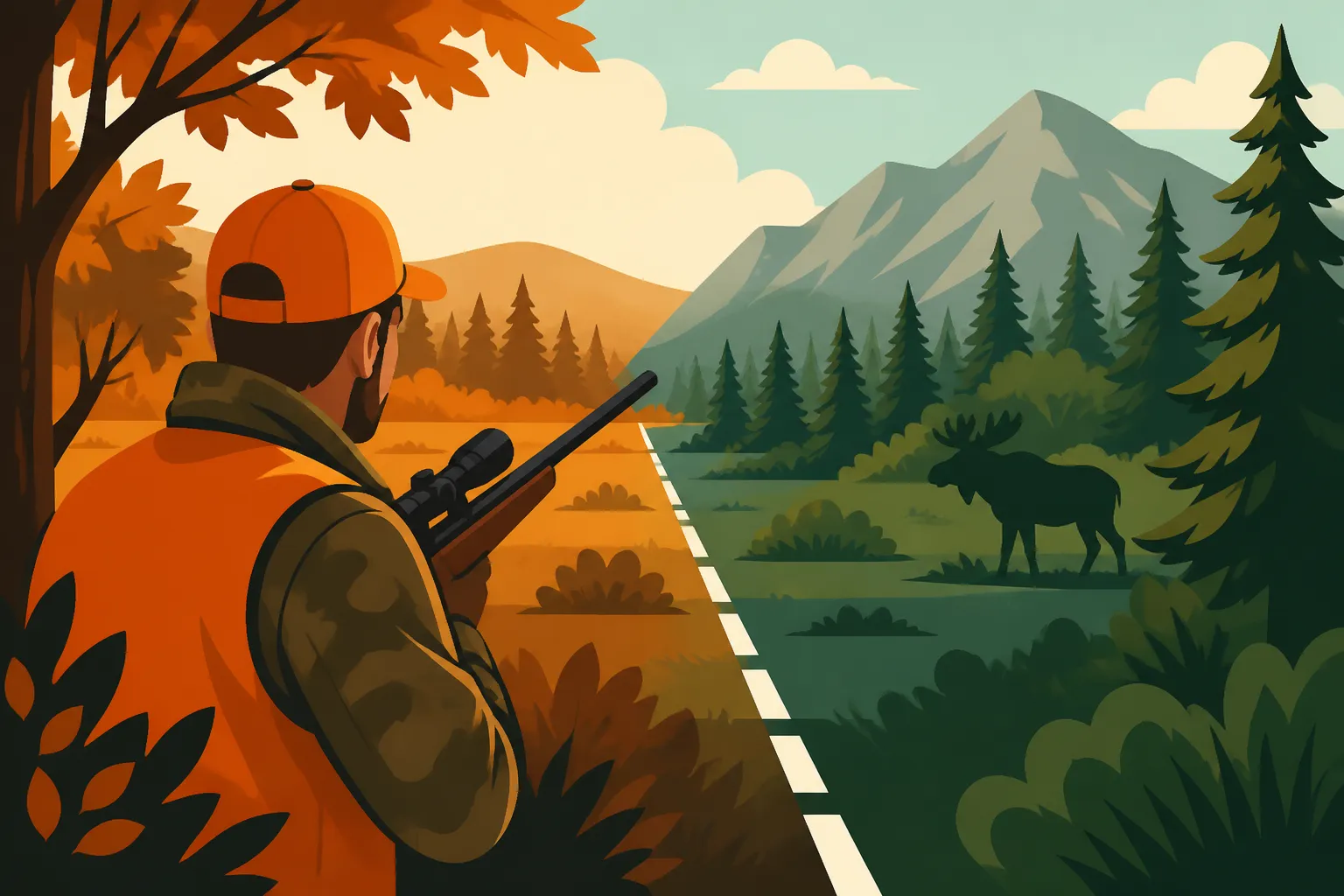
Imagine this scenario: you're still-hunting along what you believe is provincial Crown land, enjoying the quiet morning, and suddenly a magnificent bull moose steps out. You take a careful shot, and the animal drops. Only later, as you're tracking to recover, do you realize your GPS indicates the animal fell just inside the National Park boundary. This is a nightmare scenario, and one that federal laws treat with utmost seriousness. Not only is the animal now off-limits, but you could face charges for hunting in a prohibited area, possessing a firearm in a park, and potentially more. It's a stark reminder that ignorance of the boundary is absolutely no excuse.
Provincial Regulations on Adjacent Lands
On the flip side, all the familiar provincial hunting regulations still apply to the lands outside the National Park border. This means your Ontario Hunting Licences and What They Cost, your specific tags for deer or moose, and all the rules for methods of take (e.g., Legal Firearms and Bows for Big Game) are in full effect. The challenge, then, becomes ensuring you don't let the allure of game close to the park lead you into federal territory.
This is where the detailed mapping tools, like those offered by onX Hunt, become truly indispensable. They allow you to overlay provincial WMU (Wildlife Management Unit) boundaries, Crown land designations, and National Park boundaries, giving you a clear picture of what's legal and what's not. It's like having a digital guardian angel constantly reminding you where the lines are drawn. Always double-check your position, especially if you're in an area with thick cover or undulating terrain where visual cues are limited. Remember, if you're hunting near a National Park, you are effectively hunting a Hunting an Ontario River Valley or a Hunting a Cedar Swamp on Crown Land that just happens to butt up against a federal no-go zone.
Here’s a quick overview of the key differences:
| Feature | Adjacent Provincial Land (Crown/Private) | National Park Land (Federal) |
|---|---|---|
| Governing Law | Provincial Fish and Wildlife Conservation Act | Canada National Parks Act |
| Hunting | Permitted with valid licence and tags | Strictly Prohibited |
| Firearms | Permitted, subject to provincial rules | Generally Prohibited (unless cased/unloaded for transit with permit) |
| ATV/Vehicle | Subject to provincial/municipal rules | Highly Restricted, often prohibited off designated roads |
| Enforcement | MNRF Conservation Officers, OPP | Parks Canada Wardens, RCMP |
| Penalties | Provincial fines, licence suspension | Federal fines, potential imprisonment, equipment seizure |
Strategic Scouting and Hunting Near Park Boundaries
Alright, so you've done your homework, you know the boundaries, and you understand the legal landscape. Now, how do you actually make a successful and safe hunt happen near one of these unique areas? It really boils down to smart scouting and disciplined hunting practices. The draw, of course, is that National Parks often act as natural refuges, providing excellent habitat and minimal human disturbance, which can lead to higher game densities and larger animals. The trick is to intercept these animals as they move in and out of the protected zone.
Animals, especially deer, moose, and bear, don't recognize human-drawn lines on a map. They follow food sources, bedding areas, water, and instinct. During certain times of the year, particularly the rut or during migrations to wintering yards, animals will naturally push beyond the park borders. This is where strategic hunting can be incredibly effective. Focus your efforts on the peripheral areas, observing movement patterns, and identifying natural funnels or pinch points that animals use to transition between the park and the surrounding accessible land.
Focusing on Travel Corridors and Edges
The most productive hunting grounds near a National Park border are often the travel corridors and the "edge" itself. Think about how animals move: they'll use dense cover for security, follow natural terrain features, and utilize paths of least resistance. A thick band of timber along a park boundary, or a creek bed that flows in and out of the park, could be a highway for game. You might also find productive hunting in a Hunting a Bush Edge or even Hunting a Fencerow Between Two Fields that marks a subtle boundary.
Scout these areas thoroughly before the season. Look for fresh tracks, rub lines, scrapes, and bedding areas just outside the park boundary. Pay close attention to trails that seem to lead directly into or out of the park. These are your prime locations. Remember that animals often move under the cover of darkness or low light, so setting up at dawn or dusk on these travel routes can be particularly effective. Your game camera can be a powerful tool here, providing intelligence on movement times and frequencies without needing to be physically present. Reading Whitetail Sign in Ontario Hardwoods is a skill that becomes even more important when hunting these peripheral areas.
Setting Up Smart and Safe
When you're literally hunting on the edge, your setup needs to be not just effective, but incredibly safe and mindful of the boundary. This means taking extra precautions with stand placement and shot selection. Always set your stand or blind a safe distance away from the park boundary, ensuring that any shot you take will be directed away from the park and that a wounded animal is highly unlikely to cross into prohibited territory before expiring.
Before you climb into your stand or settle into your blind, use your GPS or mapping app to confirm your exact location and the direction of the park boundary. Mentally mark visible landmarks that align with the boundary line to give you a constant visual reference. This might be a distinctive tree, a rock outcropping, or a change in forest type. When an animal presents itself, be absolutely sure of your target and what's behind it. If there's any doubt about where the animal will fall or which way it might run if wounded, pass on the shot. It's far better to let a deer walk than to face the severe repercussions of an accidental trespass or a lost animal in a protected zone. Hanging a Stand on an Ontario Bush Edge techniques can be adapted with these extra precautions in mind.
Ethical Hunting and Respecting the National Park's Purpose
Beyond the legal implications, hunting near a National Park border also carries a significant ethical responsibility. National Parks are set aside for the preservation of ecosystems and for public appreciation, not for hunting. While we, as hunters, appreciate the conservation efforts that result in healthy wildlife populations, it's vital that our actions reflect respect for these protected areas and the larger public perception of hunting.
Bad behavior by a few individuals can cast a shadow over the entire hunting community. An accidental trespass, a lost animal in the park, or even just appearing to be disrespectful of park boundaries can fuel anti-hunting sentiment and lead to increased restrictions for everyone. Our goal should always be to uphold the highest standards of ethical conduct, demonstrating that hunters are responsible conservationists who respect the law and the land.
Minimizing Disturbance and Impact
When hunting near a park, strive to minimize your disturbance to both the wildlife and the natural environment. This means being particularly stealthy and leaving no trace. Avoid leaving trash, excessive scent, or creating unnecessary noise that could impact animals or other users of the adjacent Crown land. Think about how your presence might affect the delicate balance that the park aims to protect. For instance, chasing a wounded animal aggressively towards a known park boundary is not only risky but also creates undue stress on the wildlife.
Furthermore, recognize that while you are hunting just outside the park, hikers, birdwatchers, or other outdoor enthusiasts might be using the park trails nearby. Be mindful of your visibility and actions. While blaze orange is essential for safety, loud calls or unnecessary displays of harvested game right on the boundary might be seen as provocative or disrespectful by non-hunters. A little extra consideration goes a long way in fostering good relations and ensuring that hunting maintains its rightful place in Ontario's outdoor heritage.
Reporting and Accountability
In the rare but unfortunate event that an animal you've shot crosses into a National Park before expiring, or if you accidentally cross the boundary yourself, honesty and immediate reporting are your best course of action. Do not attempt to retrieve the animal or conceal your actions. Immediately contact Parks Canada wardens or the local MNRF office to report the incident. They will advise you on the proper protocol, which often involves a warden accompanying you to retrieve the animal, if permissible, or confiscating it.
Trying to hide such an incident will almost always lead to far more severe penalties if discovered. Responsible hunters take accountability for their actions, even when mistakes happen. This adherence to reporting guidelines not only demonstrates integrity but also helps conservation authorities gather valuable data on animal movements and populations, ultimately benefiting wildlife management efforts. Reporting Your Ontario Harvest is a fundamental part of responsible hunting, and that extends to challenging situations like these.
Hunting beside a National Park border in Ontario can be an incredibly rewarding experience, offering access to areas where game populations may be robust and less pressured. However, it absolutely demands meticulous planning, unwavering attention to detail, and a deep respect for both federal and provincial laws. By leveraging modern mapping tools like onX Hunt, diligently scouting, practicing impeccable shot discipline, and always prioritizing ethical conduct, you can enjoy these unique hunting opportunities responsibly and successfully for years to come.
Disclaimer
This article is for general informational purposes only and does not constitute professional advice. Laws, prices and regulations vary by location and change over time. Consult a qualified professional for guidance on your specific situation.